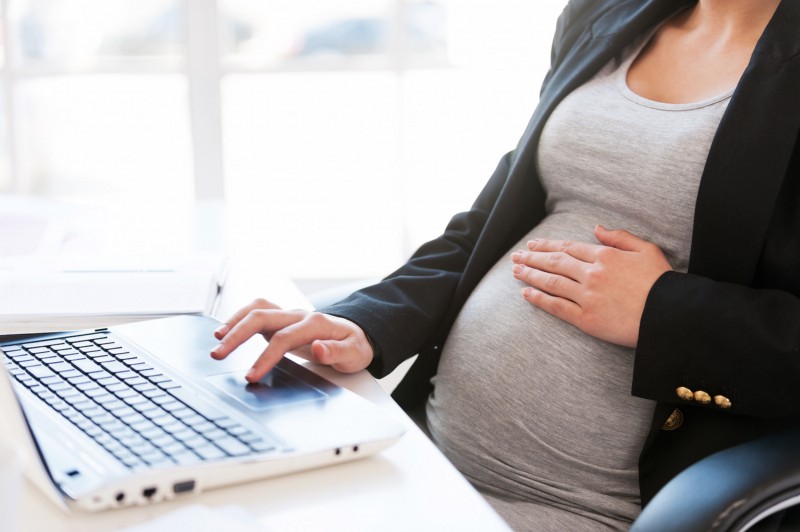
More than 100 Ohio faith leaders are calling for an end to pregnancy discrimination in the workplace, asking state legislators to pass laws to accommodate women who are unable to perform all work tasks while carrying a child.
According to the Columbus Dispatch, 105 religious leaders affiliated with the group Ohio Family Values signed on to an open letter this week demanding that local lawmakers introduce legislation to address the concerns of pregnant women who work.
“We know that growing our economy, strengthening families and valuing the dignity of work requires more than lofty rhetoric,” the letter reads. “It takes common-sense policies that serve the common good. We stand united across faith traditions, race and political affiliation to call for stronger protections to end pregnancy discrimination in the workplace.”
The letter is a direct challenge to the businesses that discriminate against working women in the United States, roughly 75 percent of whom will become pregnant while on the job, with three-quarters of that number returning to work. Women who are carrying children often cannot perform tasks such as heavy lifting while working, and regularly face negative stigmas from their coworkers. Worse, a study in the United Kingdom showed that many companies simply won’t hire a woman if they know she will become pregnant in the next six months.
Signers of the letter represented a broad swath of religious traditions in the Buckeye state, including pastors, priests, and rabbis from the Evangelical Lutheran Church in America, Conservative Judaism, American Baptist Church, Disciples of Christ, Unitarian Universalist Association, United Church of Christ, Presbyterian Church (USA), Mennonite Church USA, and even some Roman Catholic nuns.
“We believe that building a ‘pro-family’ economy and ending the pregnancy penalty requires: Employers who value the dignity of workers and respect work/family balance. Safe workplaces where discrimination of any form is never tolerated. Statewide policies that provide robust protections and accommodations for pregnant women on the job,” the letter reads.
The list signatories also includes Rev. Joshua Stoxen, pastor of the evangelical Christian Vineyard Central Church in Norwood, Ohio. Stoxen published an op-ed for Cincinnati.com on Monday championing the letter and outlining the moral case for ending pregnancy discrimination.
“Pro-life and pro-choice, Christian and Jewish, progressive and moderate and conservative, we are united in the belief that women shouldn’t face discrimination at work, demotion or firing because they’re pregnant,” Stoxen writes. “All of our traditions share a belief in the sanctity of the family and the dignity of work. Making sure women who are about to have a child are treated fairly and safely in the workplace is a moral and religious issue.”
Indeed, although often an uphill battle, the fight to end pregnancy discrimination is one of the few points of agreement between pro-choice and pro-life advocates, as both groups see value in making it as easy as possible for working women to bring children to term. They collectively celebrated a landmark Supreme Court decision on the issue earlier this year, when the Court ruled in May that UPS erred when it cut medical coverage and refused to accommodate Peggy Young, one of their drivers, after she became pregnant and was told by a doctor that she couldn’t lift heavy packages. The ruling broadened the Pregnancy Discrimination Act, passed in 1978, setting a legal precedent that empowers any worker who can prove that a company accommodates some things but not pregnancy.
As the letter from Ohio faith leaders notes, the movement to end pregnancy discrimination is gaining traction nationwide. New Jersey, New York, Maryland, Minnesota, and Nebraska already have laws protecting pregnant women on the books, and Illinois, West Virginia, Delaware, and North Dakota all passed laws over the past two years that mandate reasonable accommodations for expecting workers. Most recently, Kentucky House of Representatives unanimously approved a pregnancy accommodations bill in February.