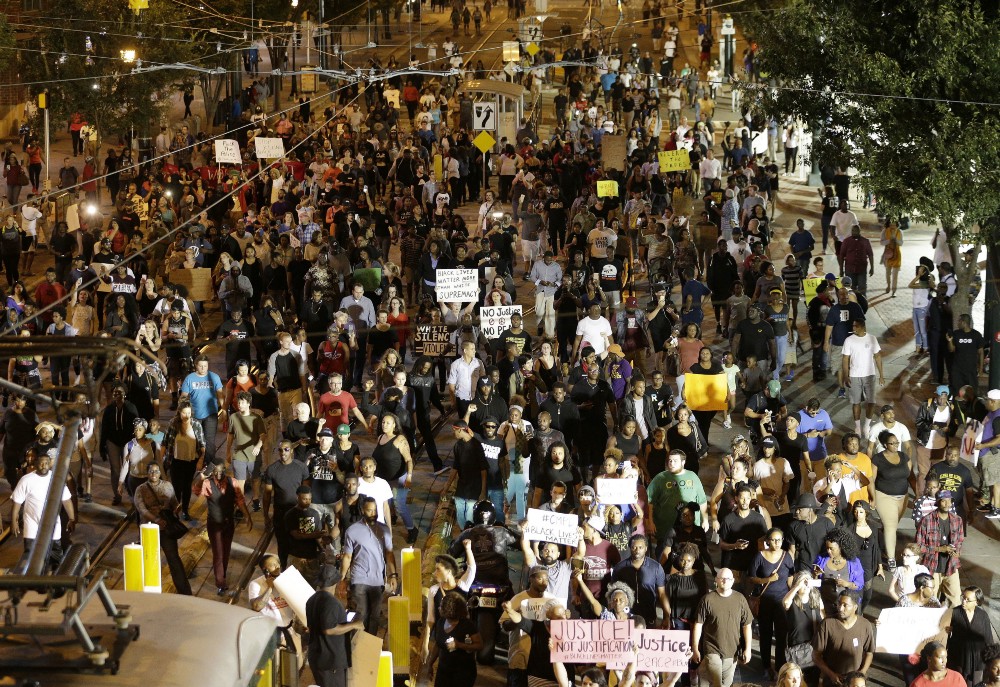
On Monday, during an annual convention for the International Association of Chiefs of Police (IACP), the leader of the 18,000-member organization issued a formal apology to “communities of color.” But the apology stopped short of acknowledging current injustices that those communities face.
Speaking on behalf of the largest police organization in the country, President Terrence M. Cunningham condemned the “darker periods” in the history of policing which “[ensured] legal discrimination” and “[denied] the basic rights of citizenship” to people of color.
“Events over the past several years have caused many to question the actions of our officers and has tragically undermined the trust that the public must and should have in their police departments,” Cunningham said. “For our part, the first step in this process is for law enforcement and the IACP to acknowledge and apologize for the actions of the past and the role that our profession has played in society’s historical mistreatment of communities of color.”
Yet Cunningham’s statement also characterizes mistreatment as a thing of the past, ignoring the current reality that communities of color grapple with: widespread racial profiling, disproportionate arrest rates, sentencing disparities, and violent police interactions.
“While this is no longer the case, this dark side of our shared history has created a multigenerational — almost inherited — mistrust between many communities of color and their law enforcement agencies,” Cunningham added.

According to the IACP leader, the law enforcement community fails to understand the root causes of people’s skepticism of police, which makes it difficult for officers to smooth tensions with people of color. But Cunningham also said present-day officers shouldn’t be criticized for past wrongs.
“At the same time, those who denounce the police must also acknowledge that today’s officers are not to blame for the injustices of the past,” he said, noting that there must be “an atmosphere of mutual respect” to make real change. “If either side in this debate fails to acknowledge these fundamental truths, we will be unlikely to move past them.”
Alicia Garza, a co-founder of the Black Lives Matter movement, told ThinkProgress that Cunningham’s admission is a positive step toward “justice, reconciliation and healing,” but doesn’t go far enough to address modern-day problems.
“If the last three years has shown us anything, it’s that these deplorable actions are still happening today. Black people are dying at the hands of police at the rate of one every 28 hours,” she wrote.
While several police-involved killings have received widespread attention in recent years—from Mike Brown, Eric Garner, and Tamir Rice in 2014 to Philando Castile, Alton Sterling, Terence Crutcher, and Keith Lamont Scott in the past four months—most instances of police brutality and harassment don’t make national headlines.
In 2015, the Guardian concluded that black men in particular were nine times more likely to be killed by police than any other demographic in the U.S. This year, more than one-fifth of the 856 people killed by police were black, while making up 13 percent of the U.S. population overall.
“Acknowledging that Black people have experienced oppression in the past is not enough. Acknowledging the role that police and policing plays in the oppression of Black people today is an important step. I’d prefer to have an honest conversation than one that just feels good,” Garza said.
This year, the organizations that represent Latinos in the U.S., including the National Council of La Raza (NCLR), have been vocal about the alarming number of Latinos killed by police as well. And like their black counterparts, Native Americans are also impacted by police violence at a disproportionate rate.