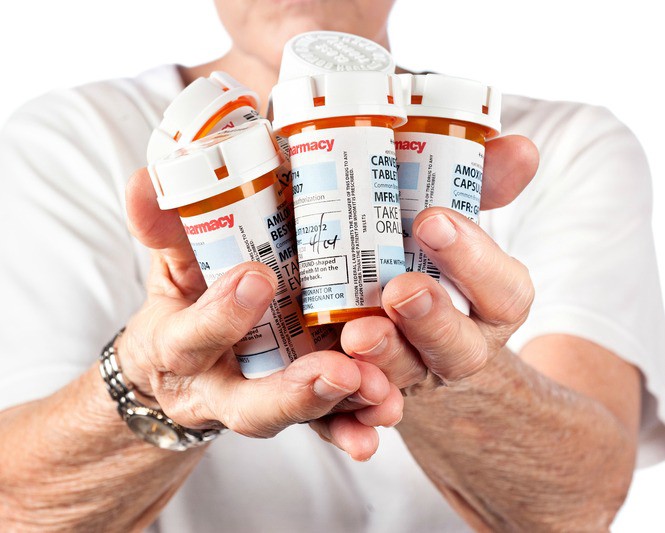
Spending on prescription drugs increased by 13 percent within a year, totaling $374 billion in 2014. Experts in the health space attribute exorbitant spending on medicine to pharmaceutical companies’ decision to set higher prices for name-brand drugs that offer no value greater than existing products, as well as the categorization of specialty drugs that allows drug makers to bypass requirements in the Affordable Care Act.
The issue has gained national attention recently, especially as prices for generic, HIV, and Hepatitis C medication have skyrocketed. Global public health officials and U.S. lawmakers have reached out to drug companies, demanding answers and accountability. Democratic presidential candidates Hillary Clinton and Bernie Sanders have also spoken out against overzealous drug companies on the campaign trail.
But what types of policies can actually help address the issue? A new report from the Center for American Progress sets out to find the answer (disclosure: ThinkProgress is an editorially independent site housed at the Center for American Progress). The report, titled “Enough Is Enough: The Time Has Come to Address Sky-High Drug Prices,” outlines six major policy recommendations that could help:
Provide more transparency on drug companies’ research and development costs
Authors of CAP report say R&D spending “pales in comparison” to marketing budgets and profits. They also debunk drug producers’ claims that expensive treatments are innovations, saying that companies may actually be underinvesting in research. This policy recommendation would require pharmaceutical companies to disclose how much they pay in research and development costs. Those who fail to meet the spending threshold would be required to make payments to a new fund to support the National Institute of Health, an institution that has facilitated the production of new medicines in years past.
Provide star ratings of comparative effectiveness in drug labeling and marketing
To counter industry claims that new drugs have added benefits, the study authors suggest the launch of a public rating system that would allow physicians and patients to easily understand a drug’s effectiveness. The data for the ratings would come from an assessment. A public awareness campaign would also accompany the new ratings, informing consumers about their meaning. The report’s authors likened this recommendation to the National Highway Traffic Safety Administration’s 5-star safety ratings system.
Incentivize drug companies to set reasonable prices
Taxpayers help fund more than 9 percent of new drugs and nearly 25 percent of priority-review medication — which is why report’s authors say drug companies need to reasonably price their products. Under this recommendation, if a final price negotiated between a drug company and payer fell outside the price range suggested by the report’s authors, the company would have to justify the price increase in a document that would go on its website. Prices that exceed the recommended range would be designated as unreasonable. As indicated in the Bayh-Dole Act, drug patents that come from federally funded research would be licensed to competitors for the creation of generic versions.
Reform Medicare payments for physician-administered drugs
If carried out, this recommendation would discourage physicians from over-prescribing costly treatments. The current Medicare ASP plus 6 payment formula pays health care providers based on the drug’s average sales prices with an additional 6 percent for overhead. This amount amounts to more than $7 billion over 10 years. The Obama administration’s 2016 budget would reduce the ASP payment to 3 percent — and the report’s authors suggest taking that further by making a flat fee that would cover overhead costs.
The Medicare Payment Advisory Commission also analyzed two approaches: a $24 flat fee per drug per day and a blended payment that would include a 2.5 percent payment with a $14 flat fee. The report’s authors said the Centers for Medicare & Medicaid Services should analyze all options and expand upon the one that would accrue the highest cost savings.
Vary Medicaid drug rebates based on the comparative effectiveness of drugs
This recommendation would base rebates on its CER classification instead of a single default rebate amount. In the ideal scenario, the overall rebate would remain constant, regardless of the budget. States could vary within that amount, paying a smaller amount for higher-value drugs than the minimum 23.1 percent currently required. States could offset this amount by making greater rebates on lower value, more costly products.
Protect people covered by insurance plans by capping cost-sharing
Authors of the CAP report suggest that the Health and Human Services secretary adopt requirements similar to that of the silver-level plans in all exchanges. A standardized benefit plan would include monthly out-of-pocket costs for prescription drugs and a smaller, separate deductible. This would cap cost-sharing for drugs at $3,250 annually. Admittedly, this amount would be burdensome for low-income patients; ideally, consumers should not spend more than 5 percent of their income on prescription drugs. But overall, the cost-sharing limits would allow insurers to have greater flexibility in designing their official list of medicines.