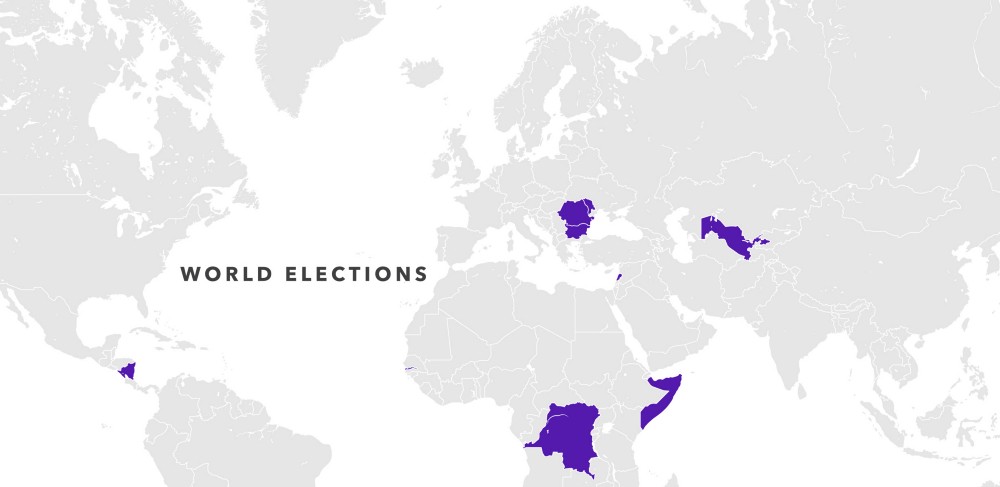
As the election nears in the United States, so do elections in other parts of the world.
Nicaragua’s presidential election is next week, and many Nicaraguans aren’t sure exactly who’s running. Elections in Somalia and Bulgaria could have huge ramifications for the global refugee crisis. And after two and a half years, Lebanon just elected a president on Monday.
Here are 9 elections to keep an eye on — and why they matter:

Okay, technically Lebanon’s election just happened, but the ramifications are still huge, which is why it’s on this list.
Lebanon elected a president Monday, almost two and a half years after the end of the last president’s term. Michel Aoun, a general during the civil war, succeeds Michel Sleiman, who stepped down at the end of his term in May 2014 and the presidential position has sat vacant since then. While Prime Minister Tammam Salam was legally the acting president, the position was unfilled for the last couple years as rival political factions battled for leverage. This stalemate made it hard for Lebanon’s government to deal with some of the most pressing issues facing the country, including neighboring Syria’s civil war and the influx of refugees into the country.
Lebanon’s president is voted on by the 128 member parliament. Two-thirds (86) of parliament must come to a consensus on a candidate, something they were unable to do over the last two years. But the Saudi-supported Future movement of former prime minister Saad al-Hariri cut a deal with Michel Aoun, the leader of the so-called Free Patriotic Movement — a Christian party who holds a loose alliance with Hezbollah and other pro-Syrian parties. Under the deal, Aoun received enough votes from parliament — after three rounds of voting — to become Lebanon’s president. It is expected that Hariri will be reinstated as Prime Minister.
Aoun is a former army general who opposed the Syrian regime presence in Lebanon during the civil war and went into exile in 1990. When the Syrian occupation ended in 2005, Aoun returned to a hero’s welcome, but quickly sided with the pro-Syrian ‘March 8’ coalition — principally Hezbollah and Amal. He’s been vocal in the past about his support for Bashar al-Assad’s regime in Syria, and Assad has also thrown his support behind Aoun. While Syria officially left Lebanon in 2005, it still retains a certain influence over domestic affairs through its close relations with members of the March 8 coalition.

President Daniel Ortega is running for a third consecutive term (fourth overall) on October 6, in an election he’s widely expected to win.
“The election is, in effect, a one-party event. Mr Ortega’s main political foe, Eduardo Montealegre, was removed as the [Independent Liberal Party’s (PLI)]’s leader by the Ortega-friendly supreme court in June,” the Economist wrote this month. “A month later 16 PLI deputies were expelled from parliament for refusing to accept the authority of the new leader, Pedro Reyes, who is thought to have close links to Mr Ortega. Mr Reyes then decided not to run for president and presented José del Carmen Alvarado, as the PLI’s new candidate. He and his running mate, Ms Ríos, are leaders of a neutered party.”
In fact, many Nicaraguans polled said they aren’t even sure who is running in the upcoming election.
Nicaragua still struggles economically as the second poorest country in the Americas. But Ortega is still incredibly popular and would more than likely win a free and fair election. Ortega’s gained popularity in a multitude of ways. He has managed the economy well and reduced poverty, but simultaneously suppressed his political opposition. He also overthrew the “dictatorial Somoza family” in 1979, according to the Economist.
Despite his popularity, Ortega continues to stifle the opposition. He’s also centralized authority in a way likened to dictatorial regimes of Nicaragua’s past. “Municipal governments have to consult with the central executive on all important decisions,” Elvira Cuadra of the Institute for Strategic Studies and Public Policy, a Managua-based think tank told the Economist.
The last election, which took place in 2011, was criticized by the European Union for lacking transparency. Ortega’s ruling Sandinista National Liberation Front initially said it wouldn’t allow observers for the upcoming election, but recently reversed that decision. The Organization of American States accepted an invitation by the government to send observers from November 5–7.
The Sandinistas are running their candidate for election for the seventh consecutive time, according to the Washington Post. The future may look bleak for Nicaragua, as the common people are unhappy Ortega’s wife is his running mate. The U.S. Congress is also considering a bill that will bar international financial assistance, should Nicaragua fail to hold fair elections — a potential reason behind his acquiescence over foreign monitors.

Bulgaria’s presidential election will be held on November 6, and as is the case with so many other elections occurring, one of the bigger questions at hand is Russia. Both a member of the European Union and NATO, Bulgaria owes a great deal of allegiance to Europe in general. However, Bulgaria is also a former Soviet state, and its ties to Russia are many. Moreover, Bulgaria is one of the poorest member states in the European Union, and is not included in the Schengen Zone, a point of some contention within the country. All of these issues could play a role in the election — and prove key to determining its successor.
Rumen Radev, a former air force commander and the leading independent opposition candidate, has called for lifting sanctions on Moscow and engaging in friendlier relations with the Russian government. In an interview with Reuters, Radev said he would take into account Bulgaria’s European allegiances and obligations if elected, but that he would also seek a “more balanced” foreign policy approach when engaging with the country’s eastern neighbor. He has also railed against the contemporary state of Bulgarian politics — taking aim at the growing number of refugees arriving within the nation’s borders.
But Radev still has to contend with Tsetska Tsacheva, of the ruling center-right GERB party, to say nothing of a wide selection of long-shot candidates. Most stand no chance, but both Radev and Tsacheva are widely viewed as the front-runners, a race that has historic implications: if elected, Tsacheva would be Bulgaria’s first female president. But if Radev triumphs, Russia could have a new friend in Eastern Europe — something that concerns the European Union.

Caught between powerful forces, Moldova’s young democracy has suffered starts and stops since the fall of the Soviet Union. Courted by both the Kremlin and the European Union, the small country has teetered unstably in recent months. In August, Moldova marked 25 years of independence. But celebrations were not without interruption — protesters disrupted President Nicolae Timofti while giving a speech, and later scuffled with police.
On October 30, that tension was put to the test when Moldovans went to the polls to choose their next president. It was the first direct presidential election the country has held since 1996; since 2000, Moldova’s parliament has selected the president indirectly. However, two years of political uproar and months of protests over corruption and governmental mishandling of funds succeeded in shifting this approach. In March, Moldova’s Constitutional Court ruled that indirect presidential elections were unconstitutional; as a result, citizens will once again be able to democratically elect their chief figurehead.
Their options offered a stark contrast in visions for the future. Ten candidates in total were running, following numerous withdrawals. Initial front-runners included Igor Dodon, leader of the Socialist Party, Maia Sandu, an independent reformer who has emerged as a competitive force with her new Action and Solidarity Party, and Mihai Ghimpu of the Liberal Party, who served as Moldova’s former acting president from 2009 to 2010.
As of October 31, it seems the candidates will now head to a run-off — Dodon secured 48.5 percent of the vote, but failed to obtain the 51 percent needed to sail to victory. He will now face Sandu, who won 38.2 percent, on November 13.
On the issues, the candidates’ stances on Europe and Russia will continue to be the main event. Dodon has grabbed pro-Russian votes, while Sandu is more appealing to those with European sympathies. With Dodon poised to become Moldova’s next leader, the country could be eying a pivot to Russia — one that would have long-term implications for Europe.
Of course, with the names of deceased Moldovans having peppered voting lists in the initial count, it goes without saying that, regardless of who prevails in the run-off, there will be questions asked about the legitimacy of any candidate’s victory.

Somalia was once democratically ruled for nearly a decade after it broke from Britain, France, and Italy in 1960. But a bodyguard assassinated the second democratically-elected president and a coup d’etat followed shortly thereafter, setting the stage for General Siad Barre to take over for 21 years. The United Nations Development Program has called Barre’s time in power as having “one of the worst human rights records in Africa,” with people subjected to summary killings, beatings, rape, and freedom of movement and expression. After opposition groups ousted Barre in 1991, the country has been mired in two decades of conflict.
Somalis live under the constant threat of al-Shabab militants — a group loyal to Al Qaeda — which has already set off intensified attacks in the country this year. Many of the militant group’s targets include an inordinate number of government officials, civilians, and military targets. The United States has helped to carry out at least 13 ground raids and airstrikes this year as part of a “self-defense” strategy against the militant group. But the militant group still has an unrelenting hold on thousands of square miles in the country.
Now, the country is set to elect two federal parliaments — the Upper and Lower house — which will then elect the president on November 30. Elections have already been hampered by fears of political manipulation and election delays. Security issues and administrative problems set back the presidential election which was supposed to take place in August.
The country has a unique electoral system which doesn’t allow for an one-person, one-vote election. Rather, “about 14,000 people representing federal states across the nation will choose the new lawmakers,” Al Jazeera pointed out. Al-Shabab has threatened to attack polling stations and disrupt the election process.
The election is set to take place on the end date that neighboring Kenya expects to shut down its 25-year-old Dadaab refugee camp, which is currently holding 300,000 mostly Somali refugees. Many Somalis have already been returned on broken promises of money, housing, education, and safety.

President Yahya Jammeh has held his position for 22 years now, coming to power through a military coup in 1994. Although he caved to international pressure to allow presidential elections to take place in 1996, soldiers stood at polling places to direct people how to vote while the opposition candidate “hid in the Senegalese Embassy, fearing assassination,” The Atlantic reported. As no surprise, then, Jammeh won the election. Jammeh also won the presidential elections in 2001, 2006, and again in 2011, and it became commonplace for police to arrest journalists and activists during those elections.
Jammeh is now seeking reelection in the December 1 presidential elections.
During his time in office, Jammeh has claimed that he discovered a cure to HIV/AIDS, threatened to behead gay people, and forced hundreds of people in a small village to drink a hallucinogenic potion to root out witches and sorcerers.
Human rights organizations have condemned Jammeh for summarily detaining, torturing, and violating other human rights. Amnesty International has accused the country of restricting freedom of expression, while a July 2015 Human Rights Watch report found that the president had “ruthlessly repressed all forms of dissent” since he took power.
Gambia’s National Intelligence Agency (NIA), a paramilitary group that also goes by “Jungulers,” are enlisted to carry out torture on behalf of Jammeh.
“When [Jammeh] wants to torture you, he uses the Jungulers team to torture you,” a former paramilitary officer told Human Rights Watch. “Or if he wants to arrest you secretly, he uses this Jungulers team. Or when he wants to kill you without anyone finding out, they will just kill you and throw you [away].”
Even the United States has grown concerned over the detention of peaceful protesters in July, asking the country to “allow an independent investigation of allegations of torture and abuse” as well as “guarantee the constitutional rights of its people to freedom of expression and peaceful assembly,” according to a U.S. Department of State press release.
Adding to the troubling allegations against the Jammeh presidency, Gambia may be turning away from international scrutiny. The country became the third African country to withdraw from the International Criminal Court last week, after alleging bias that the court opened inquiries on individuals from mostly African countries.

Uzbekistanis suffered a shock to the system when the country’s leader, Islam Karimov, died at the beginning of September. Seventy-eight years old at the time of his death, Karimov ruled the Central Asian nation with an iron fist for over 25 years, and was considered one of the post-Soviet sphere’s harshest figures. Still, he is the country’s first and only president, and the only leader many Uzbekistanis have ever known. On December 4, the country will vote on his replacement, though whether the process will be remotely democratic is debatable.
In Uzbekistan’s presidential election last year, Karimov was reelected with 90 percent of the vote, mirroring many of his prior victories. Whether or not such an overwhelming margin will be reflected in the upcoming election is unknown. Currently, former Prime Minister Shavkat Mirziyoyev is serving as Uzbekistan’s interim president, while he aims to take on the job full-time. A Kremlin ally, Mirziyoyev is serving as the Liberal Democratic Party’s candidate and the most likely choice to replace Karimov. While it’s raising eyebrows, Mirziyoyev’s likely ride to victory could be integral to the country’s stability. Uzbekistan serves as Central Asia’s chief source of fighters in foreign conflicts — the Islamic State has gained numerous recruits from the country. If destabilized, there are concerns that militants might attempt to make more aggressive inroads, taking advantage of a precarious situation.
However, with the option of another authoritarian government looming and the threat of militancy ever close at hand, Uzbekistanis will likely find their choices limited regardless of who triumphs in December. Ultimately, the only thing certain in Uzbekistan now is uncertainty. With Karimov gone, the country has been thrust into instability — and few know what its future will hold without him.
“He is the state and the state is him,” Steve Swerdlow, the director of Central Asia research at Human Rights Watch, told the New York Times of Karimov in September. “And it has been that way for at least 25 years.”

Romania’s legislative elections are set to take place on December 11, and come after three years of civil and political unrest throughout the country. In 2012, unpopular austerity measures imposed by the government cued rioting, which thrust Romania back into an atmosphere of deep political uncertainty — the last thing the country needs. Under the dictatorship of Nicolae Ceaușescu for more than two decades during the Soviet Union, Romania suffered intensely at the hands of an authoritarian, genocidal government. While the nation has worked hard to grow its economy and restore trust in politicians following the Romanian Revolution (which overthrew Ceaușescu), the last few years are a sign that the situation is still precarious, and upcoming elections are unlikely to change that.
Two things to look out for when Romanians head to the polls: the economy and dissatisfaction with the status quo. Geopolitics are less likely to play a role; unlike Moldova and Bulgaria, Romania teeters less between Russia and Europe, as the country’s membership within the European Union and NATO are popular with all prominent political parties. Other issues, however, have emerged as points of contention. Poverty is an overwhelming obstacle for Romanians. More than 30 percent of the population live on less than five American dollars per day, putting the nation in stark contrast with many of its European neighbors to the west. This discrepancy coupled with a (newly reinforced) perception of politicians as corrupt and self-serving could see the ruling Social Democratic Party (PSD) thrown out, and potentially replaced with the leading opposition choice, the center-right National Liberal Party.
But, not so fast. Money and mistrust of the government aside, the PSD may well retain control of parliament. Local elections in June saw victory for the PSD, and not much has changed in the time since. If this scenario plays out the same way in December, it is likely the status quo will prevail, despite visible discontent among Romanian voters. That in no way spells a rosy future for the PSD, however; the party is viewed as being sympathetic to former communist officials, in addition to being highly complicit in corruption.
Still, there is some good news for those partaking in the democratic process. This election also marks a change for the Romanian diaspora — out-of-country voters will now be able to mail in their ballots and access polling stations abroad. Electronic voting will also be made available.

The presidential election in this Central African country was supposed to take place in November. But the government of the Democratic Republic of Congo has pushed the election to April 2018, leaving the term-limited President Joseph Kabila to extend his time in office until the expected vote.
Kabila — who came to office after his father’s assassination in 2001 — is constitutionally bound to leave office in December after his second term ends, but he has not ruled out changing the country’s laws so that he could run again. He will likely lead an interim government in the meantime.
During the lead up to this year’s expected November election, authorities cracked down hard on protesters, including issuing blanket bans on demonstrations while allowing pro-government rallies to take place. Dozens of people were killed during protests in September, mostly by police and government forces.
The U.N. Security Council has warned that the country is at “extreme risk” of falling into chaos.
“The coming period will certainly be extremely difficult, the tipping point in the serious violence could be reached very quickly,” U.N. envoy Maman Sidikou told the Security Council in mid-October. The U.S. government also imposed sanctions on two top DRC officials back in September, saying that they threatened “the country’s stability by suppressing the opposition,” the BBC reported.
In the meantime, international observers have been pushed out, harassed, and expelled out of the country, freedom of press has been suppressed, and opposition leaders have been unable to move around the country freely.
Adrienne Mahsa Varkiani contributed to this report.