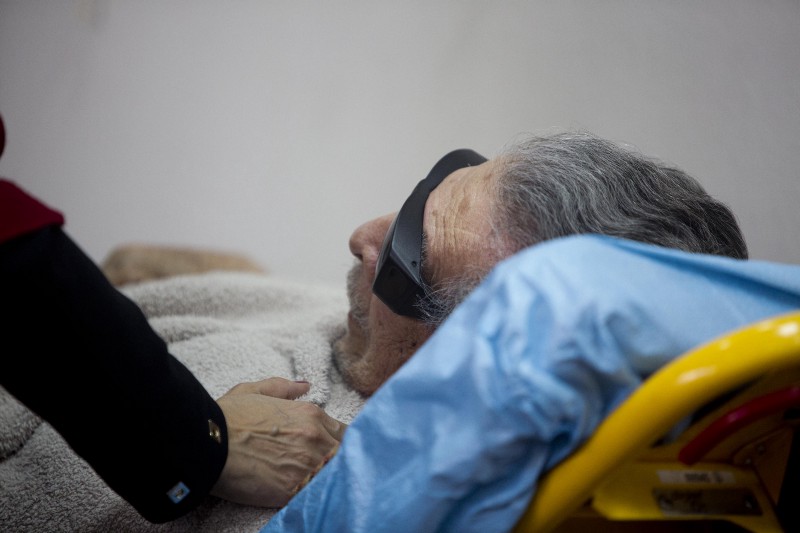
On Tuesday, courts in Guatemala ruled that the country’s former military dictator is to stand trial for genocide — but he will not be sentenced because he suffers from dementia. The decision came after a panel of 10 doctors examined the former Efrain Rios Montt’s health after he was wheeled out of the courtroom on a stretcher in January.
Judges announced that the trial will resume in January under special circumstances and all evidence and witnesses will be presented behind closed doors. Rios Montt himself, who is 89 years old, will not have to be present in court.
“The delaying strategies, abusive use of judicial recourses and alleged threats and pressure against judges and prosecutors working on the case that have characterized the genocide trial, reveal significant flaws in the administration of justice in Guatemala,” the UN Special Adviser on the Prevention of Genocide, Adama Dieng, and Pablo de Greiff, the UN Special Rapporteur on the promotion of truth, justice, reparation and guarantees of non-recurrence, said in a statement.
“Guatemala still needs to transform a culture of impunity into a culture in which the truth is told and individuals are held accountable, whoever they are,” they added.
Rights’ groups have expressed concern over the latest delay in the trial which has been suspended since early this year.
“[The] ruling clearly shows that when justice is delayed for so long, there is a very high risk that those responsible for crimes such as mass killings and disappearances will be able to get away with it,” Erika Guevara-Rosas, the Americas Director at Amnesty International said in a statement.
In 1999, a United Nations Commission found that more than 23,000 people were killed in Guatemala’s 36-year civil war. Eighty percent of them were part of Guatemala’s indigenous Mayan population.
During the civil war, Rios Montt admitted to making command decisions in a documentary made by the American filmmaker Pamela Yates. His admission was submitted to courts in a 2013 trial as proof that he ordered innocent civilians to be killed. That trial found Rios Montt guilty of genocide and crimes against humanity and sentenced him to a total of 80 years in prison. The conviction stood for just 10 days before it was annulled on procedural grounds and a new trial was ordered.
The current president of Guatemala was also implicated in the genocide during that trial. A former army mechanic testified that Otto Perez Molina, a former field commander in the Guatemalan military, ordered soldiers to loot and burn villages, and to kill those who fled from them.
“It is clear that there was a serious lack of judicial independence here and that this current government was, at least in some ways, puppeteering it what was going on in the trial,” Holly Dranginis, a policy analyst with the anti-genocide Enough Project, said in an interview with ThinkProgress in January.
Molina may have helped orchestrate the delays and dead-ends Rios Montt’s trial has faced — as much to save himself from prosecution as to save his former boss.
Molina has recently come under fire for a very different reason, however. Thousands of Guatemalans swept the streets of Guatemala City on Thursday to call for his resignation over a corruption scandal.