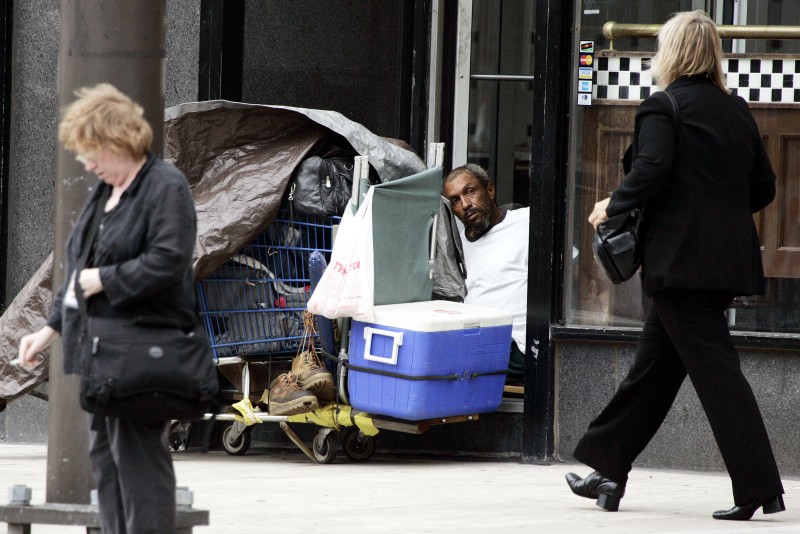
The city of Cleveland was hit with a lawsuit on Tuesday alleging that its plans for the upcoming Republican National Convention will interfere with the rights of homelesss people who live near the convention center and potentially “criminalize their existence.”
The lawsuit, filed by the American Civil Liberties Union (ACLU) of Ohio on behalf of a Cleveland-based homelessness organization and other groups, claims that the official 3.3 square mile “event zone” — which Cleveland officials will be regulating with a number of “draconian” restrictions — will lead to unnecessary confrontations between police and homeless people.
While the event zone regulations will affect anyone near the convention area, homeless people are more likely to be carrying many possessions that are banned in the area, like large backpacks, tents, coolers, rope, glass bottles, and canned goods.
“By designating many of their basic, everyday necessities as contraband, and drawing an unreasonably wide zone for enforcement, the city is subjecting its homeless residents to unnecessary encounters with the police, and interfering with their rights to liberty, privacy and movement,” the lawsuit says.
Susan Becker, general counsel of Ohio’s ACLU, told ThinkProgress she is concerned about what increased interactions between police and homeless people could mean.
“We’re very concerned that these restrictions will basically criminalize their existence,” she said.
“Whenever you give the police more potential reasons to stop people, ask them questions and those kind of things, it increases the potential that the police will cross the appropriate boundaries in terms of detaining people, questioning them, that kind of thing,” she continued. “We’re concerned about unreasonable detentions, possibly even arrests.”
The complaint notes that between 90 and 110 homeless people live in the event zone, which encompasses four of Cleveland’s five largest shelters, a daytime drop-in center, a primary healthcare site for the homeless, and roughly 10 established homeless encampments. While the suit acknowledges that it could be appropriate to relocate the 12–20 people who live close to Quicken Loans Arena, most of the homeless population lives far from the actual convention area and should not be facing restrictions, the complaint says.
The Northeast Ohio Coalition for the Homeless, the homelessness group named in the lawsuit, recently settled a lawsuit with the city of Cleveland that gave homeless people certain rights, so Becker said the ACLU is concerned with whether police will respect that agreement.
“The consent decree set parameters that the police would respect the rights of homeless people to congregate in certain areas, to travel freely about the city, to not be escorted off of public property because they might be an embarrassment to the city,” she said.
Meanwhile in Philadelphia, the site of the Democratic National Convention, the city is attempting to get its chronically homeless people off the streets and connected with government resources this summer. Mayor Jim Kenney said the recent push is not an effort to keep the homeless out of sight for the DNC, but instead to show national Democrats how they can help Philadelphia’s outreach initiatives.
The last Republican National Convention, held in Tampa Bay, Florida in 2012, took place in the city with the nation’s highest rate of homelessness. Homeless men and woman at the time told the BBC that they experienced increased pressure and hostility from police and that they were forced out of many of the locations where they typically rest or search for jobs.
“It’s what I would call a clean-up operation,” Gina Molina-Abella, a 49-year-old homeless person told the website. “They want to make sure when the Republicans come to town, there’s no riff-raff on the street.”
And in 2012, the Huffington Post reported that both the DNC and RNC may have caused a rise in homelessness due to soaring motel prices — an issue that could affect both Cleveland and Philadelphia this summer.
Tuesday’s lawsuit also challenges Cleveland’s protest rules, alleging that the city is not granting parade permits to groups that have put in requests to be able to demonstrate during the convention. Citizens for Trump, a pro-Donald Trump umbrella organization that’s named as a plaintiff in the lawsuit, plans to stage demonstrations with thousands of people from across the country, yet it claims it cannot plan events until it has a permit.