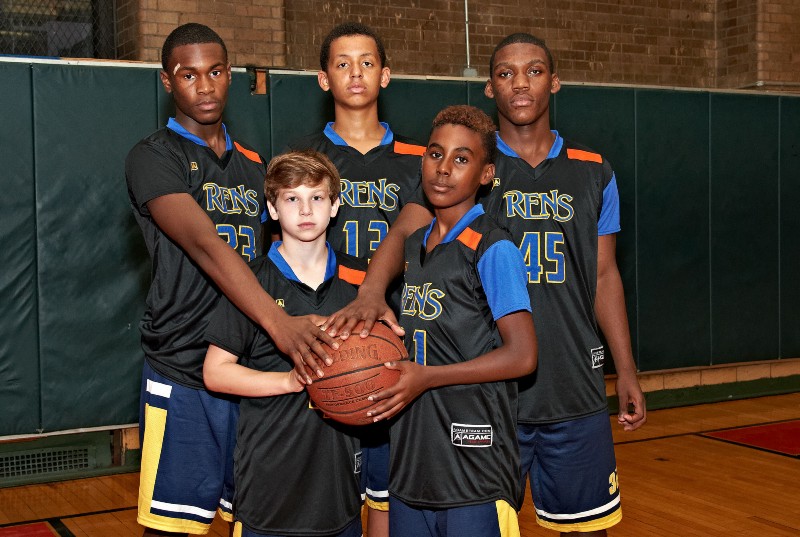
For the 200 kids who play in the New York City based New Renaissance Basketball Association (RENS), gun violence isn’t just a statistic to be used in debates about the second amendment and gun control. Gun violence is something they deal with on a daily basis. It’s personal.
So this season, the teams will wear orange patches on their jerseys as they travel the country to play games. The orange patches are supposed to be to gun violence what the pink ribbon is to breast cancer and the red ribbon was to AIDS. The purpose is to draw attention to the epidemic of gun violence and promote a culture of change, one where guns are no longer considered cool.
The “Wear Orange” campaign was started a few years ago by Chicago teens who wanted to send a message that they would no longer stand for the gun violence in their communities. They had the desire to take action after the death of 15-year-old Hadiya Pendleton, who was shot and killed by gang members in a Chicago park in a case of mistaken identity. The RENS teams will be the first sports teams in the country to wear orange patches.
Mustapha Heron, a 17-year-old who started playing for RENS when he was in eighth grade, hopes fans and competitors will be curious about the orange patch and that it can start a conversation.
“Hopefully they start asking questions, like ‘What does that orange patch mean?’ And I can tell them, we want to make a push to end gun violence for the streets,” Heron told ThinkProgress.
How is this common? How is this accepted?
While gun violence has always been an issue for these kids growing up in inner-city New York, this year the problem hit closer to home. Between March and August, two kids in their community were injured and another was killed due to gun violence. A former sixth grade RENS player, who is now 14 years old, was charged with shooting his girlfriend to death.
“There’s a feeling that the kids are numb, that there’s a borderline acceptance that this is just part of the culture,” Andy Borman, the executive director of RENS, said. “That’s the most upsetting thing. How is this common? How is this accepted?”
Gun violence has become an epidemic in America, and a report published in February 2014 by the Center for American Progress (CAP) and Generation Progress (GP) found that it’s a problem that disproportionately impacts youth and minorities. (ThinkProgress is an editorially independent news site housed at CAP.)
While Americans under the age of 25 account for only 3 percent of all deaths in the country each year, they account for 21 percent of all of the deaths from gun violence. The study projected that in 2015, gun violence will be the leading cause of death amongst people ages 15 to 24, surpassing motor vehicle deaths for the first time. Overall, CAP and GP calculated that 1 million years of potential life are lost due to gun deaths each year.
Moreover, while only 13 percent of Americans are black, 65 percent of gun murder victims between the ages of 15 and 24 were black, and young black men in that age range are killed at a rate 4.5 times higher than their white counterparts.
Young people also commit gun offenses more frequently than other age groups. In 2012, 75,049 young people between the ages of 10 and 29 were arrested for weapons offenses, such as illegally carrying or possessing a firearm; this group made up 65 percent of all arrests for weapons offenses that year. Many of these offenders end up imprisoned, often for extended periods. The report estimated that in addition to the general cost to society of the loss of productivity and tax revenue, a 20-year-old imprisoned for life will cost American taxpayers roughly $2 million.
“The thing I said to the kids is — this is terrible, what are you going to do about it?” Borman said.
For Heron, the problem really hit home when fellow basketball player Tyrek Chambers, who Heron often practiced with and competed against, was shot in the stomach in broad daylight while walking to the store three months ago in Brooklyn. Chambers, 15, was with a group of friends at the time, but they all fled when the shot was fired, leaving Chambers lying on the ground, wounded and alone, until the ambulance came. Chambers will survive the incident, but he still has to wear a colonoscopy bag, and he hasn’t been able to get back to school or play basketball since the incident. There are no clues about who shot Chambers, or why.
Heron, a top 25 basketball prospect in the class of 2016 who has already committed to Auburn, cried when he found out about what happened to his friend.
It hits you closer when it’s someone you’re close to
“It hits you closer when it’s someone you’re close to and you’ve developed a relationship with over time,” Heron said. “When I found out about what happened with Tarek, that’s when I wanted to get involved and take a stand. Gun violence happens so much, especially where I’m from, every day you hear about people getting shot, even in broad daylight. I want to stand up for the younger generation and steer them away from it. I didn’t know there was a way out.”
Borman hopes that this initiative can move beyond awareness and into education and action. RENS has teamed up with Everytown and Sandy Hook Promise, two prominent anti-gun violence organizations, to provide educational materials and resources for the kids. The mothers who lost children in the Sandy Hook massacre will speak directly to the RENS players about ways to deal with grief and make better choices.
“We’re going to bring in people that can talk to our kids about the built-in responses and give them a safety clause,” Borman, who played on the 2001 Duke national championship basketball team and is the nephew of Duke coach Mike Krzyzewski, said. “I tell my kids, if you have to think about it, don’t do it. If you are sitting there and you are trying to decide whether this is a good or bad decision, it’s a bad decision, just stay away. Walk away, get out, or ask for help.”
Since announcing the orange-patch campaign, Borman has already heard from approximately 25 programs across the country looking for orange patches of their own. He hopes that by each team focusing on change on their own local level, that the campaign can make a much broader impact.
But primarily, Borman hopes that he is empowering the kids in his program, and that ultimately, lives can be saved. So far, it sounds like the message is getting through.
“Everyone has a voice and everyone has a decision to make, and no matter how much you think you don’t have a choice, you do,” Heron said. “You don’t have to go down that path.”