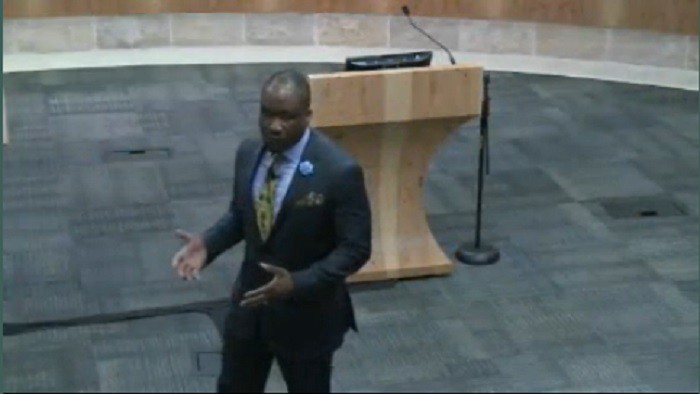
When women took over the majority of council seats in Austin, Texas the city manager’s office brought in speakers to advise municipal employees on how to deal with women.
Speaker Jonathan Allen, who was recently fired from his position as city manager of Lauderdale Lakes, Florida, spoke about the delicacies of dealing with women in government. He explained that over the last 20 years, the number of women in local government has increased the “diversity” of local government, and that a lot of the women elected are “activists” who don’t have previous experience in government.
As the Austin American-Statesman reported, Allen encouraged patience when answering questions from female councilmembers, expressed that women often don’t want to deal with “the financial argument” on a given issue but rather want to hear about impact on communities, and mentioned that the number of women in local government is at risk of an increase with Hillary Clinton running for president.
The “expectations” of how to interact with council members were the same between men and women, Allen reminded city employees during his March 27 presentation (recorded on the Austin city website), but the “dynamic” is different.
“So you see women in positions that you as a city manager, and you as a city administrator, will have to interact with them in a different way than you would have normally interacted with non-diverse leader in that position,” Allen said. “I submit to you that if Hillary Clinton runs — just runs — for the office, you going to see even greater numbers in leadership positions. You’re going to see even greater numbers in positions at the bottom.”
Much of Allen’s talk focused on the overall trends of the number of women increasing in government at all levels, even quoting Sheryl Sandberg’s TED talk about the dearth of women in leaders. He points out that the number of women mayors had increased in Florida and Texas.
Once Allen finished, he brought on Miya Burt-Stewart, a self-described “global business guru,” who seemed to take the book Men Are From Mars, Women Are From Venus as gospel.
“We already know that men and women don’t think alike,” Burt-Stewart opened her presentation referencing the widely derided book. “The author says that men act on facts and women act on emotions.”
“Men have egos, women have wish lists,” she continued. She emphasized that women tend to have a “compromising” business style, while men in leadership roles tend to have a more “dominating” style. “We have to openly knowledge gender differences now more than we ever had.”
“Women often don’t feel included, particularly when you’re talking about a male-dominated environment,” Burt-Stewart explained. She suggested that it was a mistake for women who take over shouldn’t shut men out of discussions just because women were shut out of leadership roles for so long.
But perhaps women don’t feel included in male-dominated environments because they aren’t included. Women make up about 20 percent of Congress, but very few women hold committee chairmanships under current leadership. It was only in the last few years that women were allowed to use the Senate pool.
Clearly, it’s been a problem for House Republicans. House Speaker John Boehner conducted trainings for male members of Congress about how to talk about women when running against them. Bohener defended the sessions in a press conference, saying that male colleagues needed to be “more sensitive” when dealing with women’s issues.
Even in business, where women are a tiny fraction of CEOS, they’re more likely to be pushed out of their jobs or make less than male CEOs.
Burt-Stewart advised women to get angry during their time in office. “Stop giving folks a piece of your mind, because the more you give away, the less you have.”
In a conversation with Concilwoman Ora Houston’s spokesperson, Genoveva Rodriguez, she relayed what the councilwoman said about the story in a local press conference on Wednesday. Part of the meeting was to address the council’s switch to a 10-seat council instead of a seven-seat council with at-large members. “Citizens chose the seven females on council for specific reasons, and probably not because we’re female. Each of us comes with our own unique strengths and leadership styles,” her spokeswoman relayed from Houston in an email statement. “It is my desire that the City of Austin continue to challenge these long held stereotypes through conversations that are facilitated by trained facilitators.”
Update:
Updated with remarks from Councilwoman Ora Houston’s spokesperson.