The Department of Justice (DOJ) has launched an investigation to find out why voters were forced to wait up to five hours to vote in Maricopa County, Arizona’s presidential primary last month, an issue that only existed because the U.S. Supreme Court gutted the Voting Rights Act (VRA) in 2013.
The DOJ’s Civil Rights Division sent a letter to the largest county in the state on Monday, demanding that it provide information so that the government can determine if the county complied with federal voting rights statutes. This appears to be the first major DOJ investigation into election issues since the presidential primary season began.
Before the Supreme Court eliminated the requirement with its Shelby v. Holder decision in 2013, Arizona was one of nine states subject to the VRA’s Section 5 preclearance requirement. Any changes to election law in those states had to be approved by the DOJ because of their histories of racial discrimination. Since that requirement was eliminated, those nine states and dozens of others with Republican-controlled legislatures have passed measures like voter ID laws and made cuts to voting hours and polling locations, with the intention of suppressing minority voters.
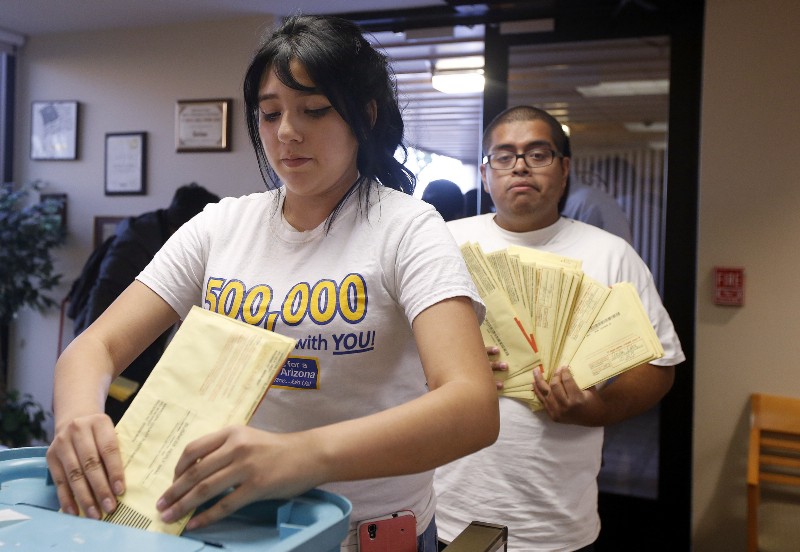
This year, in an effort to save money, Maricopa County elections officials reduced the number of polling places by 70 percent from 2012. That year, there were 200 places for the county’s voters to cast ballots. Last month, for the heated March 22 presidential primary, there were just 60 — one for every 21,000 voters.
As a result, many voters in Phoenix waited in line for five hours, some polling locations ran out of ballots, and many people left in frustration. The head of the state’s Democratic Party said in a statement that as many as 20,000 voters had been disenfranchised.
Maricopa County election administrator Helen Purcell, the recipient of the DOJ’s letter on Monday, eventually took responsibility. Purcell argued her department had incorrectly assumed almost all residents would vote by mail and was trying to be “cost-effective.”
But Maricopa County Supervisor Steve Gallardo does not accept this explanation. “Money should never be the determining factor if someone should vote or not,” he told ThinkProgress shortly after the Arizona primary.

The current back-and-forth would not have occurred before 2013 because the decision to eliminate the polling locations would likely have been blocked by the DOJ when the agency was still tasked with approving Arizona’s election changes. Now, the DOJ is forced to launch investigations and potentially lawsuits in order to remedy the voter suppression caused by these discriminatory decisions.
The DOJ’s letter requests that Purcell’s office provide the federal government with information by April 22 on the county’s polling places, registered voters, and provisional ballots issued, among other data.
Phoenix’s mayor had previously requested that the DOJ launch an investigation into this matter. While the agency responded on Monday and may take further action, other calls for federal investigations into voting issues have gone unanswered.
After Alabama announced plans to close 31 driver’s license offices — most of them in rural, impoverished, majority-black counties — making it even harder for residents to get the most common form of ID used to vote, Rep. Terri Sewell (D) called for a DOJ investigation into the potential voter suppression. Like Arizona’s election officials, lawmakers in Alabama also cited cost-cutting as the rationale for the change.
“The state of Alabama is balancing its budget on the backs of the people who can least afford it,” Sewell said during an event in October. “There’s no denying that the impact and effect is a disproportionate burden on low income communities.”
But the DOJ did not respond — at least not publicly. Instead, Alabama Gov. Robert Bentley (R) announced he would be somewhat reversing his decision to shut down the DMVs. But under the new plan, the offices will remain open just one day a month, beginning last November.
Sewell said the change was not enough. In a statement, the congresswoman called the new plan “bare minimum access” for the thousands of voters in those counties who lack the proper ID, and who may have difficulty accessing the office during that one day because of work or transportation issues.
Dena Iverson, the DOJ Civil Rights Division’s public affairs specialist, told ThinkProgress that the department “does not confirm or deny voting investigations” and declines to comment on whether the Maricopa County investigation is the first launched into issues with the presidential primaries.
The DOJ may be launching fewer investigations and lawsuits into voting rights issues because the elimination of Section 5 of the VRA makes it much harder to allege discrimination. Previously, the DOJ would automatically examine voting changes in jurisdictions with histories of racial discrimination. But now, after discriminatory changes are made, voting rights lawsuits have to be filed under the VRA’s Section 2, which places the burden on the plaintiffs to prove discrimination.
According to a recent examination, voting civil rights lawsuits in 2016 are down 40.4 percent from levels reported in 2011. In 2012, the last year with a presidential election, there were more than 200 federal voting rights lawsuits filed. This year, there are projected to be roughly half that amount.
The DOJ’s inability to intervene and block voter suppression measures is affecting states across the country. A total of 33 states will require voters to show some form of identification at the polls in 2016. Challenges to North Carolina, Texas, and Virginia’s voter ID laws are ongoing in federal court. And other lawsuits have been filed over measures to make voting harder, like the elimination of early voting and registration hours.