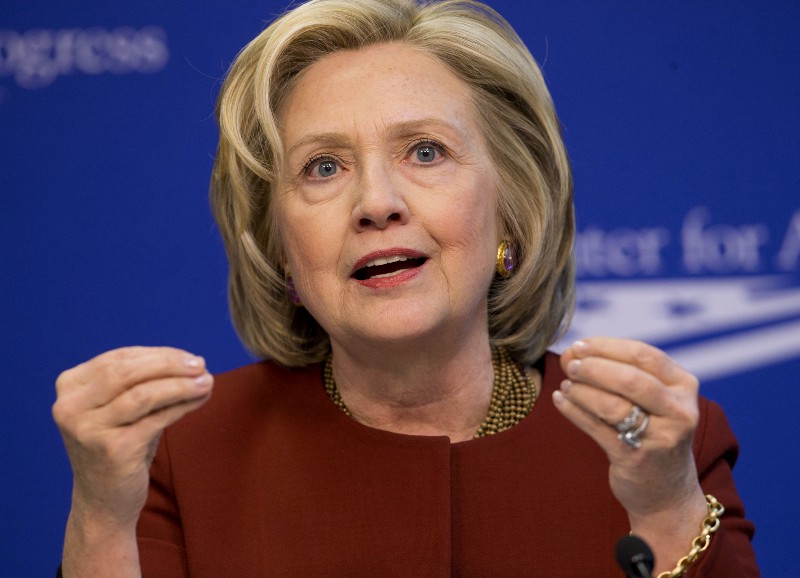
After months of scrutiny and anticipation, Hillary Clinton will formally announce that she is seeking the Democratic nomination for the presidency on Sunday before heading on the campaign trail to meet with voters.
The former Secretary of State has already and will continue to walk a fine line between criticizing actions of the Obama administration and paving her own path forward when it comes to issues of foreign policy. So far, Clinton has remained relatively quiet on issues from government surveillance to drones to trade agreements. But now that her campaign is formally launching, here are four issues Clinton will have to address:
Surveillance
When Edward Snowden first revealed massive domestic surveillance by U.S. intelligence agencies, Clinton largely kept quiet even as other presidential hopefuls weighed in. She has been critical of National Security Agency contractor Edward Snowden, suggesting he did not need to flee the country if he wanted to be a whistleblower.
But she has also said she would support reforms to ensure that surveillance doesn’t go too far and that the National Security Agency should be “more transparent” about its practices. She has also called for a “full, comprehensive discussion” about the NSA’s spying program. “That’s the discussion that has to happen in a calm atmosphere without people defending everything we’ve done and people absolutely opposing everything we’ve done,” she said in a 2013 appearance. “And we’re not having that conversation yet.”
The NSA’s current controversial phone metadata surveillance program expires in June. The reauthorization of the program or similar surveillance measures is already a hot topic among the Republicans vying for their party’s nomination.
Now that she is launching her campaign, Clinton could be the one to launch that conversation and establish a solid position on surveillance. If she defends the NSA’s practices, she may alienate progressives, younger voters, and those who have been pushing for more government accountability when it comes to warrantless searches. According to a recent poll, a majority of Americans oppose the government’s collection of phone and internet data under anti-terrorism programs.
Drones
As Secretary of State and now as a presidential hopeful, Clinton has defended the government’s use of drone strikes, calling them “one of the most effective and controversial elements of the Obama Administration’s strategy against al Qaeda and like-minded terrorists” in her book, Hard Choices. She added that “dozens of senior terrorists had been taken off the battlefield by drones.”
A recent poll found that of 44 countries surveyed, the U.S. is one of just three in which a majority of people approve of U.S. drone strikes targeting extremists in counties like Pakistan, Yemen and Somalia.
But Clinton still has to solidify her position and whether she will continue on Obama’s trajectory of using drone strikes as an approach to counterterrorism. Will Clinton continue to support aggressive policies to secure the country from an insecure world? Or will she balance her position with that of opponents who worry about civilian casualties?
Israel
As the Obama administration reassesses its relationship with Israeli prime minister Bibi Netanyahu, who recently declared he would fight a two-state solution with the Palestinians, Clinton has largely avoided picking a side. After Netanyahu’s reelection, she reportedly told a group of Jewish leaders that the U.S. must work with all sides in support of a two-state solution.
But Clinton has stressed that she built “a very good relationship” with Netanyahu as Secretary of State. In an interview with the Atlantic’s Jeffrey Goldberg in August, Clinton “offered a vociferous defense of Israel, and of its prime minister, Benjamin Netanyahu.”
“I think Israel did what it had to do to respond to the rockets,” she said. “Israel has a right to defend itself. The steps Hamas has taken to embed rockets and command-and-control facilities and tunnel entrances in civilian areas, this makes a response by Israel difficult.”
But as she formally launches her campaign, Clinton may be pushed to articulate how far she would go to make a two-state solution happen. Clinton will have to explain how she envisions attaining a two-state solution through the bilateral track, despite Obama’s rejection of the idea.
Trans-Pacific Partnership
The Obama administration hopes to complete the Trans-Pacific Partnership (TPP), a deeply controversial 12-country trade agreement, by the end of the year. The trade deal faces strong opposition from members of her own party — including labor unions and Elizabeth Warren, who recently challenged Clinton to state her position.
As the Atlantic notes, Obama’s TPP push could put Clinton in a tight spot as she determines how much to distance herself from his policy. At the same time, her opponents will likely point to her husband’s signing of the North American Free Trade Agreement, and its failures and the subsequent loss of U.S. jobs.
In 2007, she called NAFTA a mistake and later said she raised a “yellow caution flag” against the pact, according to the Hill. “As a senator, Clinton backed bilateral trade deals with Singapore, Australia, Chile and Oman, but she voted against the Central American Free Trade Agreement with five Central American countries and the Dominican Republic,” the Hill reported. “As Obama’s secretary of State, she supported a controversial Colombia trade agreement that organized labor vehemently opposed.”
Clinton has yet to say how she would approach the TPP moving forward, but groups on both sides say it’s time she tells people where she stands.