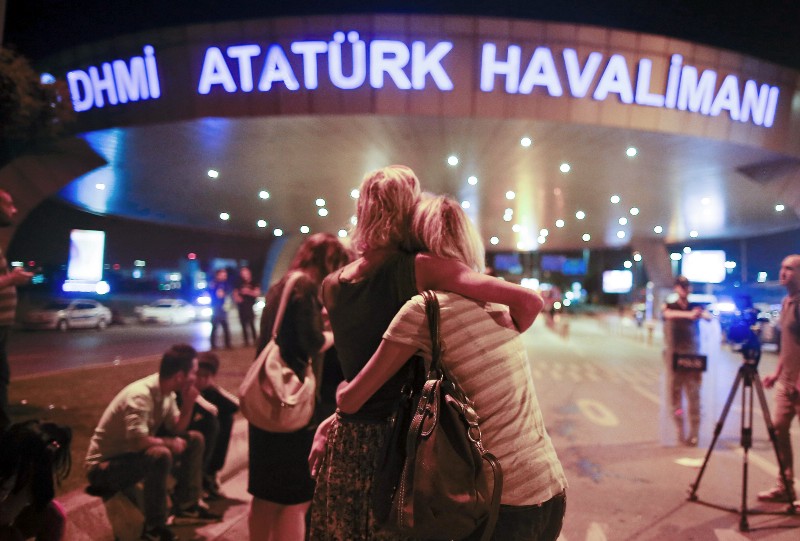
Istanbul’s Ataturk Airport, which is one of the world’s busiest transit hubs, was hit with explosions on Tuesday. According to Turkish officials, there were three suicide bombers, and at least 41 are dead and 239 are wounded. The official death toll has risen steadily since news broke, and may still rise.
The attack took place at the entrance to the airport’s international terminal. According to Reuters, security police fired shots at the suspected suicide bombers, who didn’t make it past security. In Turkey, passengers go through security twice: Once before entering the airport, and once more before heading to the gate. The explosions apparently took place outside the first ring of security. Pictures and video emerging on Twitter show people running and scenes of devastation outside the airport.
İstanbul Atatürk Havalimanı'ndaki patlama anı kameradahttps://t.co/er3zBIGKuB pic.twitter.com/UGnpWEyjgV
— BirGün Gazetesi (@BirGun_Gazetesi) June 28, 2016
Huge numbers of passengers stranded outside Ataturk pic.twitter.com/E5w4jRJI9N
— Borzou Daragahi 🖊🗒 (@borzou) June 28, 2016
While details are still emerging, this is the 8th major terrorist attack to hit Turkey in the past 12 months. In the most recent, a car bomb ripped through a central district of Istanbul, killing 11 and wounding 36 more. Not including today’s attack, at least 226 people have been killed in bombings in Turkey’s main cities of Istanbul and Ankara, making it the bloodiest year in recent history. Some of the attacks — particularly those on international or civilian targets — have been attributed to ISIS, while others have been claimed by a militant offshoot of the Kurdistan Workers Party (PKK).
In addition to the high-profile bombings, violence is mounting in Turkey’s southeast between Turkish police and military and the PKK. Earlier on Tuesday, a car bomb attack targeting a police vehicle in the southeast injured eight. A fragile peace between the PKK and the Turkish government dissolved last year after the first of the recent spate of bombings, which has been blamed on ISIS and which attacked a Kurdish community center in the southeast, killing 34 young peace activists.
Turkey’s economy relies heavily on tourism, which has dropped dramatically in the wake of the violence. In April, the number of visitors to Turkey was 28 percent lower than the same period in 2015. In May, the number of visitors to Turkey was 34.7 percent lower. The country is experiencing the largest drop in tourism since 1999, when a massive earthquake near Istanbul killed tens of thousands.
A new travel warning for U.S. citizens was issued on Monday, replacing an earlier one from March. The advisory warned citizens to avoid travel to the southeast, and noted that “throughout Europe extremists have targeted large sporting events, theatres, open markets, aviation services, transportation systems, and public venues where people congregate as well as religious sites and high-profile events.”
This is a breaking news story that will be updated as more information becomes available.