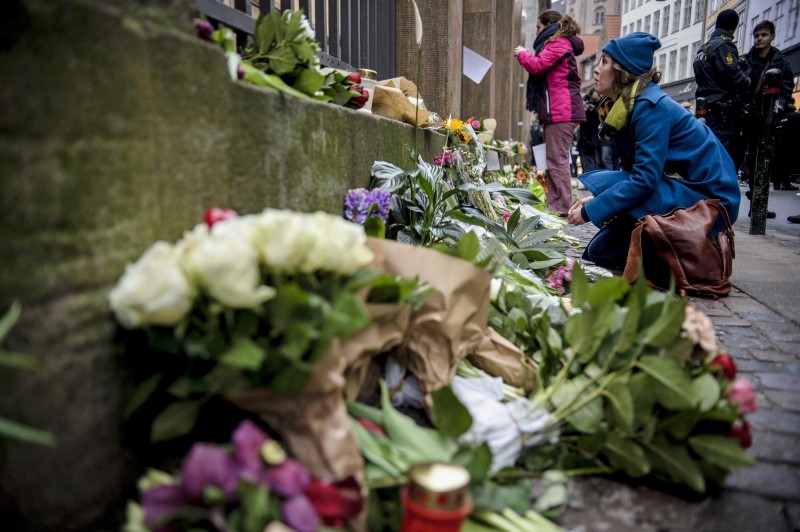
The killing of a Danish film director and a Jewish guard in Copenhagen, Denmark this weekend paired with the vandalism of a Jewish cemetery in eastern France on Thursday have given rise to concerns about a rise of Islamist terrorism and antisemitism across the continent.
Omar Abdel Hamid El-Hussein, who is believed to have carried out this weekend’s attacks, was shot dead by police in a gun battle on Sunday. The 22-year-old Copenhagen native was released from prison two weeks ago. Reports indicate that Danish authorities put him on a list of people radicalized in prison after he spoke openly about his wishes to join the Islamist terrorist group ISIS in Syria.
The head of Denmark’s domestic security suggested that El-Hussein may have instead been “inspired” by the attacks last month on a French satirical magazine and a kosher market in Paris.
The attack did single out strikingly similar targets. The gunman first shot Finn Norgaard, a film director, at an event where a Swedish cartoonist who infamously drew cartoons of the Prophet Mohammad was speaking. On Sunday, he opened fire on police and guards at a synagogue.
The vandalism of a Jewish cemetery in the Alsace region of France have added to a growing list of anti-semitic attacks, which have stirred greater fervor so soon after the attacks in Paris.
French prosecutors said on Monday that they have taken five French teenagers into custody for defacing and damaging around 300 tombs and vandalizing a monument to Holocaust victims. They are from the area where the cemetery is located and their ages range from 15 to 17.
French prosecutor Philippe Vannier said that the boys have denied that they were motivated by anti-semitism to vandalize the tombs, and have been “very, very affected by the scale of the reaction to this affair.”
“We don’t know the motives of these adolescents who don’t have past criminal records and we don’t know of any ideological convictions that could explain their behavior,” he added.
For some Europeans, these attacks point to a rising tide of anti-semitic sentiment.
It’s hard to read a notable increase into the year-to-year count of anti-semitic incidents in European counties, but, according to a survey by the Anti-Defamation League, nearly a quarter of all Europeans harbored negative sentiments towards Jews. In 2012, nearly one-fourth of about 6,000 Jewish people in eight European Union countries surveyed by the European Union Agency for Fundamental Rights said that they had experienced some form of anti-semitic harassment in the year before the survey.
Nearly 7,000 people moved to Israel from France in 2014, the highest number of any country according to the Jewish Agency, an international Jewish organization. 26,500 people immigrated to Israel from around the world in 2014 — a 32 percent increase to migrations from the year before.
“Israel is your home. We are preparing and calling for the absorption of mass immigration from Europe,” Israeli Prime Minister Benjamin Netanyahu said in a statement on Sunday, following the Copenhagen attacks. This call was similar to one he made last month after four Jews were killed in terrorist attacks in Paris.
French authorities are working to counter the idea that France is unsafe for Jews. “The French Republic won’t allow another act against our values,” France’s Interior Minister Bernard Cazeneuve said in a statement. In a tweet, French Prime Minister Manuel Valls called the destruction of the 19th century tombs, “A vile, anti-Semitic act, an insult to the memory.”
On Monday, Danish Prime Minister Helle Thorning-Schmidt made a similar statement when she addressed an estimated 30,000 people at a vigil in honor of the two slain Danes.
“Tonight I want to tell all Danish Jews: you are not alone. An attack on the Jews of Denmark is an attack on Denmark, on all of us,” she said.