Australian Prime Minister Tony Abbott said on Monday that Australians are “sick of being lectured to by the United Nations,” after the international organization released yet another report decrying its policies toward asylum seekers.
The report, which was issued by the U.N. Special Rapporteur on Torture Juan Mendez, found that Australia violated international agreements to ensure that asylum seekers are free from torture or cruel punishment. Australia currently houses nearly 3,000 asylum seekers on Australian detention centers on islands in Papua New Guinea and the island nation of Nauru.
“The government of Australia, by failing to provide adequate detention conditions; end the practice of detention of children; and put a stop to the escalating violence and tension at the regional processing center, has violated the right of the asylum seekers including children to be free from torture or cruel, inhuman or degrading treatment,” the report by the U.N. Special Rapporteur stated.
In response, Abbott claimed that the conditions at the detention center were “reasonable under the circumstances” and said that “all of the basic needs of the people on Manus Island are being met.”
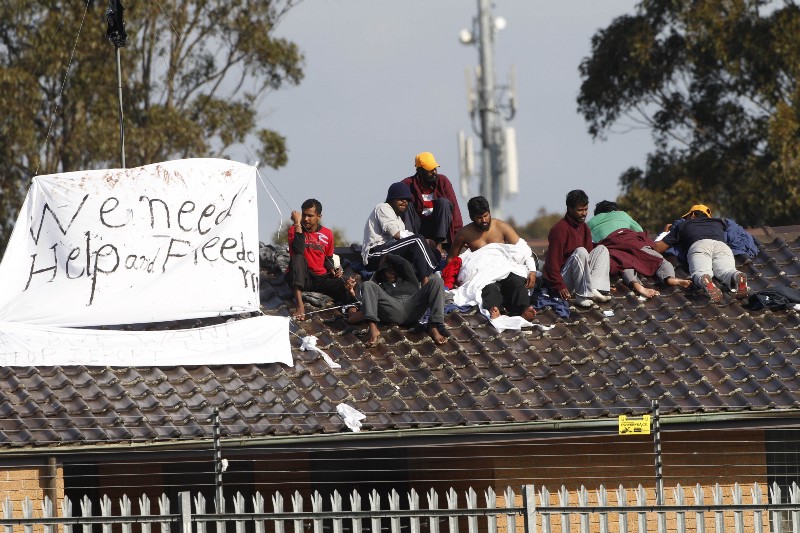
Those who are living in the facility have a very different understanding. In January, more than 200 asylum seekers went on a hunger strike to protest their living conditions on Manus Island. About 10 are believed to have sewn their lips shut to show the extent of their frustration.
Last month, the Australian rights’ organization Refugee Action Coalition documented facilities which it called “disgusting.” The organization cited unsanitary toilets, clogged sewage pipes, a lack of basic hygienic items such as shampoos, and mosquitos which “remain in plague proportions” as evidence of the uninhabitable state of the facility.
While the detention centers continue to spark protest and incite international furor, the Australian government has adopted a very different way to keep migrants in check.
“The most humanitarian, the most decent, the most compassionate thing you can do is stop these boats because hundreds, we think about 1,200 in fact, drowned at sea during the flourishing of the people smuggling trade under the former government,” Abbot told reporters.
As a part of its new policy he instated, the Australian navy intercepted and turned back 15 boats during the course of 2014. That’s a small fraction of 400 boats that arrived on Australian territory in 2013, carrying at least 26,000 asylum seekers.
The threat of return has apparently deterred many from bothering to make the trip, but according to the United Nations, sending refugees back not really a legally viable solution.
In fact, according to the Refugees Convention — which Australia and Papua New Guinea have both signed — a refugee cannot be returned to “territories where his/her life or freedom would be threatened.” That is very likely the case, since the asylum seekers risk their lives to flee countries like Iran, Iraq, Afghanistan, and Sri Lanka.
But neither can it detain refugees in such allegedly squalid conditions — especially not the 119 children currently hold at the Nauru facility.
Given the clear infringements of binding international agreements, Australia is has a very thin defense for its actions. “[I]t’s incredibly short-sighted for the government to start thumbing its nose at the UN system just because it doesn’t like what it’s being told” Daniel Webb of the Melbourne-based Human Rights Law Centre told the Guardian.
This most recent report by the U.N. follows several other pointing to human rights violations at Australia’s immigration detention facilities closely follows a report by the Australian Human Rights Commission which Prime Minister Abbott similarly snubbed last month.
The detention centers have been racked with controversy since they were re-opened in 2012 after a temporary closure. One particularly shocking incident noted by the report is the case of two asylum seekers who have claimed that they were tied to chairs, and threatened with physical violence, rape, and persecution to pressure them into retracting statements on the alleged murder of another detainee by guards at the Manus Island facility.
Australia is among 68 countries that the U.N. Special Rapporteur on Torture is investigating for violations to the U.N. Convention Against Torture and Other Cruel, Inhuman, or Degrading Treatment or Punishment which more than 150 countries have signed onto.