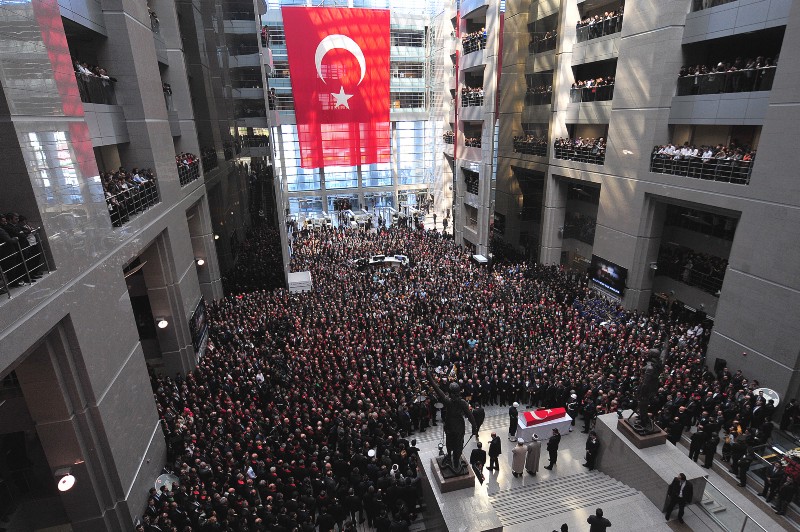
Outside and looking in, social media seems to be public enemy number one in Turkey. Almost every time the country makes headlines in the United States it’s for censorship, and this week was no different. Turkey quickly banned Twitter Monday for several hours to keep users from seeing a graphic picture of a Turkish prosecutor who had been kidnapped and held hostage by leftist militants in late March.
The prosecutor, Mehmet Selim Kiraz, was photographed with a gun pointed to his head and wearing his government ID badge. He was killed days later.
President Recep Tayyip Erdoğan banned Twitter and YouTube Monday as a result. For Twitter, the ban was lifted hours later after the U.S.-based company acquiesced the Turkish government’s request to block the graphic image of Kiraz. Google followed suit, avoiding a more widespread ban on the company’s other services. Facebook also complied with government requests and escaped the ban.
“The ban was a result of a hostage situation last week. There was a young boy who was killed during Gezi Park protests [in 2013], and the prosecutor responsible for that case was held hostage by mercenaries. Images of that circulated Twitter and YouTube and the government [imposed] a gag order until the hostage situation was resolved, including pictures online. And because there were still images circulating, the government decided to shut [the services] down,” said Elmira Bayrasli, co-founder of Foreign Policy Foreign Policy, Interrupted, an initiative to help amplify women’s voices in media and foreign affairs.
Turkish Twitter users are used to such bans and easily circumvented the brief disruption. Monday’s ban came a year after then Prime Minister Erdoğan banned YouTube and Twitter to suppress audio footage that implied he and his son were involved in corruption.
Like last year, this ban comes ahead of an election. The parliamentary elections will be held in June, and could prove historic with Democratic Kurdish minority party, the HDP, standing to gain significant political ground in June.
“This is part of the pre-election campaigning for the general elections that will take place in June this year,” said Bayrasli, who is also a New York-based fellow at the New America Foundation. “On a broader scale, we’ve seen Erdoğan shut off social media before.”
That’s not a coincidence. Instead, it’s expected and the bans on social media do more than censor Turks who may criticize Erdoğan, the government or tweet something deemed immoral, and deflect from deeper issues that could change the country’s trajectory.
“A lot of what Erdoğan is doing, feeds the narrative that he wants to create in Turkey. It’s a powerful narrative: ‘I represent the black Turks, the underdogs — not the lighter and richer ones that had previously been in power — even though he’s no longer the underdog,” Bayrasli said.
“When he bans social media he’s silencing the upper classes, because they’re the ones who can afford the technology. His base loves that. But the reason that is so dangerous because it’s creating a class warfare that is false and stalling mobility.”
Tech companies with a presence in Turkey are increasingly subjected to government requests for blocking or removing content at the risk of getting their service suspended.
From July through December, Twitter honored almost half, 149, of the Turkish government’s 328 requests to take down content for violating personal rights or defamation of private citizens or government officials, according to the micro-blogging site’s transparency report. Twitter contested over 70 percent of those requests in court, but won very few.
Facebook has seen an increase in take-down requests worldwide, with much of them coming from Turkey. The social network approved 71 percent of Turkey’s data information requests and restricted 3,624 pieces of content in the second half of 2014, according to the social network’s transparency report.
For Google, the company refused to take down 11 videos and 22 blogs for Turkish officials in the latter half of 2013 because it didn’t find offensive content. It did, however, block 150 videos, according to the latest transparency report.
Those companies have a global presence and financial clout to spare, but their treatment by the Turkish government has a local economic impact.
“It hurts Turkey’s potential to be a technology hub for startups. Turkey can no longer rely on manufacturing and textiles in the 21st century. It has to switch over to services,” Bayrasli argued. “Erdoğan has an economics problem. If the government is randomly going to shut down your website, that’s not going to be conducive.”
A Rock And A Hard Place For Tech Companies
The image at the center of Monday’s ban conjured up sentiments from past kidnappings worldwide. It was nearly impossible to escape video and still images of American photojournalist James Foley being beheaded by the Islamic State or ISIS last year. The graphic images of the moments right before Foley’s execution were published in mainstream media and populated Twitter and Facebook feeds for days. And taking down or blocking the images became a decision social media platforms, which greatly prize open expression, had to make to preserve the user’s experience.
“What’s happening is these companies, ask themselves, ‘Do I want to be completely inaccessibile to this entire population or do I want to entertain this request?’ If the content is illegal in that jurisdiction, they can block it locally,” said Rebecca MacKinnon, New America’s director for Ranking Digital Rights, a project that measures free expression and privacy rights worldwide, in Washington, D.C. “They’re thinking about the nature of the market, the types of requests they’re getting: ‘If I’m getting requests from a particular regime how can that damage my reputation?’”
And if companies don’t develop mechanisms to honor the requests, they risk losing exposure in a particular market. “Tech companies increasingly have rules about hate speech, violent speech [beyond the scope of] what the law says. Posing as a regular user, often governments unofficially file reports on content the basis that it violates the [platform’s] terms of service. But those numbers aren’t in the transparency reports and tend to have a global effect, taken down everywhere not just locally,” MacKinnon said.
While Monday’s ban more closely resembles a moral decision to keep images of someone in their violent dying moments from circulating out of respect, it plays to the larger issue of taking that decision out of the hands of the people and putting it with the government. “The first ban [last year] was very much to stop the voice recording [implicating then Prime Minister Erdoğan in widespread government corruption]. In the aftermath of that, the Turkish government began putting in a legal foundation for these sorts of bans, giving certain courts and even prosecutors the ability to ban Twitter users, demand that content be removed, temporarily block sites in the absence of a court order,” all to bolster now President Erdoğan’s political control of the conservative party or AKP, said Max Hoffman, national security and foreign affairs policy analyst for the Center for American Progress, a progressive Washington, D.C. think tank with which ThinkProgress is affiliated.
American social media are the only unfiltered outlets in Turkey, which controls or heavily influences television and print media in the country. “Turkish media has never been fully free. But there was a great hope in 2002 when the AKP took power, passed democratic reforms and seemed to be more open to criticism,” Hoffman said.
That changed however when Erdoğan began calling out journalists and levying taxes on media outlets among other things that have led to self-censorship.
Nearly half of Turks are connected to the internet with 35 percent of them active on social media. Twitter has a significant following in Turkey, which grew to over 6 million users after last year’s ban.
Those users also tend to be more affluent and urban, and banning the medium doesn’t alienate the Erdoğan’s political base which tend to be more conservative, religious, middle and lower economically classed, and view Twitter as Western and secular.
“This particular ban has to be contextualized at a more philosophical level beyond Erdoğan and the AKP,” Hoffman said. “Much of Turkish society has a different understanding and threshold for freedom of expression and where that line should be drawn. In the U.S., we might say it was in poor taste to tweet the images of someone who was shot and killed but people should have the legal right to do that. If you put that to a vote, Turkish society would likely vote heavily that it was in poor taste and unacceptable.”
But even if Monday’s ban was morally distinct, it’s still part of an ongoing method to shut down media outlets ahead of elections in an effort to control the outcome and keep voters in the dark on economic and other non-censorship related issues.
“You have these manipulative democracies where you don’t throw journalists into jail or kill them but you control print and electronic media to a degree that after you win the election, there’s really no way to contest the power structure in the country,” said Micheal Werz, senior fellow for the Center for American Progress.