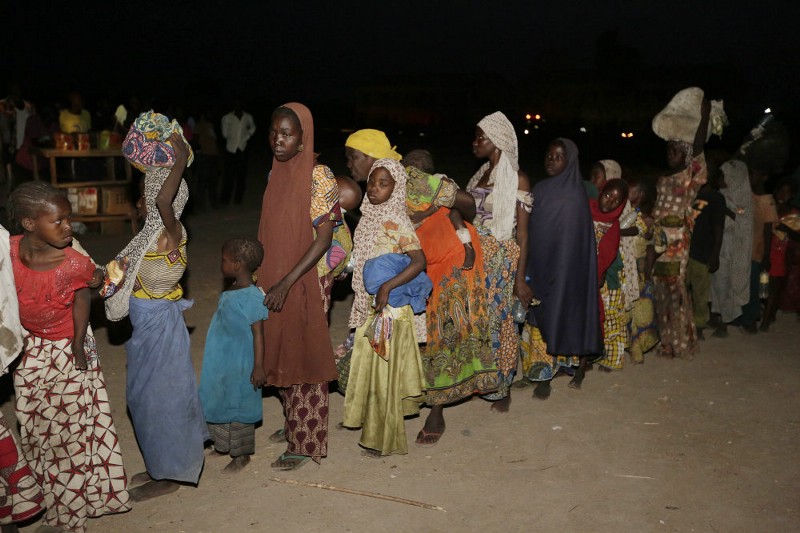
As the Nigerian military moved in on a Boko Haram stronghold, the militants pelted hostages to death with stones in an effort to keep them from being rescued. A group of about 300 women and children held as hostages were freed by the Nigerian forces on Sunday. The military said that it’s released 700 from Boko Haram captivity in the last week.
“They aren’t so much ‘bringing back our girls’ as they are beating back Boko Haram and one of the ancillary results is that people are being freed,” Brandon Kendhammer, a professor of political science at Ohio University, told ThinkProgress. That’s because the hostages are held, often by the hundreds, alongside Boko Haram fighters in the camps they’ve established in the country’s northeast.
While none of the civilians freed are believed to be the girls kidnapped from their school in Chibok last year, the release of so many hostages is a remarkable advance. Even more so because it comes in the final month of President Goodluck Jonathan’s term in office — and just after he lost a re-election bid in April.
“Had [the administration] done this six months ago, Jonathan probably would have won the election,” Kendhammer said.
Instead, he will be succeeded by General Muhammadu Buhari, a former military dictator.
Jonathan earned much scorn among Nigerians for neglecting to make any real strides in combatting Boko Haram as it took hold of the country’s northeast, razing villages and massacring thousands. Long after use of the #Bringbackourgirls hashtag waned from use by prominent figures like Michelle Obama, demonstrators continued to call on the government to do more to find them. According to a report released by Amnesty International in April, the schoolgirls were among at least 2,000 women and girls abducted by the militant organization in 2014.

“Every day we witnessed the death of one of us and waited for our turn,” Asabe Umaru, who was freed from a Boko Haram camp along with 234 women and children, told Reuters. “We thank God to be alive today. We thank the Nigerian army for saving our lives.”
Until just the last month or so, however, few had reason to praise the Nigerian armed forces. The country’s troops were glaringly absent from what was meant to be an operation coordinated between Nigeria and its neighbors, Chad and Niger.
“We want the Nigerians to come and occupy, so we can advance,” Chad’s President Idriss Déby said in March after soldiers from his country and Niger wrested the city of Damasak from Boko Haram control.
Campaign season came to a fever pitch then, but many Nigerians were furious with their President for going about his re-election drive as if the country were at peace. Boko Haram killed more than 7,300 civilians in three northern Nigerian states in 2014 — but Jonathan hardly mentioned the insurgency, and focused instead on the southern part of the country from which he hails. In parts of the country, Nigerian troops were deployed to guard the president’s campaign posters and billboards — earning him scorn from some voters.
“Why are they using soldiers and other security operatives [to guard signs]? They should be deployed to Sambisa and fight with Boko Haram,” one young man yelled as he tore down a poster of a smiling Jonathan in January.
Months later, Nigerian troops have moved in to the Sambisa Forest, just north of Chibok. Jonathan recently said the forest is the last stronghold of Boko Haram in the country.
“We can now say two states are completely free from terrorist control, while in the third state, it is only in one Local Government Area that they are still present. That is in the Sambisa Forest,” he said last week.
Jonathan has vowed to hand over a country free from Boko Haram to his successor, General Buhari.
“I think his promise to hand over a country free of terrorist strongholds should be taken with a grain of salt,” Ebenezer Babatunde Obadare, a sociology professor at Kansas University said in an email.
John Campbell of the Center on Foreign Relations would agree. He said in a phone interview with ThinkProgress that the military campaign against Boko Haram waged by Chad, Niger, Nigeria, along with mercenary soldiers South Africa hasn’t defeated the militant organization. Instead, it’s only caused them to shift their tactics back to those it deployed in the early 2000s.
“There has been enough pressure on Boko Haram that it essentially has reverted from holding territory to blending back into the countryside and into the slums which was the way it operated up until 2011,” Campbell said. “Now with no territory, it becomes very difficult to hold the literally hundreds — and I suspect more than a thousand people — that it had kidnapped over the years so that as it has withdrawn, it has either left its kidnapped victims in place, or in some cases, has murdered them.”
While hundreds of women have been freed through raids on Boko Haram camps, Campbell said that very little is known about how Boko Haram, on the whole, treats its captives or why it holds so many of them. He noted, however, that women and children may have been held to create what it described as an “Islamic state.”
“Part of it is that their stated goal was to create essentially an Islamic state and presumably some at least of the girls that were kidnapped were to be building blocks in that effort,” he said.

It may be that as it’s been pushed back from the land it’s held, Boko Haram fighters have put up less of a fight to keep their hostages, Brandon Kendhammer of Ohio University said.
“As a strategy it makes a certain amount of sense in that it really puts the pressure on the government, it makes them look incompetent,” Kendhammer said. “[But] as a tactic, when you read the descriptions of these camps and the level of surveillance that was required to keep these women and children in place, the logistical challenges of feeding them even if you’re not feeding them well as Boko Haram is on its heels makes no sense at all.”
But the pressure on Boko Haram doesn’t mean that the girls kidnapped from their school in Chibok will turn up.
“My sense it would be a pretty big stroke of luck if they were to turn up in a group.” Kendhammer said. “It seems possible that perhaps whatever resources they do have to holding hostages are being devoted to these girls over other hostages, but I’m not terribly optimistic [that the Chibok girls will be found].”
Neither is General Buhari, who will assume the presidency on May 29.
In an op-ed for the New York Times after he was elected, Buhari wrote squarely about the Chibok schoolgirls whose mass abduction shocked the world.
“We do not know the state of their health or welfare, or whether they are even still together or alive,” Buhari wrote. “As much as I wish to, I cannot promise that we can find them: to do so would be to offer unfounded hope, only to compound the grief if, later, we find we cannot match such expectation. But I say to every parent, family member and friend of the children that my government will do everything in its power to bring them home.”
“What I can pledge, with absolute certainty, is that from the first day of my administration, Boko Haram will know the strength of our collective will and commitment to rid this nation of terror, and bring back peace and normalcy to all the affected areas,” he continued.
Buhari, who took power in a coup in a military coup in December 1983 and remained in power for 20 months that were marked by human rights abuses, but also an effective bid to combat the rampant corruption that continues to plague the country.
The incoming president’s military pedigree should give him an advantage in combatting Boko Haram,” Ebenezer Babatunde Obadare, a sociology professor at Kansas University said, adding that “he should be better placed to address issues of morale among the rank and file.”
But, Obadare noted, Buhari will face the same limited resources Jonathan dealt with during his tenure.
“[H]e’s going to need more than that to dislodge a group that has been entrenched for so long. Part of what the failure to deal with Boko Haram has revealed is the overall decline in Nigeria’s military prowess,” he said. “This is not something you can successfully address in hurry.”