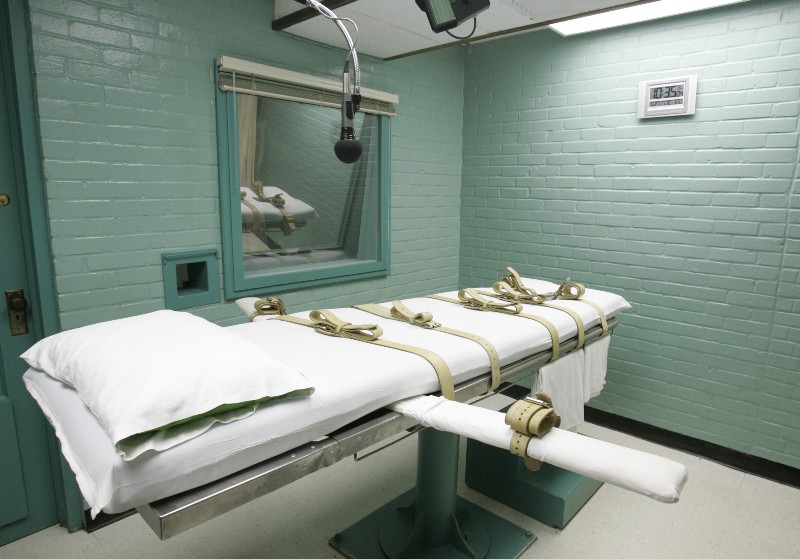
Almost immediately after the Supreme Court decided not to hear Richard Glossip’s last-minute appeal for his own life — a decision that effectively greenlighted his execution which was scheduled to happen Wednesday — Oklahoma Gov. Mary Fallin (R) issued an unexpected order granting a 37 day stay of execution to the condemned man.
Fallin’s order does not speak to considerable doubts regarding Glossip’s guilt, instead focusing on a narrower question of whether the state has followed its own protocols in procuring execution drugs. “This stay is ordered due to the Department of Corrections having received potassium acetate as drug number three for the three-drug protocol,” Fallin’s order explains. “This stay will give the Department of Corrections and its attorneys the opportunity to determine whether potassium acetate is compliant with the execution protocol and/or to obtain potassium chloride.”
The Department of Corrections Director told reporters the stay was requested by the Department of Corrections because they had received the wrong drug. Execution protocol calls for potassium chloride for the lethal injection, but the state was going to use potassium acetate. The Director said she was not sure if the state had been sent the wrong drug or if they had to request the drug because of a shortage.
Oklahoma was the cite of two botched executions where two inmates where effectively tortured to death after they were administered lethal doses of drugs. One inmate was heard saying “my body is on fire” and that the drug felt “like acid.” Fallin’s order appears to be an effort to prevent a similar incident from occurring during Glossip’s execution.
It’s worth noting, however, that Glossip had already been to the Supreme Court once due to concerns about the efficacy of a painkiller Oklahoma wished to use in his execution. The Court rejected his concerns in that case in a 5–4 opinion.
Update:
This post has been updated with new information.