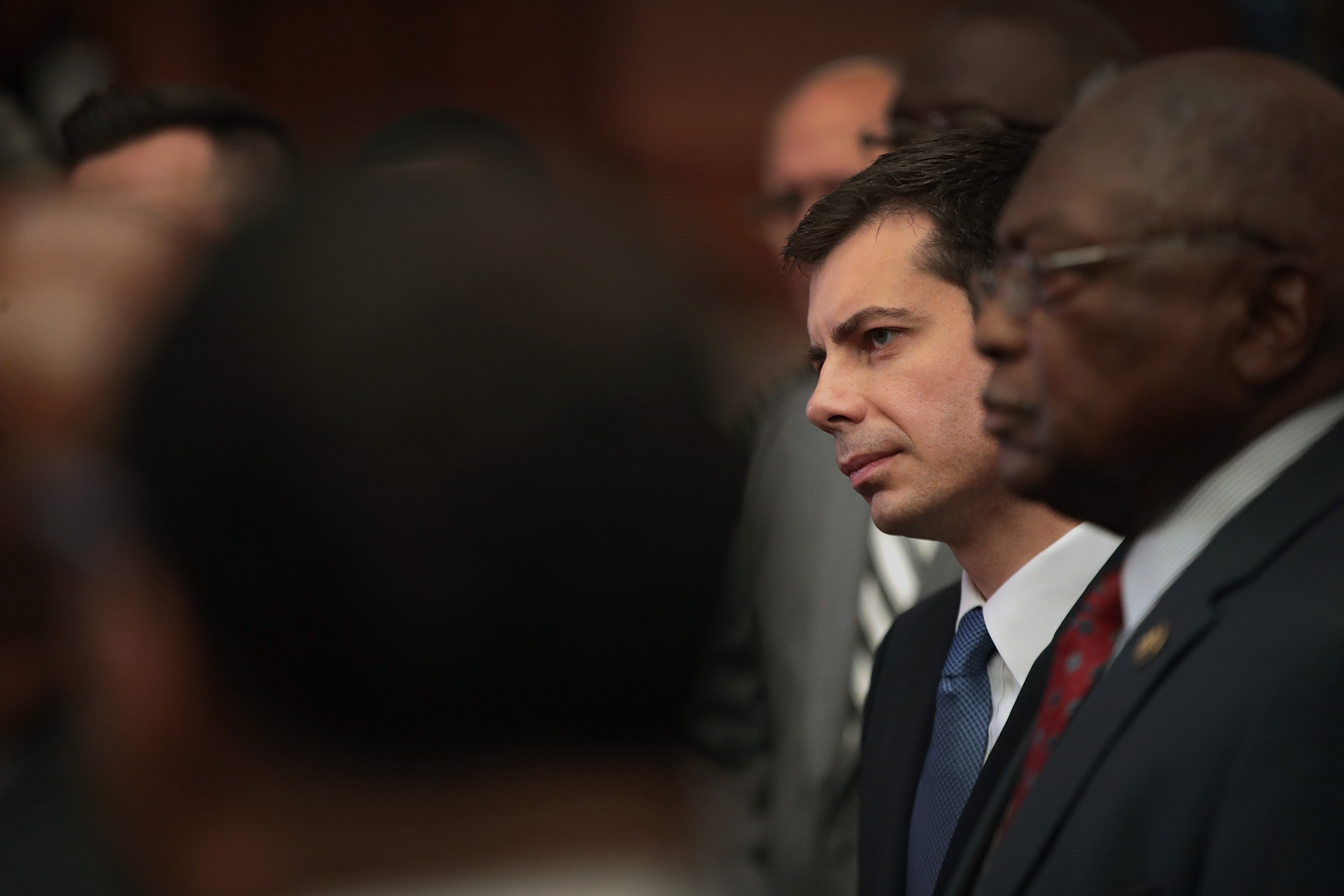
Democratic presidential candidate Pete Buttigieg, a military veteran who served in Afghanistan, proposed to expand national service for civilians, aiming to enlist a network of 1 million Americans by 2026 to combat climate change and care for the elderly, largely in minority and undeserved communities.
“National service can help us to form connections between very different kinds of Americans, as was my experience in the military,” Buttigieg said in a statement released Wednesday, in advance of a town hall meeting in Sioux City, Iowa, where he promised to share additional details. “I served alongside and trusted my life to people who held totally different political views. You shouldn’t have to go to war in order to have that kind of experience, which is why I am proposing a plan to create more opportunities for national service.”
I am proposing A New Call to Service—a plan to dramatically expand service opportunities across the country. Shaping a new generation bonded by the experience of serving will not only deliver good work, but also help repair the social fabric in our nation. https://t.co/Sw2r5VqhZN
— Pete Buttigieg (@PeteButtigieg) July 3, 2019
Buttigieg, the mayor of South Bend, Indiana, promoted his “A New Call to Service” plan in a tweet released Wednesday in advance of a town hall meeting in Sioux City, Iowa, where he promised to share additional details.
According to news reports, Buttigieg’s proposal would immediately increase the number of available national service positions from the current 75,000 to 250,000 opportunities. Additionally, it would target students — notably those in high schools, community colleges, historically black colleges and universities, and vocational schools — as well as young Americans between the ages of 16 and 24 who are unemployed and aren’t enrolled in a school.
The proposal would create granting programs that would design “service ecosystems” to focus on local and regional issues. Participants in the programs would be eligible for student debt forgiveness, hiring preferences, and vocational training.
Potentially, the plan calls for as many 4 million high school graduates to serve in new forms of public service, such as a Climate Corps, Community Health Corps or Intergenerational Service Corps, in addition to expanded versions of the existing AmeriCorps and Peace Corps programs. All would serve under a to-be-created Chief Service Officer reporting to the Domestic Policy Council and the National Security Council.
Buttigieg didn’t offer any specifics about how much the plan would cost or how it would be financed. But the Associated Press estimated the plan would add funding to existing federal programs such as AmeriCorps and cost $20 billion over the next decade.