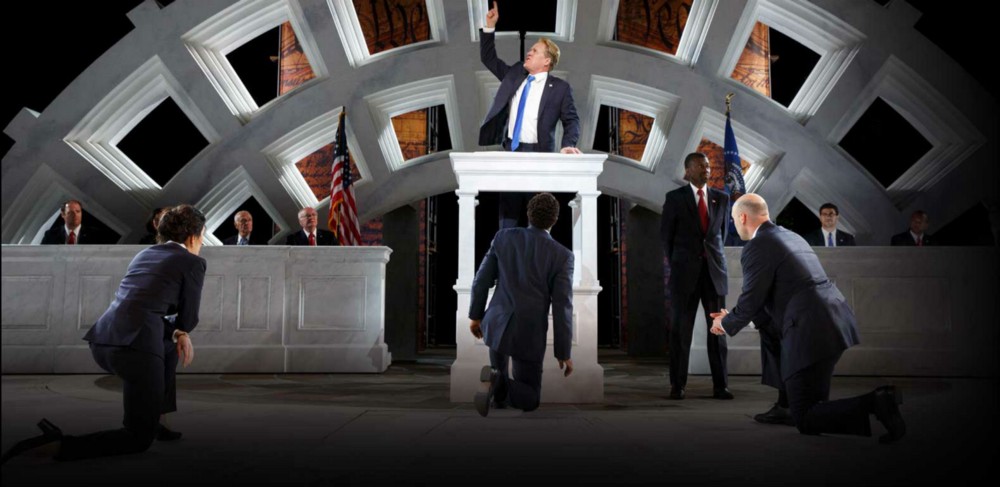
This weekend, Fox News and Donald Trump, Jr. ginned up outrage over a New York City production of Shakespeare’s Julius Caesar that portrays Caesar, who is assassinated in the play, in a way that resembled President Trump. In response, both Delta and Bank of America announced they were abandoning their sponsorship of New York’s Public Theatre because of the portrayal — a rather disturbing display of hypocrisy.
According to Delta’s Twitter replies to various users, the “graphic staging” of the production “crossed the line on the standards of good taste.” But in 2012, Delta had no problem funding a production of Caesar in Minneapolis that portrayed the protagonist as President Obama instead. Given the sponsorship level under which Delta was recognized, the airline donated somewhere between $100,000 and $249,000 to the Guthrie Theater, which then bragged about it in its Corporate Responsibility Report the following year.
The director of that 2012 production openly admitted, “We’re imagining a Julius Caesar that captures the energy and excitement of American politics of the last presidential and mid-term elections.” As Broadway World notes, reviewers had no trouble making the connection that it was meant to resemble Obama, and at least one conservative outlet even ran a review defending the artistic decision.
Bank of America said in a statement distributed at the Tony Awards Sunday night that it does not condone the new production’s interpretation “and its depiction of political violence in a modern context.” In a follow-up public statement, it suggested the portrayal “was intended to provoke and offend.”
We are withdrawing our funding pic.twitter.com/MlaONF82FN
— Bank of America News (@BofA_News) June 12, 2017
Their attempt to claim moral high ground with regards to its giving also rings hollow. Despite its promise to go carbon-neutral by 2020, Bank of America committed to lending $350 million to fund the Dakota Access Pipeline. Activists have called on Bank of America to pull that funding, and held protests in front of Bank of America locations. Several cities have also announced they would divest in protest, but the company has never even made a public comment about the controversial lending — let alone abandon the loan.
Though Delta and Bank of America are the only two companies that have pulled funding, the political outrage is reverberating elsewhere. American Express issued a statement clarifying its funding didn’t actually go to the Caesar production.
A Statement from American Express: pic.twitter.com/Ig0Ju3B2dP
— American Express (@AmericanExpress) June 12, 2017
The National Endowment for the Arts (NEA) also placed a pop-up splash on its website linking to a statement clarifying that no NEA funds were used to support the production.
The modal splash of the NEA's website today. https://t.co/A7vyZ2rCut via @sopandeb pic.twitter.com/PLtqm6S9pM
— southpaw (@nycsouthpaw) June 12, 2017
In response to the decisions by Delta and Bank of America, commenters have emphasized the fact that in the play, Caesar’s assassination is not portrayed as a good thing. Indeed, it backfires for every character that conspired its execution and wipes out democracy entirely. On social media, there is a growing consensus that anyone objecting to the Trump-like portrayal simply hasn’t read the play:
"Julius Caeser" advocates the assasination of Julius Caeser in the way they "Hamilton" advocates the murder of Alexander Hamilton.
— Nick Confessore (@nickconfessore) June 12, 2017
THE ENTIRE GODDAMN PLAY IS ABOUT ASSASSINATION BEING A TOTAL DISASTER!
THE PATH TO RUIN!!!
Read a book for the love of God.
— Christopher Hayes (@chrislhayes) June 12, 2017
The Washington Post’s Alyssa Rosenberg similarly chastised the corporations for making these decisions without seeing the production for themselves. “A production of Julius Caesar that alludes to the Trump administration could easily be a warning about people who respond to populism with violence,” she wrote, “rather than a declaration that Trump is a dictator in the making.”
By caving to superficial outrage, the corporations are undermining the very artistic values they boast about when they make such donations. Rosenberg warns that the 2016 presidential election already “provided an unnerving lesson in what happens when citizens only read news reports that tell them what they want to hear.”
Thank you @Delta and @BankofAmerica. This was the right thing to do… https://t.co/COOfg9QqUq
— Eric Trump (@EricTrump) June 12, 2017
The way the Trump family has fanned the flames of this backlash in many ways resembles the way President Trump has similarly tried to undermine the legitimacy of the press with accusations of “fake news.” These reactions are not actually based on meritorious arguments — just blanket rejections of anything that could possibly be interpreted as critical.
Oskar Eustis, who directs the production, said in a director’s note, “Julius Caesar can be read as a warning parable to those who try to fight for democracy by undemocratic means. To fight the tyrant does not mean imitating him.”
Ironically, the Trump family’s approach of suppressing expressive critique does more to paint Trump as a tyrant than any stage portrayal ever could.