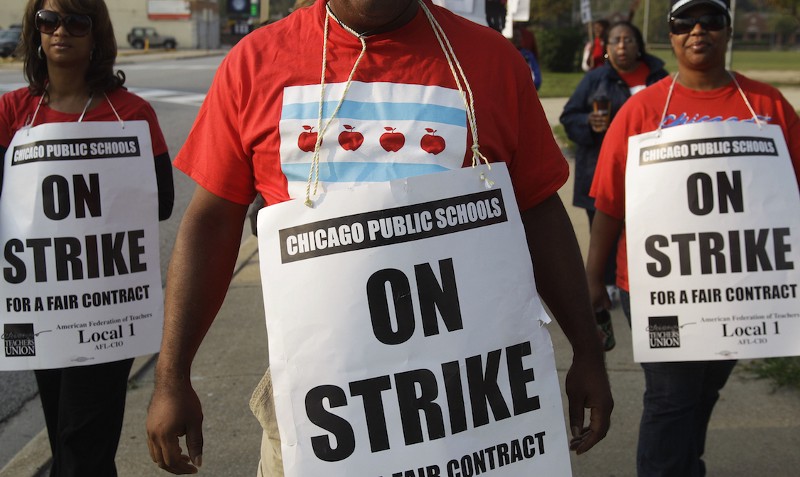
In 2012, Chicago teachers went on strike for the first time in 25 years. And this week, the city narrowly averted another strike by reaching a tentative contract with the Chicago Teachers Union late Monday night. The city addressed teachers’ concerns about pension pickups and class sizes.
What brought the Chicago Teachers Union, Mayor Rahm Emanuel, and Chicago Public Schools this close to a strike again? In fact, many of the same issues teachers went on strike for in 2012 — such as raising pay, protecting pensions, and providing services for students — were never fully resolved.
CPS argued it simply doesn’t have the money and the state won’t provide it. CTU, meanwhile, argued that teachers shouldn’t have to take a pay cut. The union rejected a contract proposal in January and has been without a contract since last June.
A couple weeks ago, 95 percent of the Chicago Teachers Union voted to strike. “This should come as no surprise to the Board, the mayor or parents because educators have been angry about the school-based cuts that have hurt special education students, reduced librarians, counselors, social workers and teachers’ aides, and eliminated thousands of teaching positions,” the CTU stated after the vote.
How the 2012 strike informs a 2016 strike

The last extended teachers’ strike at CPS was in 2012, when teachers walked off the job for seven school days at the start of the school year. Teachers said they wanted the city to maintain the schedule for career advancement, put less emphasis on standardized testing in teacher evaluations, and provide compensation for longer school years.
Emanuel criticized the teachers’ decision to strike, saying, “Don’t take it out on the kids of the city of Chicago if you have a problem with me.” Many Republican politicians, including Wisconsin Congressman and now Speaker of the House Paul Ryan, supported Emanuel at the time. Ryan called teachers a “special interest group” and said “I want our kids to have the skills they need for the jobs of tomorrow and that means put our kids first and put the teachers union behind.”
“Don’t take it out on the kids of the city of Chicago if you have a problem with me.”
Since many families couldn’t afford to look after children or send them to day care services during the day, the city opened libraries, churches, and nonprofits, and some schools to displaced students, a plan that will repeat itself if teachers go on strike again. On Wednesday of last week, the Chicago Board of Education voted to set aside $15 million for a contingency plan in case teachers strike, DNAInfo reported.
The teachers union ended up winning annual raises and negotiated a provision to help laid-off teachers find more job opportunities in Chicago schools but standardized test results would still be part of teachers’ evaluations.
Chicago Public Schools is in financial distress

The city offered a contract proposal that put a cap on private charter schools and gave teachers an 8.75 percent base salary raise over four years. It also allowed teachers to go back to a model where raises are based on experience and educational level in the last three years of the deal. One of the major problems, however, is that the deal would stop the city from continuing to pay for 7 percentage points of teachers’ 9 percent pension contributions.
Some of the union proposals included providing more school counselors and social workers, as well as restore cuts to school libraries. CTU President Karen Lewis has also stated that any contract proposal that ends in a pay cut for teachers will be turned down, and that losing part of the pension contribution counted as a pay cut.
In the midst of union negotiations, Chicago Public Schools is in serious financial trouble. The Chicago Public School board approved a $5.4 billion budget in August. It also authorized a line of credit of $1.5 billion. The budget is based on the proposal rejected by the union in January. Chicago Public School CEO Forrest Claypool said if the state doesn’t provide the funding, there will have to be more cuts to classrooms.
Illinois lawmakers approved a property tax levy in June that should provide $250 million for Chicago teachers’ pension fund but the money won’t actually come in until July or August 2017, the Chicago Tribune reported. On Monday, CPS announced more layoffs, which include 140 teachers and 109 support staff, since there is falling enrollment at many Chicago schools and schools receive funding per pupil. In August, CPS laid off more than 1,000 teachers and members of support staff.
The Illinois State Board of Education’s commission of appointed policy leaders and lawmakers is currently reviewing the state funding formula. Last year, the Education Trust arrived at the conclusion that Illinois had the least fair school funding system in the country. Republican lawmakers have endorsed the idea of a state takeover of the school system but Democrats, who hold a majority in both chambers of the state legislature, and Mayor Rahm Emanuel, have opposed it.
What happens in Chicago matters on a national level
Chicago’s larger political environment certainly plays a role in how the teachers union operates and how the union is perceived. Issues of economic inequality and racial prejudice seep into debates about education funding. Chicago officials released the video of the police shooting of Laquan McDonald a year after his death, prompting questions about what city officials, including the mayor’s office, were trying to hide and whether the timing of the video’s release was tied to Emanuel’s re-election efforts.
The discussion of why the police denied FOIA requests and why it took Emanuel so long to hold police accountable for the shooting and their handling of its aftermath affected the mayor’s political influence after his re-election. Following the release of the video, Emanuel visited a school, where students chanted “16 shots” at him.
In this larger backdrop of a city grappling with how to handle issues of police violence and racial bias, a group of parents and community activists held a hunger strike over the closure of Dyett High School. The school was slated to close in the 2015–2016 school year. Hunger strikers called attention to the school’s closure as an example of a black community losing its neighborhood school.
The closure became an example of the city’s alleged racial bias in deciding which schools to close, a debate that is bigger than Dyett, since Chicago residents are still angry about the announcement of 49 school closures in 2013. The strikers went weeks without solid food. Although they didn’t get exactly the deal they wanted for the school, they were able to keep the school open.

Both of these events, however, are examples of how Chicago-specific issues over racial bias and economic inequality become part of a larger national debate over equity in education. Student activism is thriving in high schools, where students are raising issues of racial bias in Eurocentric curricula and in what they call “forced assimiliation” through school uniforms.
During the Dyett hunger strike, national organizations, such as the National Education Association and the American Federation of Teachers, joined strikers in demanding that the school stay open. The AFT and NEA are also part of the coalition Alliance to Reclaim Our Schools, which brings issues of racial justice directly into its platform. AROS coordinated walk-ins, which mainly focused on providing more funding for public schools, all over the country in over 30 cities in February. In its national walk-in on Thursday, the number of cities participating grew to over 200.
In the context of all of this education activism and a discussion on racial bias that has reached the presidential debates, a Chicago teachers strike would have far more activist muscle and political support now than it did in 2012, which may be the reason they reached a deal this time.