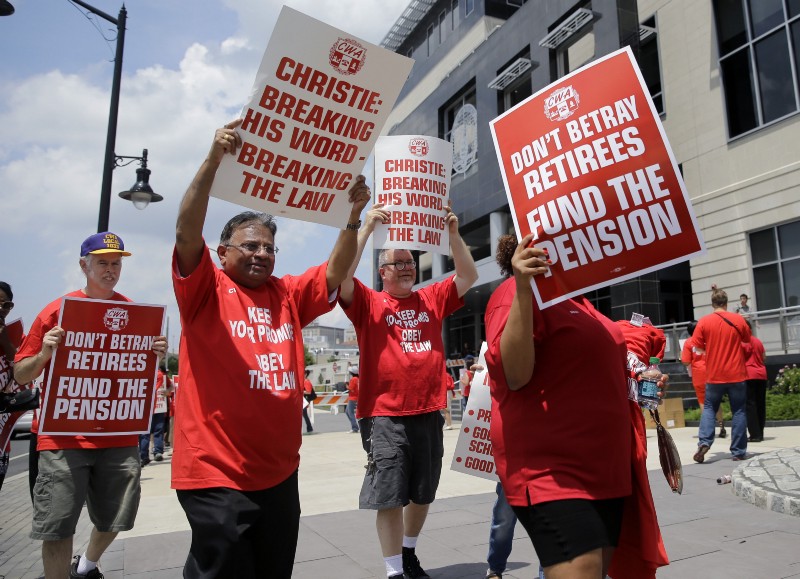
On one of his many recent tours of Iowa this week, New Jersey Governor and likely presidential candidate Chris Christie (R) spoke about his efforts to reform the state’s now troubled pension system — a talking point that helped Wisconsin Gov. Scott Walker (R) win support of conservative Iowans last month.
Christie emphasized how he has dramatically cut his administration’s spending on public employees and has increased employee contributions, among other “common sense steps,” according to the Des Moines Register. “Not only in my state but in 40 other states in this country, the pension and public employee health-benefit systems are going to be the thing that eats states alive if we don’t get them under control,” he said at a fundraiser in Des Moines.
But Christie’s attempts to shrink the state’s $80 billion public employee retirement system have actually been a “mess,” as the Wall Street Journal called his efforts. Last month, a state bond sale disclosure reported that the state’s unfunded liability had increased by almost $30 billion since 2011 and projected that six of New Jersey’s seven pension funds will go broke by 2027. The governor has also been the target of a lawsuit brought by three New Jersey pension funds for cutting state contributions.
To put it lightly, Christie’s plan to save billions of dollars from the state budget has not gone as smoothly as he had hoped. Although he first prioritized pension reform and made cuts in 2011, early in his first term, to ensure the “long-term solvency of the pension and benefit systems,” he resorted to cutting pension funding by an additional $900 million last year to close a budget gap. This year’s budget includes an even greater cut of $1.5 billion.
Late last year, state courts heard arguments over whether or not Christie had the power to make the drastic cut to the state’s contribution for this year. Ironically, the trustees filing the suit claim the cuts were made despite a law Christie signed during his first term in which the state promised to increase payments to the fund and which said the governor “must make the annual required contribution on a timely basis.” But lawyers for the Christie administration are now arguing that the Christie-supported law is “void and unenforceable.”
As Christie continues to make reforms to the state’s pension funds which hurt employees — including increasing their contributions and raising the penalties for early retirement — lawmakers in New Jersey’s Democrat-controlled legislature passed a tax increase on corporations and wealthy individuals in order to help employees and increase the government’s contribution to the retirement accounts. But Christie vetoed the bill which would have provided $2.25 billion to the pension fund, slashing the amount to $681 million.
“Current economic reality compels this reduction,” Christie wrote in his line-item veto message sent to legislators, according to reports.
Then in August, Christie attempted to rescue his image and formed a bipartisan committee to look into the state’s struggling system. But Democratic lawmakers were reluctant to cooperate. “The governor broke his promise to fund the pension system,” state Senate President Stephen Sweeney (D) said in a statement. “The fact remains that the problems will be fixed if he simply keeps his word and provides the appropriate funding. Until the governor decides to keep that commitment, there will be no further discussion between us on pensions.”
Though Christie once hyped his ability to initiate pension reform in a Democratic state –- a move he thought would win him national support for a presidential campaign he hopes to launch this year — the governor’s recent reluctance to raise taxes or work with Democratic lawmakers to pay for the dramatic cuts is not likely to draw him praise as he tours the country in advance of his campaign. According to reports from the event in Iowa Monday, “Christie’s audience was relatively small and largely silent.”