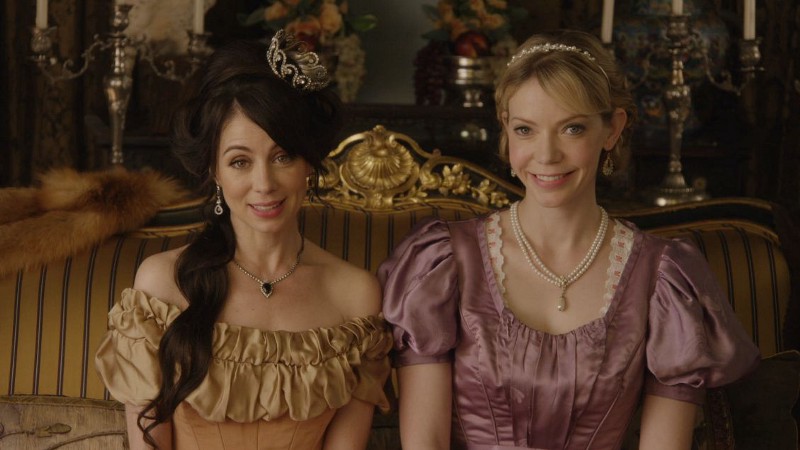
In Comedy Central’s breakout new show, Another Period, it’s 1902. We’re on Newport, Rhode Island, where 90 percent of our still-kind-of-new nation’s wealth is concentrated. The show’s co-creators are also its executive producers, writers and stars. Natasha Leggero is Lillian Abigail Hitler Schmemmerhorn-Fish, who should have been married at age eleven — a woman’s sexual peak, as she explains — but was abandoned at the altar, and now languishes around her mansion sucking the cream out from cream puffs and throwing the empty shells at servants. Riki Lindhome is Beatrice Tiffani Amber Thiessen Downsy, Lillian’s space-cadet kid sister, who is madly in love (…with her twin brother, Frederick).
The duo are part of the Bellacourt family in a sort of Real Housewives of Downton Abbey structure: Vacuous and vain, obsessed with wealth and beauty, eager to be famous for just about anything. They regularly forget about their many, many children, whom they refer to as “sons” and “non-sons.” Why bother thinking about pesky things like parenting when they have a fleet of servants — played by, among others, Michael Ian Black and Mad Men’s Christina Hendricks — to come running at the ring of the custard bell, make quadruple-berry birthday cake, administer morphine, pour cocaine wine, and, when their masters prefer not to see them, disappear into the furniture?
Another Period is Gilded Age comic gold, in no small part because the serious themes running underneath it all — income inequality, homophobia, the struggle for women’s rights — could be the center of a period drama about 2015. The series just got renewed for a second season; executive producer-writer-director) Jeremy Konner (part of the team that brought you Drunk History) had no spoilers to share, because writing hasn’t even begun. But he could talk about the ridiculousness of that turn of the century Newport style, how money does terrible things to people, and why being in high society — or, as the case may be, trying to elbow your way into high society — was a full-time job.
What’s the origin story of Another Period? The early pitch was more of a reality show, but Comedy Central steered you in another direction?
The original moment was that Natasha was on a mansion tour in Newport, as one is. Which I just did a couple weeks ago! Natasha and Riki have been trying to get me to go on one of these tours for the past year, and I finally went three weeks ago with them. And it was the greatest, craziest place on earth. And I totally understood how this would come about. I’d already done all my research, but just to stand there and feel it, it’s an experience. These people are just the most decadent, disgustingly wealthy humans who’ve ever lived. So Natasha came to Riki and they created this concept, and wrote a little short, and we went out and filmed the short. And then shopped it around for a while, and eventually Comedy Central said yes.
But when we originally sold it, it was more of a reality show than it is now. Although I still think it’s a reality show. There was a scene in our original pilot that we wanted to shoot where someone walks by a mirror and for a second you glimpse, in the mirror, a man behind a giant wooden box cranking film. So it was like, we actually were going to try to explain it. And Comedy Central said, “No need to explain it, just be funny. Modern Family doesn’t explain it.”
Talk to me about this world of 1902 Rhode Island, and how filthy rich everyone was. What was this culture that you’re working with like? How did it get that way?
You go there to Newport. At the time, 90 percent of the country’s wealth was all concentrated in Newport. All the Astors, Rockefellers, Carnegies, Vanderbilts, everyone had their “summer cottages” in Newport, and they were obscenely large. These people wanted to live like British aristocracy. They had seen Downton Abbey — the real version! Not even the one that aired on BBC. The original. They knew the British aristocracy and they wanted to be part of it, and this was their way of being part of it, even though most of them sort of would be considered “new money.” And one of the things that’s very funny is in that world is, the difference between old money and new money is often just one or two generations. It’s not like in England, when you talk about old money and it’s thousands of years old. These people, literally, the Astors are old money because John Jacob Astor became a successful fur trapper about 50 years before Vanderbilt started his railroad empire. That’s the gist of old money vs. new money.
When people talk about the state of culture and celebrity today, there’s always this nostalgic gleam to it: That people are so trashy, so vain, and so much worse than they’ve ever been. That the Kardashians are worse than any celebrities we’ve ever had. But what this tells me, and what Another Period gets at, is that this is nothing new.
People have been terrible shitheads forever. And money does terrible things to humans. And when you come into this much wealth, you’re likely to treat people below you terribly. And the jealousy of what’s above you starts becoming an obsession.
Is the most absurd material in the show from reality? Or do you make up the most extreme stuff?
These people are just the most decadent, disgustingly wealthy humans who’ve ever lived.
A lot of our favorite stuff comes from reality. A lot of our favorite things are just things that really happened to these real people. Thomas’ character is based loosely on Ward McAllister, who was this guy who was in charge of Newport society, even though he wasn’t really a part of Newport society. But he was Mrs. Astor’s right hand man. And Mamie Fish threw this dog dinner party, which, in real life, was much crazier than our dog dinner party. She had a real one, with dozens and dozens and dozens of dogs. It was on the front page of the newspaper and it caused this national uproar, because people couldn’t believe the wealth that people had and the kind of spending they were doing while the rest of the nation suffered. I think one of the main stories was someone walking out at the end of the night with this sick dachshund. This dog ate itself sick, and there’s, like, starving people all over the country.
When you’re writing the show, are you deliberately trying to make these connections between that wealth disparity and that “we are the 99 percent” unrest that’s going on today? Do you lead with those parallels?
We don’t necessarily seek it out all the time, but it is a never-ending well of hilarious stupidity. We live in a very similar time period, because back then, everybody had figured out how to illegally exploit workers and Chinese laborers and there was no income tax. And that’s why these people rose to such prominence. If you can build the railroads and use, basically, slave labor, there’s a lot more profit to be had. And now, we live in a fully global economy where we can do the exact same thing, just in different countries. We pretend like it’s not the same thing but it’s exactly the same thing.
Is that depressing to you? Do you think that, fundamentally, nothing has changed?
I think we’ve progressed in a lot of ways. The fact that yesterday was celebrating the anniversary of women getting the right to vote, which was just 100 years ago, and for a woman of color that came even more recently. So yeah, a lot of things bum me out about it. It feels like we’re back to it, and now there’s just a lot more people making a lot more money and a lot more people working for terrible wages, or no wages at all, under really terrible, harsh conditions. It’s not like it didn’t exist thousands and thousands of years ago, it has, but it’s sad to see that we think of ourselves as so much more evolved, when I’m not sure we’re much more evolved in many ways. At least when it comes to wealth.
That seems true in some of the social issues you address, too. There’s a great episode where Freud tries to “cure” someone’s homosexuality — a character who isn’t gay, actually, but is having sex with his sister. Which according to Freud is totally fine! Way better than homosexuality, apparently. But there are still people and organizations that believe in “gay therapy.”
The fact that it still exists is so depressing. But that whole storyline about curing homosexuality came about with a joke that we didn’t end up using, and I’m really sad we didn’t use it, it was that people used to diagnose homosexuality based on the shape of nipples. And if you had a certain shape nipple, that meant that you were a homosexual, and that was just scientific fact. Everybody knew that. And that’s where we originally got so inspired to write that. But many things have not changed.
What are the rules of the Another Period universe? Do you have strict guidelines about what people can and can’t say or do, to keep things period-appropriate?
People never say “like.” We have always stayed away from any kind of really modern language. Maybe something will sneak in once in a while, but it’s not intentional, it’s probably an improvised line, and if it’s funny enough, we’ll stick with it. But we don’t really want to break that facade down too much. We like the concept of this as: It does take place back then. And then I think the absurdity and the surreality that exists on the show is something that we love, but I don’t think it breaks our own rules. Our show exists in 1902, but also as a parody of both reality shows and nighttime soaps, like Downton Abbey. But also Mad Men and even Game of Thrones, we all watch one-hour dramas and we love them and we also enjoy making fun of them.
Shows like Downton and Mad Men are famously obsessive about period accuracy, and there is some of that in Another Period, too, that the clothes and language be right. Where does that impulse come from, to value that so much?
Definitely, a lot of that impulse comes from production designers and wardrobe designers who are trying to get Emmys. Which this year, our Drunk History wardrobe person did win an Emmy! When we talk to them, they’re often doing all those things without us even realizing. That’s the thing: You get people who are the best at their jobs, and that’s an aspect of being the best at your job, if you’re a costume designer or a props master, and you’re working on something that takes place in 1902, you want that to be perfect. And they want that to be perfect, too, even though we’re the ones fighting them saying, “It’s a silly comedy and no one will care.” I want to keep things accurate 99 percent of the time. There are instances where I think the joke is more important than whether or not someone is in a nighttime dress or an evening dress or a lunch dress, and that kind of accuracy, if that’s going to take another hour of dressing and that means we lose 12 jokes, I would push for jokes over accuracy. But we also only shoot an episode in a few days, and if you have the kind of money and time someone like Scorsese does and you can shoot Boardwalk Empire one episode over many weeks, it’s different.
It’s so funny to think of these people as having five wardrobe changes a day. How did they have time for anything else?
That’s what they did. Being part of society was a full-time job, for these people. Dressing up, changing your wardrobe five times a day, was commonplace, and you had to do it if you didn’t want to look like ass.
And yet in some ways, as Another Period shows, it was such a gross time to be alive. Just in terms of hygiene and bathrooms and general standards of cleanliness. It was sort of a disgusting era, even for the uber-rich.
It’s sad to see that we think of ourselves as so much more evolved, when I’m not sure we’re much more evolved in many ways. At least when it comes to wealth.
Oh, yeah. We visited one of the mansions that was, like, the Elms, and that guy — I think it was the Elms — made all his money in coal. So he had the first sort of really electrified house, because it was all a big show. And you go into the bowels of the house, and it’s like a coal mine. There’s literally carts that are coming through underground tunnels that are coal mine carts that are delivered directly into the basement, where people are shoveling coal 24 hours a day. It must have been a total nightmare down there. They never wanted to see any of the servants.
But one of the things I like about our show that we get to play around with is, there are people like the Vanderbilts and the Astors, and then there is our family, and they not the same. They want to fit in and they want to be there, but even the social codes and social mores that high society has established do not necessarily affect our family. They’re not rich enough, they’re not classy enough, they’re not in society enough. They’re just climbing and climbing and climbing. They’re not even Kardashians. They’re trying to be the Kardashians.
Your theme song is by Snoop Dogg. How did that happen?
That was entirely through Natasha doing the Justin Bieber roast. Backstage, everyone was smoking weed with Snoop — of course, because that’s what you do when you’re with Snoop — and she said, we need someone to do our theme song, and he agreed! And he went in and met with Natasha and our sound dude and he laid it down in just a few minutes. He improvised a little bit. It’s a little perfect thing. And then he walked out and it took us about six months to track him down to get him to sign the rights.
I read this interview with Natasha where she talked about how these people lived like rap stars, which I’d never thought about before. But it makes Snoop an even more fitting choice.
It’s true. They’re both people who come into incredible wealth, all at once. And then spend it all at once.