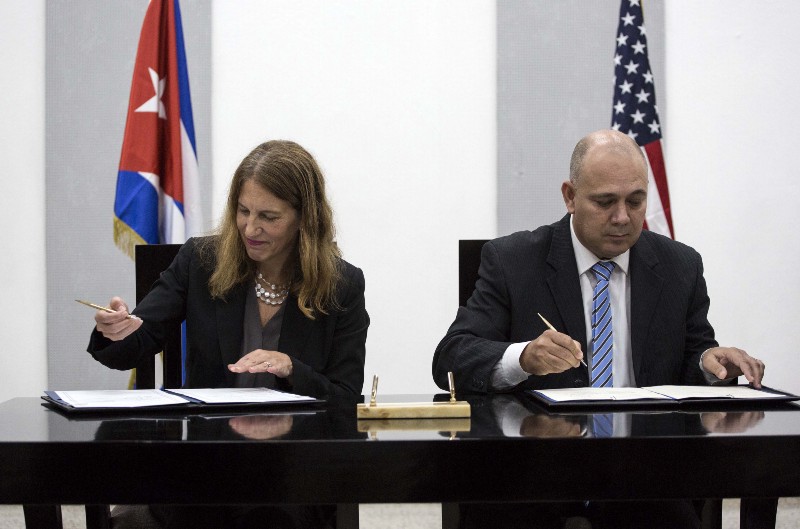
The white star, red triangle, and blue and white stripes of the Cuban flag ascending the flagpole at the reopened embassy in Washington, D.C. earlier this year was a powerful symbol. For Americans, it signaled a break in more than 55 years of a frozen relationship with Cuba. But the implications of the renewed relations has shown to be infinitely more significant for Cubans, as the country is already going under massive economic and cultural shifts, according to experts.
“I’ve witnessed more change in Cuba within the past two years than in my prior two decades traveling there,” Travel writer and Cuba expert Christopher P. Baker told ThinkProgress over email.
Cuba opened an embassy in Washington in July of this year after more than 50 years of suspended relations. About a month ago, President Obama named the first U.S. ambassador to Cuba in more than five decades, and Obama became the first U.S. president to visit Cuba since Calvin Coolidge 88 years ago.
Cuba is still under a trade embargo enacted by the United States though — which can only be lifted by Congress. This embargo has seen a dearth of certain modern technologies enter the Communist country. This lack of modernization on some fronts has left an aura of exoticism around the Caribbean nation that spurs many Americans to try and visit before it becomes a popular tourist destination for young backpackers.
But that development has already began on many fronts. American visits in 2015 rose 77 percent. That doesn’t include visits by hundreds of thousands of Cuban Americans. Baker said quaint, colonial-era villages like Trinidad and Vinales are now “rapidly being subsumed by the influence of mass tourism.”
Real estate is booming with some homes costing upward of one million dollars. Cuban President Raul Castro let Cuban homeowners buy and sell property last year, and while Americans are still not allowed to buy property, many are finding loopholes.
Travel to Cuba has increased to such a level that most luxury hotels are fully booked, and there is a stress on local infrastructure.
“From offloading at the airport to restaurant availability, infrastructure is maxed out,” Collin Laverty, founder of Cuba Educational Travel, a group that organizes legally permitted travel tours for Americans, told Reuters.
With no rooms to be found, some younger tourists are even sleeping in parks. To fill the demand, Airbnb has stepped in.
“AirBnB just passed a milestone with 10,000 listings in Cuba, which has been it’s fastest growing market to date,” Baker told ThinkProgress.
With more money circulating in Cuba, the locals have started to close the gap between them and the rest of the world in regard to technology. Laptops and mobile phones are now commonplace. But with a struggling economy, many problems have arisen.
“In combination with U.S. travelers propensity to tip big, and to buy more than Europeans and other travelers, the result has been noticeable inflation,” Baker said. “Taxi prices are no longer negotiable and have almost doubled (taxi drivers are now self-employed and lease their vehicles from the state). And the shortage of hotel space has fueled a greater demand for private room rentals, so prices there have increased also.”
A further issue is the racial dimension surrounding the new monetary influx. Shortly after the Cuban Revolution, Fidel Castro declared racism solved in Cuba after they ended institutionalized segregation and passed laws against racial exclusion. Nonetheless, while Cuba is around 66 percent black or mixed race, the public leadership is 70 percent white, according to the New York Times.
Castro’s economic openings have favored those in power and with privilege — the majority of which are white. Black Cubans don’t have the same access to financial capital as white Cubans. Additionally, a lot of the money flowing into the country comes from the diaspora which is also predominately white.
“The vast majority of that money (especially family remittances) is flowing to white Cubans,” Baker said. “Society is again being fractured economically along ethnic lines, with blacks gaining comparatively little. There’s a reason President Obama ate at Paladar San Cristobal — it’s the only noteworthy black-owned private restaurant in Havana.”