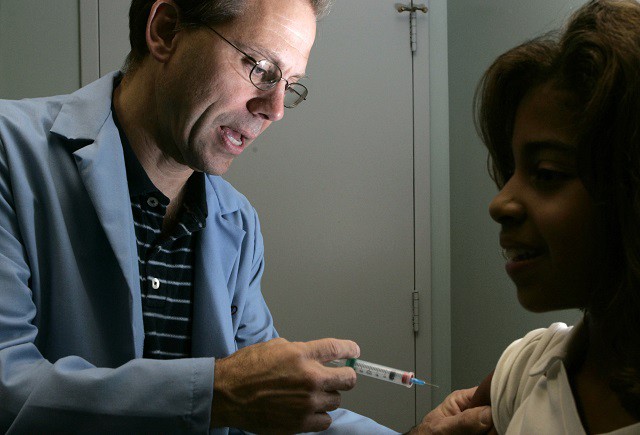
The international charity Doctors Without Borders is criticizing two major pharmaceutical companies for keeping the cost of recommended vaccines too high for low-income countries to afford, saying it’s Big Pharma’s responsibility to lower their prices in order to save lives.
GlaxoSmithKline and Pfizer are currently the sole manufacturers of the pneumococcal vaccine, which protects young children against sepsis, bacterial meningitis, and pneumonia. Those pneumococcal diseases kill up to 1.6 million people each year, most of whom are children under the age of five, according to estimates from the World Health Organization.
In a new report, Doctors Without Borders urges the Big Pharma giants to help prevent some of those deaths by dropping the price of their vaccine to $5 in developing nations. The charity group notes that the total cost of vaccinating a child in the poorest countries — which involves protecting them against 12 major diseases — has climbed 68 times higher than the cost in 2001. That’s due in large part to the pneumococcal vaccine, which currently accounts for 45 percent of the price tag.
In countries where the cost of the pneumococcal vaccine has been disclosed, there are huge variations. As the Guardian reports, hospitals in Tunisia pay about $67 for the vaccine, while it costs about $58 in France.
“We have an irrational situation where some developing countries like Morocco and Tunisia are paying more for the pneumococcal vaccine than France does,” Kate Elder, the group’s Vaccines Policy Advisor, said in a statement. “Because of the astronomical cost of new vaccines, many governments are facing tough choices about which deadly diseases they can afford to protect their children against.”
Officials from GlaxoSmithKline have responded to the criticism by reiterating that this vaccine is particularly “complex,” saying the company is already struggling to cover its manufacturing costs with the current prices it charges. Drug makers often say that their medication’s price tags need to remain high to cover the cost of bringing new drugs to the market, which can take years.
Nearly 17,000 children around the world die every day from diseases that could be prevented, partly because of uneven access to vaccines. Often, that’s because Western drug makers develop their products with an eye on a market that can afford to pay more. Western companies charge up to twice as much for their vaccines than Indian and Indonesian companies do, for instance. Plus, according to a previous report from Doctors Without Borders, most drug companies devote just a small fraction of their budgets to developing treatments for diseases that disproportionately afflict people in poor countries.
Groups like Doctors Without Borders advocate for more transparency about vaccine prices around the world, which they hope will ultimately help drum up competition and drive down costs.