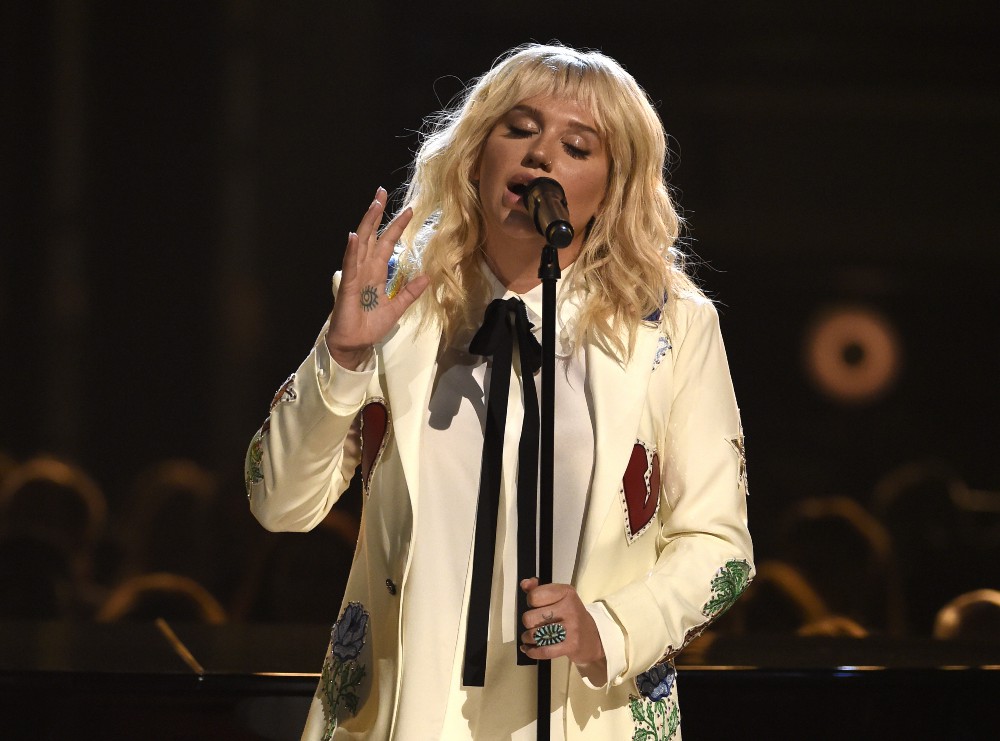
Kesha wrote the song “Rainbow” on a toy keyboard in rehab. It reportedly has a “big, sweeping” Beach Boys style, lyrics thick with hope: “I found a rainbow, rainbow, baby. Trust me, I know life is scary, but just put those colors on, girl, and come and paint the world with me tonight.”
That’s how the New York Times Magazine describes it, anyway, but the rest of us may never know, because Kesha Rose Sebert is still enmeshed in a years-long legal battle with her producer who, she alleges, abused and raped her. Since 2014, Sebert has been struggling to get out of her recording contract with Lukasz “Dr. Luke” Gottwald, Gottwald’s Kemosabe Records, and Sony Music Entertainment. The courts have not been kind to her; then again, neither was her contract.
Sebert has chosen not to pursue criminal action against Gottwald (this does not make her unusual among sexual assault survivors); she’s taken Gottwald to civil court, where he, in turn, countersued her and her mother for defamation. Without a criminal case against him, Gottwald is, technically, not in breach of contract, and neither is Kemosabe. “There’s not really a mechanism, in contract law, for her to address what she’s trying to do,” Deborah Wagnon, attorney and associate professor specializing in recording industry legal issues in the College of Media and Entertainment at Middle Tennessee State University, told ThinkProgress in February.
So Sebert finds herself in a torment that matches her sparkly aesthetic: She’s like the Little Mermaid, with her voice stuck in a shell. She wants, desperately, to share her music with her fans and the world; she is, at present, incapable of doing so. She has produced 22 songs at her own expense, hoping to essentially record her way out of her recording contract. (In the meantime, she’s continuing to pursue her appeal in New York; she dropped her case in California, where she originally filed her claims but her case had been on hold for a year, in August.)

In addition to maintaining that all of Sebert’s allegations are false, Gottwald has said the only person standing in between Sebert and a new album is Sebert. And on Wednesday night, Gottwald’s lawyers responded to the Times profile:
The reality is that for well over two years, Kesha chose — and it was entirely her choice — not to provide her label with any music.
Kesha was always free to move forward with her music, and an album could have been released long ago had she done so.
She exiled herself.
It was not until months after the denial of her injunction motion — for the first time in June and July 2016 — that Kesha started to provide the label with music.
She provided 22 recordings created without any label consultation which were not in compliance with her contract, were in various stages of development, and which Kesha’s own team acknowledged needed work. Then, and for the last several months, the label has been in discussions with Kesha and her team to choose the best music, create additional music, and work on the tracks created.
One of Sebert’s many legal battles centered around her request for a preliminary injunction. She wanted to be assured that, if she recorded music outside of the confines of her Sony contract while her case played out in court, she would be protected from legal action by Gottwald. She lost that fight, and Justice Shirley Kornreich’s ruling — “You’re asking the court to decimate a contract that was heavily negotiated and typical for the industry. My instinct is to do the commercially reasonable thing” — sparked horror among Sebert’s supporters. #FreeKesha flooded Twitter, even as Gottwald’s lawyer released a statement claiming that “Kesha is already ‘free’ to record and release music without working with Dr. Luke as a producer if she doesn’t want to. Any claim that she isn’t ‘free’ is a myth.”

Sebert claims that, upon her arrival in Los Angeles in 2005, Gottwald “sexually, physically, and verbally” abused her for a decade. That first year, she says, Gottwald gave her what he called “sober pills” but were, in fact, GHB — colloquially known as the date rape drug — and, after drugging her, raped her. Three years later, Gottwald allegedly made Sebert snort illicit substances before taking a flight together and, while the plane was in the air, “continually forced himself on her.” In her lawsuit, she details relentless, degrading emotional abuse by Gottwald and says he threatened to end her career and hurt her family. She claims that his abuse, which included calling her a “fat fucking refrigerator,” contributed to her development of an eating disorder, which led to her treatment at a rehab facility.
As I reported earlier this year, Sony representatives promised that Sebert could record without any involvement from Gottwald. But Sebert is still on Gottwald’s label, which means any work she produces will ultimately benefit the man she says is her rapist. Even if Sony would, or could, allow Sebert to remain on Sony but remove her from Kemosabe, Sebert alleges that Gottwald’s “proclivity for abusive conduct was open and obvious” to Sony execs, but was ignored and/or facilitated by top brass at the label. Staying at Sony, then, means working for and with the very same people who enabled Gottwald’s abuse. (In her lawsuit, Sebert claims that Sony “provided Dr. Luke with unfettered and unsupervised access to vulnerable female artists beginning their careers, and who would be totally dependent upon Dr. Luke for success.”)
And Sony has pointed out, more than once, that the only person with the power to terminate Gottwald’s contract with Sebert is Gottwald. As an attorney for Sony told the New York Times, “Sony is not in a position to terminate the contractual relationship between Luke and Kesha.” Sebert’s deal is through Gottwald’s production company, the atrociously-named Kasz Money Inc. That is the deal through which she is signed to Kemosabe, a Sony imprint. “Sony is doing everything it can to support the artist in these circumstances, but is legally unable to terminate the contract to which it is not a party.”
Sebert and Gottwald could settle, a move that would probably force Sebert to buy her way out of her contract. Which means, depending on your point of view, in order to get rid of Gottwald, Sebert would have to pay her alleged rapist for raping her.
Sebert plans to tour next summer. In July, she announced that she will be performing “songs you’ve never heard me play before, and I may never play again.”