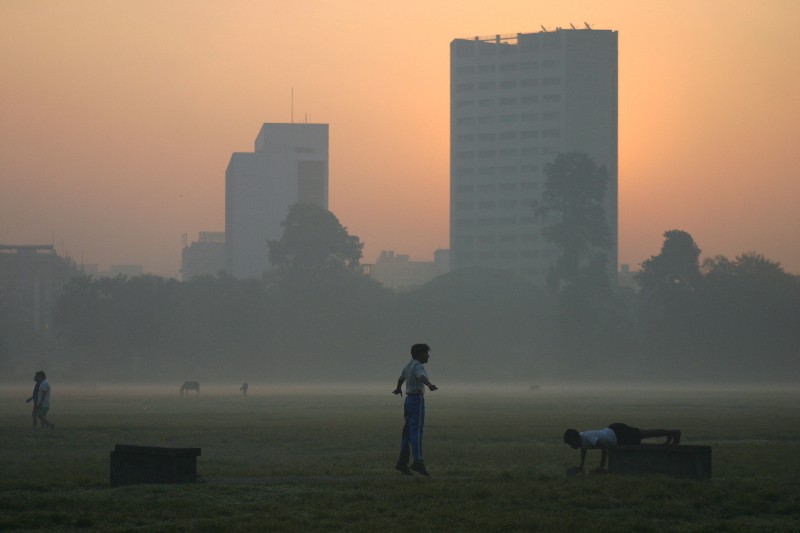
Most urban lungs around the world are breathing harmful air, according to a new World Health Organization (WHO) report.
More than 80 percent of people living in urban areas that monitor air pollution breathe air that exceeds WHO air quality limits, according to the report, which was released Thursday. The report, which evaluated a database encompassing 3,000 cities in 103 countries, also found global urban air pollution levels increased by 8 percent from 2008 to 2013, despite improvements in some regions.
“Urban air pollution continues to rise at an alarming rate, wreaking havoc on human health,” Maria Neira, director of WHO’s department of public health, environmental and social determinants of health, said in a statement. The agency said ambient air pollution — composed of high concentrations of small and fine particulate matter that includes pollutants such as sulfate, nitrates, and black carbon — causes more than 3 million premature deaths worldwide every year.
Most of this harmful air is found in developing countries in Southeast Asia and what WHO calls the Eastern Mediterranean — a region that includes the Middle East as well as some North African countries — followed by low-income cities in the Western Pacific, an area that includes 28 countries and some 1.7 billion people. Air pollution was better off in developed countries’ cities like New York and London.
India has 16 of the world’s 30 most polluted cities, but its capital, New Delhi, is no longer the most polluted city in the world, according to the report. That ranking now belongs to Onitsha, a fast-growing port and transit city in southeastern Nigeria, the Guardian reports. In the United States, the most polluted city is Visalia, situated in California’s agricultural San Joaquin Valley.
Urban air pollution has been front and center in recent months as studies from multiple agencies have quantified how many people are dying over unhealthy air. In February, for instance, the Global Burden of Diseases, Injuries, and Risk Factors Study — the most comprehensive international effort to measure epidemiological trends worldwide — found that about 5.5 million people prematurely died in 2013 because of indoor and outdoor air pollution. About 55 million people die each year, which means that air pollution is responsible for about 10 percent of that year’s total.
Megacities — cities with an estimated population of more than 10 million — like New Delhi, Paris, Beijing, and Mexico City, have in recent times experienced pollution levels that have forced them to take emergency measures. Just last month New Delhi’s Supreme Court extended a ban on registration of large diesel vehicles that was set to expire, the Indian Express reported.
That same month Mexico City instituted an emergency car driving ban that took all privately-owned cars off the streets one day per week in addition to one Saturday per month. That measure is set to expire in June.
While emitting greenhouse gases that exacerbate climate change, motor vehicles’ contribution to urban air pollution worldwide varies anywhere between 25 and 75 percent, depending on the pollutant and the location, according to the United Nations. As car driving restrictions multiply, plans to do more to combat pollution are proliferating, too. Madrid has banned traffic from many city streets and has expanded car-free zones. And Paris’ Champs-Élysées will be car-free every first Sunday of the month.
In London, the second most polluted city in the United Kingdom, a plan was introduced Friday to charge drivers of the most polluting vehicles to pay more to enter central London, Reuters reports.
This comes as experts in Mexico City are considering a pollution tax for vehicles, and charging cars for driving into parts of the city’s downtown. And then there are those who want cars to be fossil fuel free, like the Netherlands, which is considering a motion to ban the sales of non-electric cars in the country by 2025.