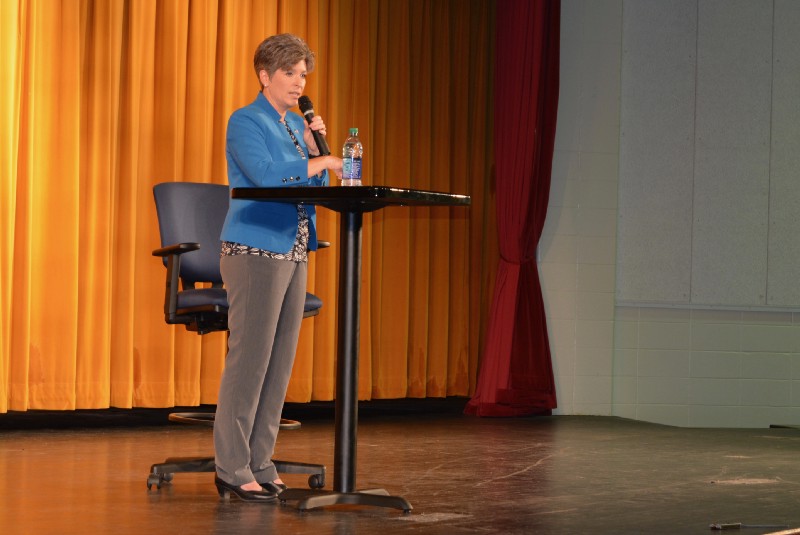
HARLAN, IOWA — In a different time, an 8 a.m. town hall in a small southwest Iowa town surrounded by dozens of miles of farmland would have been a sleepy affair. Not anymore.
Roughly 200 people attended the hour-long event Monday morning where Sen. Joni Ernst (R-IA) — one of three Republican senators to hold town halls during the July 4 recess — took dozens of questions, almost exclusively about the GOP’s plan to repeal and replace Obamacare.
In a county that voted for President Donald Trump by a margin of almost 45 points — and Ernst in 2014 by almost the same margin — Iowans pleaded with the first-term senator not to take away their health insurance. Specifically, they asked her not to make massive cuts to Medicaid, a program that has insured roughly 150,000 additional people in the state since the expansion that came with Obamacare.
“How do you justify the additional 50,000 people who are going to die every year under Trumpcare because of lack of insurance and lack of access to insurance?” asked town hall attendee Michael McKinley to a large applause.
Ernst held the event at the end of a 10-day Congressional recess marked by staunch opposition to the GOP’s health care plan. As Republican lawmakers weighed in on the bill last month, Ernst never publicly stated her position. On Monday, she avoided telling ThinkProgress if she would support the plan as it stands, instead saying she “would like to see a number of amendments” that protect certain Iowans.

Constituents at her town hall wanted her to know she should have nothing to do with the Republican plan. One by one they pushed her to work with Democrats to fix the Affordable Care Act, also known as Obamacare, and to ensure that people on Medicaid, those with pre-existing conditions, and those that require essential health benefits don’t lose their coverage.
Des Moines resident Dani Ausen asked Ernst how she could support legislation that would allow insurance to institute lifetime caps or not cover essential health benefits.
In a heated exchange, Craig Gill, a 54-year-old who has suffered from type one diabetes since he was a child, told her he worries the price of his insulin could skyrocket if Obamacare were to be repealed.
“I know how desperately I need insulin,” he said. “If we start canceling essential health benefits… I could lose those benefits in my corporate policy. That kills me.”
“I do not want to take that away from you sir, so don’t put words in my mouth,” Ernst responded, before saying that his story was “compelling.”
Later, Gill told ThinkProgress that he “did not really enjoy being here, but my life depends on this.”
“I wanted to hear that my health insurance isn’t going to change,” he said. “I wanted to hear that essential health benefits aren’t going to change.” But he did not.
Ernst repeatedly tried to steer the conversation to the problems with Obamacare, but constituents held up red signs reading “disagree” and kept pushing the senator on her own proposal.


At times, constituents argued with Ernst about the facts of the health care debate. When McKinley asked if she would support “Medicare for all,” Ernst claimed that California’s legislature had passed such a plan but decided not to implement it because it was too expensive.
“That’s absolutely untrue,” McKinley responded. “That’s not what happened in California at all.” California’s state senate passed single-payer legislation earlier this year, but the bill was killed in the state house last month.
Later, McKinley told ThinkProgress that Ernst’s comment about California “was completely off the walls” and that generally the senator seemed “very misinformed.”
Ernst also claimed that the Republican plan would not hurt anyone with pre-existing conditions, a claim that is not true.
“I think a real misconception out there is that we just want to get rid of and not support folks who have pre-existing conditions, and that’s absolutely incorrect,” she said, repeating a Republican talking point. “I do understand that those are significant impacts on any family’s life, so as we are moving forward, we need to make sure that folks are covered.”
When Ausen asked the senator specifically how she could support a plan that would allow insurers not to cover essential health benefits, like maternity care, or those who pre-existing conditions, Ernst again repeated the false talking point.
“The pre-existing condition coverage does not change from what it is under Obamacare,” Ernst said. “Allowing states the flexibility to decide on what those essential health benefits are allows flexibility in the market.”
After the town hall, Ernst told reporters that she is seriously considering Sen. Ted Cruz’s (R-TX) amendment to the Senate’s draft health care bill, which would gut protections for people with pre-existing conditions.
Under Cruz’s plan, states would be allowed to reduce the essential health benefits insurers must cover, as long as there’s at least one insurer on the market that covers everything. The costs of that plan would undoubtedly skyrocket, making it unaffordable for many who need it.
Ernst did not see it like that. “We need to ensure that pre-existing conditions are covered, and if there’s a plan that covers pre-existing condition, then that should be made available to those families,” she said.
Constituents called her out on the hypocrisy. “She doesn’t seem to have a consistent statement on pre-existing conditions,” Ausen told ThinkProgress.

Due to the large number of Iowans who receive health care through Medicaid, the federal program came up in multiple constituent questions.
Ernst called Medicaid “one of the toughest issues that we’re facing as we move through any sort of health care legislation.” Iowa is poised to see a drop in federal Medicaid funding between $340 million and $780 million over the next five years, according to estimates calculated based on the version of the health care bill that passed the U.S. House.
“We do have a large population in Iowa that receives Medicaid as their primary source of health care access,” Ernst said, before adding that she does not think all Iowans should qualify for the “unsustainable” program.
“What I’m intent on doing is making sure Medicaid is focused on the elderly, on the disabled, and on those children,” she said. “Those are the priorities.”
At other times, she attempted to explain Congress’ reconciliation process in an effort to tell displeased Iowans that Obamacare is not actually being repealed.
Ernst also talked vaguely about reigning in insurance companies and doing something to address the high costs of pharmaceuticals, but she did not mention specifics. She repeatedly pointed out that only one health insurer is still left in the state exchange in Iowa because others have pulled out — and that insurer is also considering an exit.
In the end, she told reporters that she took a lot of “great notes” from her constituents that she will bring back to Washington as Republicans move ahead this week and reassess their health care options.
“We’re going to keep working on this bill,” she told ThinkProgress. “I want to make sure whatever is the finalized version that will come up on the floor is something I’m ready to support.”