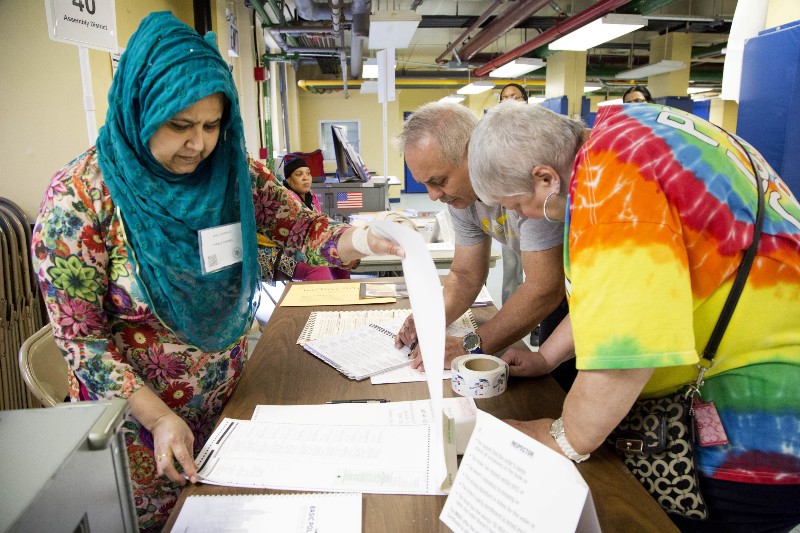
Tuesday’s presidential primary in New York served as a stark reminder that voting irregularities and restrictions are not a thing of the past and not confined to the South.
As residents purged from the rolls in Brooklyn keep struggling to have their votes counted, the nation’s attention is turning to the states scheduled to vote on Tuesday: Maryland, Connecticut, Pennsylvania, Rhode Island, and Delaware.
Following the outrage over New York’s closed primary, which excluded millions of registered independents from participating, there will be increased attention on the rules in the upcoming primary states. Delaware, Pennsylvania, Maryland, and Connecticut all have closed primaries similar to New York’s, while Rhode Island’s looser rules allow those registered as “undeclared” to cast a primary ballot.
And while some of these states have seen serious problems in recent elections — from polling places in Connecticut running out of ballots and turning away voters to Rhode Island poll workers misinforming voters about the state’s ID law — others have taken steps to make it easier to vote.
Delaware, Pennsylvania, Connecticut, and Maryland have implemented online voter registration, and Rhode Island will soon follow. Connecticut has approved Election Day registration, a policy found to significantly boost voter turnout, and lawmakers in Delaware are pushing the state to follow their lead. Maryland recently restored voting rights to more than 40,000 former felons who are serving parole or probation.
But several issues still worry Maryland’s voting rights advocates. The state recently switched from electronic voting back to paper ballots, following glitches and security concerns. But the paper ballots — where voters have to fill in circles with a pen and feed it into a scanner — come with their own headaches.
Former Maryland secretary of state John T. Willis has aired concerns that it will exacerbate both the problems of over-voting, or filling in too many choices for a single race, and under-voting, where participants quit part-way through a long ballot. Electronic voting machines are programmed to alert voters of both these problems and allow them to fix it.
Already, a municipal election using paper ballots held earlier this year has to be done over due to machine errors.
Maryland officials have also accused Montgomery County Republicans of suppressing the votes of low income residents by shifting early voting locations from working class, public transit-accessible neighborhoods to wealthier and less populous ones.
Voters in other counties have faced long lines and confusion at early voting sites, describing the experience as “bedlam.”
Yet voters in Maryland will still have easier access than those in Pennsylvania, Delaware, Rhode Island, and Connecticut, which offer no early voting at all.