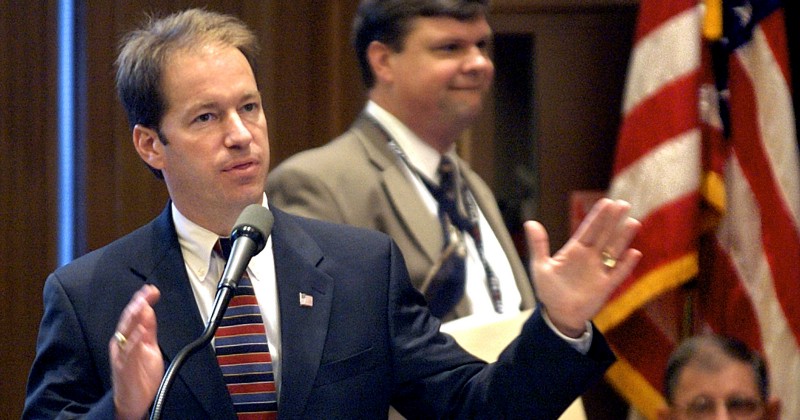
Conservatives who want to weaken anti-poverty programs are a lot like black civil rights protesters who put their lives and freedom on the line to defeat Jim Crow laws in the heart of Ku Klux Klan country, according to Rep. Peter Roskam (R-IL).
Roskam made the comparison at a Ways and Means Committee hearing on Tuesday, moments after Rep. John Lewis (D-GA) had spoken of his own impoverished upbringing on farmland in rural Alabama.
In speeches, Lewis often invokes the phrase “good trouble” when speaking to activists about his own role in the 1960s civil rights movement. Prior to Tuesday’s hearing, Lewis tweeted out a mugshot from his 1961 arrest in Jackson, Mississippi for using a “whites only” bathroom, and hashtagged it #goodtrouble.
When Roskam’s turn came to speak at Tuesday’s hearing about Republican goals for poverty spending, he read Lewis’ tweet. “I think ‘good trouble’ is maybe something for all of us to get into today, and to challenge a little bit of the orthodoxies on both sides,” Roskam said. “Good trouble may involve something where there’s an acknowledgment on the political left that says, you know, the War on Poverty wasn’t really all that successful.”
The Illinois congressman proceeded to rattle off the party line about poverty programs: For all the money America has spent fighting poverty, it remains stubbornly high, which justifies establishing new, stricter rules that would boot people off of public assistance roles if they can’t find work and that would convert federal funding into “block grants” that state-level leaders can spend on whatever they choose.
In Lewis’ usage, though, “good trouble” has a much more specific meaning. He was part of the most radical and provocative civil disobedience actions of the movement, from sit-ins at segregated lunch counters to the famed march through Selma, Alabama, in 1965, where he was beaten so badly by state police that his skull broke.
Roskam hijacked the legacy of that struggle again at the close of his remarks. “I think a number of us would be willing to sorta get into some good trouble about this, because I’ll tell you what, the status quo isn’t working,” he said. His speech made no mention of the decades-long campaign by Republican officials to undermine the War on Poverty.
The Sargent Shriver National Center on Poverty Law keeps a legislative scorecard tracking a broad swathe of policy votes that affect outcomes for the poor. Roskam got an “F” for 2015, casting just five votes that Shriver rates as helping the fight against poverty and 15 votes against the interests of low-income families. The fifth-term congressman got a “D” from the group in both 2013 and 2014, and an “F” in 2012.
The modern Republican approach to poverty policy which Roskam views as brave would replicate and expand ideas that have already failed America’s poor. The party’s ideas are built on two pillars: stricter work requirements for public assistance, and block-granting poverty funding.
Politicians have already injected both of those ideas into the country’s central anti-poverty program. Welfare reform efforts in the mid-1990s yielded the Temporary Assistance for Needy Families (TANF) program, which is doled out in block grant form. That’s been a disaster for the poor. States now spend more than one third of all federal TANF dollars on other things.
55 years ago today, I was arrested in the Jackson, MS bus station for using a "whites-only" restroom. #goodtrouble pic.twitter.com/v8zeqfVl75
— John Lewis (@repjohnlewis) May 24, 2016
And despite the rhetorical focus on linking low-income assistance to work, states spend just 8 percent of their TANF money on programs and supports related to work. In 10 states, less than 5 percent of TANF money goes to job training and other work-related programs. The three core policy areas that most directly benefit low-income families — basic cash assistance, childcare support, and work programs — account for just half of the taxpayer dollars block-granted to states.
When governors run into budget trouble, block grants leave them free to snatch TANF money away from poor families. Rather than raise taxes on wealthy families or highly profitable businesses, politicians can redistribute wealth away from the poor.
What’s more, conservatives get the causes of persistent poverty backward. The same TANF changes that they praise and seek to emulate left the program unable to meet the surge in need for assistance that comes with an economic downturn. Poverty is indeed higher now than when President Bill Clinton hammered out a welfare reform deal with Newt Gingrich’s Republican caucus.
But that surge happened in large part because the package allowed funding to stagnate, let governors siphon that increasingly-insufficient pot of money off for other projects, and made it harder for the very poorest people to get basic welfare assistance. Fewer than four in 10 Americans who are eligible for TANF actually received it in 2011. In 2014, just 23 out of every 100 impoverished families with children received any benefits from the program meant to benefit them.