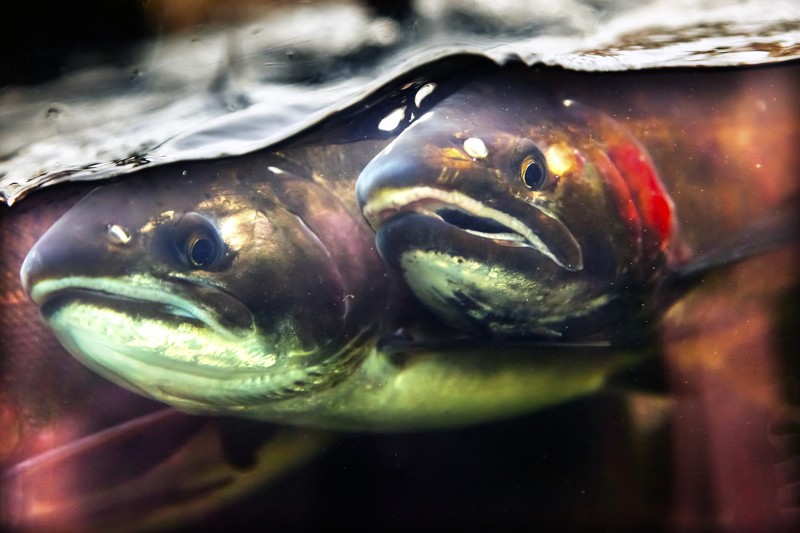
Environmental groups are going to court over genetically-engineered salmon.
A group of environmental, fishing, and consumer groups sued three government agencies this week, alleging that officials approved genetically-engineered (GE) salmon for human consumption without properly assessing the environmental threats the fish could pose. The U.S. Food and Drug administration, one of the defendants in the case, approved GE salmon in November of last year, marking the first time that the U.S. government has ever deemed a genetically modified animal safe for human consumption.
The groups allege the FDA completed an “extremely limited environmental assessment” of the application made by AquaBounty, the company that developed the salmon using a gene from an eel-like fish called an ocean pout and a growth hormone from a Chinook salmon. The resulting salmon can grow much faster than a natural fish can. AquaBounty also raises the fish as sterile females, meaning if they escape their land-based pen, they can’t interbreed with other salmon — though critics are concerned that any failure in the sterilization process could pose a risk to wild salmon.
Risk of escape is high on the list of worries for the environmental groups that filed the lawsuit. The fish are raised in land-based pens now, but if the industry takes off, there could be many more GE salmon being raised around the world, in different kinds of environments. The groups are concerned about “the risk that GE salmon will escape from the facilities where they are manufactured or grown and interbreed with wild endangered salmon, compete with them for food and space, or pass on infectious diseases; the interrelated impacts to salmon fisheries and the social and economic well-being of those who depend on them; and the risks to ecosystems from the introduction of an invasive species.”
The FDA, “ignored those concerns in its decisionmaking,” the groups say in the suit.
Others are less concerned about AquaBounty fish escaping their pens and mixing with wild salmon, however — and less concerned about their environmental impact as a whole. Alison Van Eenennaam, an animal genomics and biotechnology cooperative extension specialist with University of California Davis’ Department of Animal Science, told ThinkProgress in November that she thinks AquaBounty’s growth operations are extremely contained and don’t pose a major risk to surrounding wild fish. She also said that, since the salmon grow faster, they also require less feed than a conventionally-farmed salmon, making them arguably more sustainable.
GMO Salmon That Proponents Call ‘Sustainable’ Has Environmentalists Up In ArmsClimate by CREDIT: Shutterstock After 20 years of study and decades of controversy, the U.S. Food and Drug…thinkprogress.orgTraditional salmon breeding operations have their own problems: Salmon raised in net pens in the ocean create a significant amount of waste, which can increase the threat of algal blooms in the area. They also carry the risk of escaping from their ocean pens and competing for resources with wild salmon. GE salmon may not carry all these concerns — or at least carry them to the same severity as conventionally-farmed salmon — but critics say it will add another layer to the problems posed by aquaculture.
“Atlantic salmon populations including our endangered Gulf of Maine fish are hanging on by a thread — they can’t afford additional threats posed by GE salmon,” Ed Friedman from Friends of Merrymeeting Bay, one of the plaintiffs in the case, said in a statement. “The law requires agencies like FDA, who aren’t fisheries biologists, to get review and approval from scientists with that expertise. FDA’s refusal to do this before allowing commercialization of GE salmon is not only irresponsible, it violates the law.”
In their lawsuit, the groups also claim that the FDA doesn’t have the authority to regulate the salmon as a “new animal drug” under the Federal Food, Drug, and Cosmetic Act.
“Congress never intended or provided a means for FDA to regulate twenty-first century GE animals using its 1938 authority over veterinary animal drugs,” the lawsuit reads. “To the contrary, GE animals present enormously different risks and impacts than drugs, requiring different expertise, analyses, and regulation than were contemplated when Congress enacted the FFDC.”
GE salmon is also facing a fight on the retail level, however. Major retailers like Trader Joe’s, Costco, Target, and Whole Foods have pledged not to sell the fish.