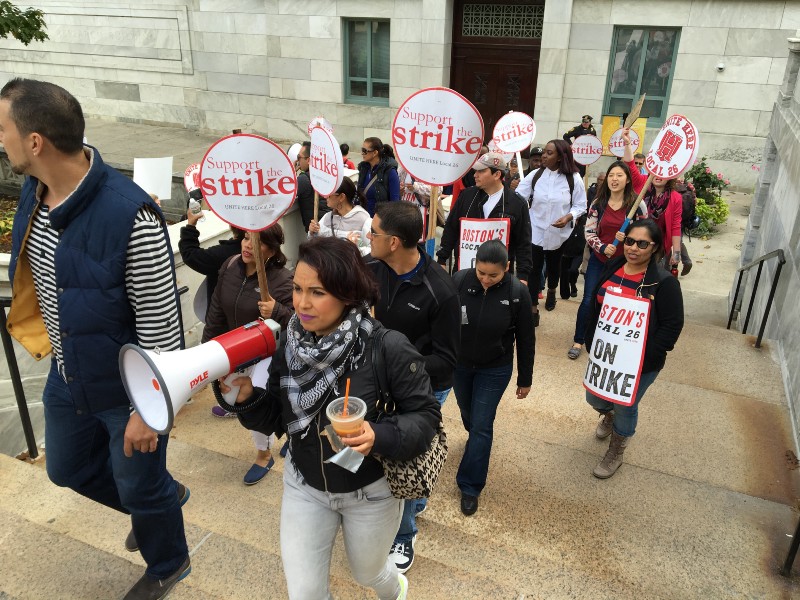
After more than four months of contract negotiations, Harvard University dining workers went on strike. Now those 750 workers are in their third week of the strike, and the university administration is barely moving to arrive at a deal, students and union spokespeople say.
Dining workers have been trying to secure annual wages of at least $35,000 and retain their current health insurance policy. They say the higher annual wages are necessary because they can’t claim unemployment when students are on break and employment during those seasons is difficult to secure.
Harvard University has responded by saying that insurance costs are too high to keep the current policy and that the university has already offered a stipend to workers with seniority during the off-seasons when students aren’t in school. Workers, Boston City Council members, and students have responded by pointing to Harvard’s $37.6 billion endowment in 2015.
“Shame on you, Harvard.”
“Shame on you, Harvard, for raising $7 billion on your endowment, of $37.6 billion — 10 times the budget of our city council — but you can’t take care of your workers,” City Counselor Tito Jackson said on Wednesday, according to Metro.us. The workers have the unanimous support of the city council.
Students across campus and various fields of study have supported the workers. Students have held rallies in support of the workers, and on Monday, students organizing a campus rally expect a particularly large turnout, Tiffany Ten Eyck, spokesperson for UNITE HERE, the dining workers’ union. Politicians and movie stars, specifically Sen. Elizabeth Warren (D) and Ben Stiller, who was working on a movie in the area, supported the workers by coming to a campus rally. The dining workers’ strike assistance fund has reached 548 contributions as of Friday afternoon, a level of support Eyck said is unusual.

Monica Kriete, a student at the Harvard School of Public Health, has been organizing marches with fellow HSPH students to protest the lack of progress for workers in their negotiations with the university. Kriete said her own classes have taught her the meaning of a “catastrophic expenditure,” or when out-of-pocket health spending is capable of pushing people into poverty. There are various methods of measuring this this but one way to define this is spending 10 percent or more of one’s total expenditures on out-of-pocket health spending. Harvard’s premium of $233 a month, not counting co-pays, would come to 9 percent of their incomes.
Harvard Medical School students analyzed the plan and found that workers’ finances would suffer more through the Harvard plan than if they didn’t have any health plan through their employer and thus opted for the state’s health care exchange.
“That is unacceptably high. Workers are having to skip doctor appointments. They’re afraid to access care,” Kriete said.
“It’s embarrassing at this point.”
Kriete added that when the university fails to offer a reasonable plan to workers, the work students are doing at HSPH is undermined.
“We do so much work around income inequality … [Harvard’s resistance to keeping the current plan] says the work of the school is not valuable enough to act on,” Kriete said.
Eyck said there has been some movement on Harvard’s part but that the process is very slow. She did not go into specifics as to what Harvard has proposed.
“Two mediators have been assisting … We’re seeing them bring new ideas to the table but they still need to move,” Eyck said.
In the meantime, Eyck said there is overwhelming support from the campus community and alumni.
“It’s embarrassing at this point,” Eyck said.
This story has been updated to include more information about the definition of catastrophic health expenditures.