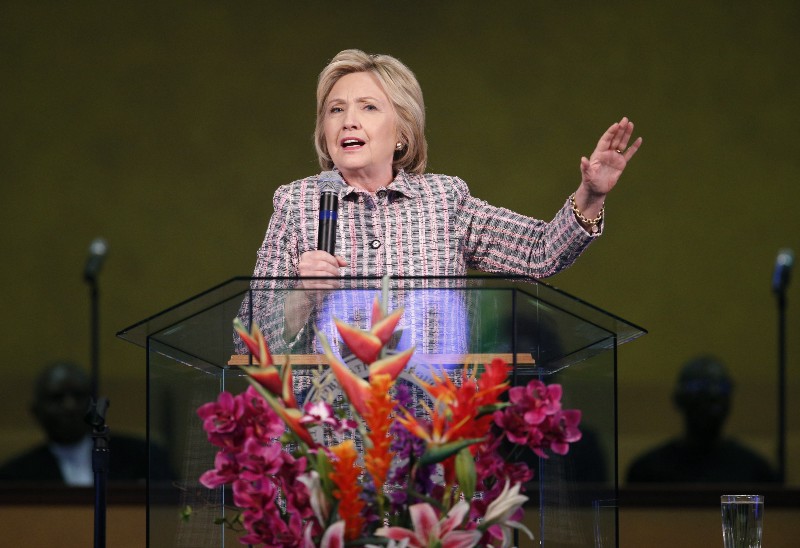
When Democratic nominee Hillary Clinton takes the stage on Thursday to deliver the closing speech of her party’s national convention, expectations will be sky high. Clinton is already following President Barack Obama’s stirring Wednesday evening address to delegates that wowed progressives and conservatives alike, and her speechwriters are striving to reach an even broader general election audience as they prepare what is being called the “most important speech of her life.”
But if the former Secretary of State is serious about winning over more than Democrats tonight, she would do well to dwell on one topic in particular: her faith.
For the first time in modern political history, the Republican nominee — Donald Trump — is actively struggling to win some religious voters, leaving an opening for faith-friendly Democrats like Clinton.
To be sure, Clinton is hardly new to the religion outreach game. She has already harped on her Methodist faith more than once during her latest run for the White House, speaking at length about her personal prayer life during debates with Sen. Bernie Sanders (I-VT) and detailing her own open-minded approach to Christian scripture during town hall events. She also has a habit of citing an old Methodist adage often (falsely) attributed to theologian John Wesley, proclaiming during her Super Tuesday victory speech in March, “Like many of you, I find strength and purpose from my family and my faith…They gave me simple words to live by: Do all the good you can for all the people you can for as long as you can.”
These and other public professions of faith are second-nature to Clinton by now, and are common among her fellow Democrats. Her running mate, Tim Kaine, even credited his Catholic upbringing as the driving force behind his political life during his speech to the convention on Wednesday. But this year, Clinton’s longstanding engagement with religion, if vocalized carefully but honestly, stands to radically reverse traditional political winds: for the first time in modern political history, the Republican nominee — Donald Trump — is actively struggling to win some religious voters, leaving an opening for faith-friendly Democrats like Clinton.
The electoral benefits of contrasting her faith with that of Trump are clear. Although Trump enjoys healthy support among evangelical Protestants, he has repeatedly fumbled religious questions on the campaign trail, failing to name his favorite Bible verse and admitting that he doesn’t need to ask God for forgiveness because he doesn’t think he has done anything wrong. Consequently, there remains a cadre of conservative Christians who are unsettled by his aggressive tone and struggles with religious literacy (including many prominent leaders of the Religious Right).
Mormons — the most reliably Republican major religious group in America — also represent a weak point for the Donald. The Mormon church has publicly opposed his proposal to ban Muslim immigration, Mormon ex-senators have rejected his anti-Muslim positions on their death bed, and some polls even have him tied with Clinton in deeply Mormon Utah.
Clinton stands to gain by contrasting her religious devotion against Trump’s spiritual gaffes, potentially cribbing more than a few churchgoing Republicans from Trump by articulating a heartfelt, faith-rooted message in what will likely be her most-watched speech of the campaign.
And despite anointing self-described “evangelical Catholic” Mike Pence as his vice presidential running mate, Trump — who Pope Francis once said is not a good Christian — still has a major Catholic problem. According to a recent analysis from FiveThirtyEight, Catholics are significantly less supportive of the Republican nominee this year than they were in 2012 — particularly those who go to church on a regular basis. Compared to 2012, Catholics who attend Mass weekly have upped their willingness to back a Democratic presidential candidate in 2016 by a full 22 percentage points. Granted, these voters are more “anti-Trump” than they are “pro-Clinton,” but it’s still a major problem for Trump as he campaigns in swing states with sizable Catholic populations such as Ohio and Florida, and a potential windfall for a faith-savvy Clinton.
Trump, to his credit, seems to be at least vaguely aware of his faltering reputation with many religious Americans, but doesn’t appear eager to correct it. His speech to the Republican National Convention last week only spoke about religious concerns once — when calling for a repeal of the Johnson amendment — and did not include a single mention of God, Jesus, or Church. When he did refer to the evangelical community, it was mostly to thank them for their support in the primary, adding, “I’m not sure I totally deserve it.”
Thus, Clinton stands to gain by contrasting her religious devotion against Trump’s spiritual gaffes, potentially cribbing more than a few churchgoing Republicans from Trump by articulating a heartfelt, faith-rooted message in what will likely be her most-watched speech of the campaign.
This doesn’t mean that Clinton should maker her speech about faith, of course, nor should she ignore roughly a quarter of Democrats who no longer claim a specific faith tradition. Not all of these “religiously unaffiliated” voters are atheists or agnostics, but polls show this diverse group shares a uniform aversion to fusions of faith and politics, particularly if the “faith” in question comes across as judgmental or exclusionary. Meanwhile, the Democratic Party is already doing damage control after an email hack revealed messages in which DNC CFO Brad Marshall suggested attacking Sanders’ perceived atheism as a campaign tactic. In addition, Clinton could alienate an even larger section of her party if she doesn’t strike a careful balance between spiritual parlance and passionate support for reproductive justice and marriage equality.
But Clinton has a long history of speaking positively about her own religious beliefs in ways that do not condemn those of other faiths — or of no faith. By lifting up her spirituality alongside her broader policy proposals and personal strengths, Clinton could begin to reverse the shockingly low favorability ratings among many conservatives, appealing instead to a shared belief in the power of the Almighty.
Most tellingly of all, her fellow Democrats are straight-up asking her to talk about it. In fact, Kaine practically set the stage for her on Wednesday, citing Clinton’s faith as a key component of her leadership portfolio.
“She’s ready because of her faith,” he said. “She’s ready because of her heart. She’s ready because of her experience.”