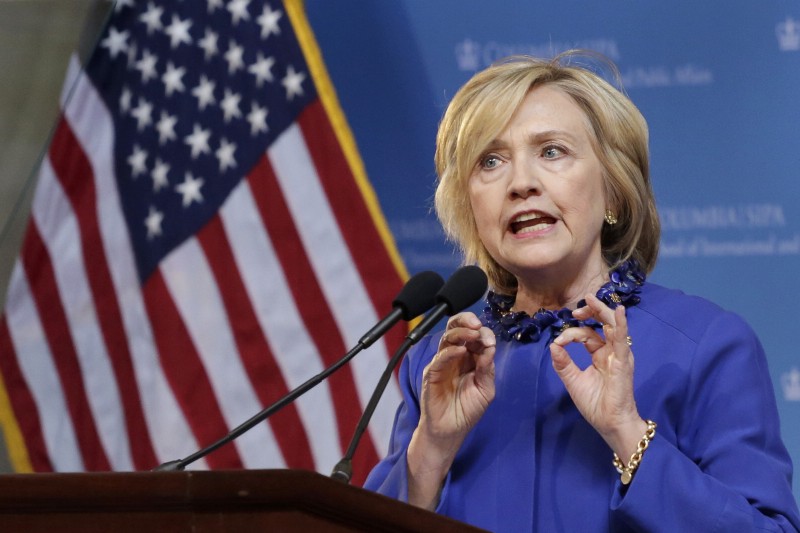
Former Secretary of State and 2016 presidential candidate Hillary Clinton weighed in on the police brutality protests sweeping Baltimore Wednesday, calling for more community policing and an end to the era of mass incarceration her husband’s administration helped create.
In an appearance at the Columbia School of International and Public Affairs, Clinton laid out one of the first policy plans of her campaign, declaring the nation needs to face “hard truths about race and justice in America.”
Clinton invoked specific popular bipartisan policies, including body cameras for all police departments, more emphasis on rehabilitation and probation for low-level offenders, and doing away with arrest quotas. But she also cautioned against “siloing” discussions of criminal justice. Instead, she made a broader case for how mass incarceration perpetuates poverty, public health crises and overall economic stagnation.
“You cannot talk about smart policing and reforming our justice system without talking about what’s needed to improve economic opportunity, better educational chances for young people, more support to families so they can do the best jobs they are capable of doing to help support their own children,” she said.
Clinton addressed prisons’ economic toll on families, both in its creation of single-parent homes and how offenders returning to the community find it nearly impossible to get a job. “Without the mass incarceration that we currently practice, millions fewer people would be in poverty,” she said. She also invoked Walter Scott, killed by an officer as he ran away, “unarmed, in debt, terrified of spending more time in jail for child support payments he couldn’t afford.”
Public health is also inextricably tied to the damage done by the criminal justice system, she argued, pointing out that there is a 20-year gap in life expectancy between a poor black neighborhood and a wealthy white neighborhood in Baltimore. Meanwhile, Clinton said, mental illness and substance abuse are being criminalized rather than treated. “Our prisons and our jails are now our mental health institutions,” she said.
Clinton’s husband, former president Bill Clinton, has also become a vocal critic of mass incarceration, admitting that drug war policies and strict sentencing guidelines he backed as president were part of the problem. “We basically took a shotgun to a problem that needed a .22,” Clinton told a community policing forum shortly after the shooting of unarmed teenager Mike Brown in Ferguson, MO. At the time, he also said he accepted his “fair share” of responsibility for “the mess we’ve got.”