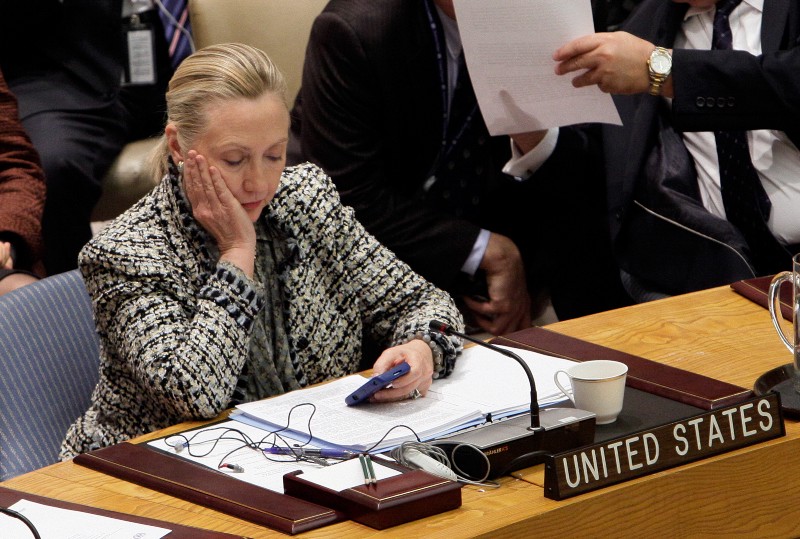
In what’s likely to be one of the major controversies of her campaign, Democratic presidential candidate Hillary Clinton’s desire to use her phone for both work and personal communications like the rest of the world has sparked a federal investigation and controversy that may likely set the tone for her campaign — and serve as a warning to the prevailing nominee.
We have a complicated relationship with our phones: They are simultaneously the center of all attention and the bane of a technologically enhanced existence. Ideally, everything from one’s personal and work lives can be done — or ignored — from a single device neatly squared away in a pocket or tote.
But this isn’t an ideal world.
Clinton or any other appointed or elected figures can’t be “normal” and use technology to make their lives a smidge easier, according to Stewart Baker, a former Department of Homeland Security administrator and national security attorney with Steptoe and Johnson in Washington, D.C.
“Security is the enemy of convenience, and the effort to find the compromise between the two is always risky. It’s not for the faint of heart and it’s not for amateurs,” he said.
After months of refusing, Clinton agreed Tuesday to submit her personal email server to the Justice Department in an effort to silence national and cybersecurity concerns.
Clinton turned over 55,000 pages of emails sent during her secretary of state appointment between 2009 and 2011. The more than 31,000 personal emails she sent were wiped from her private Clintonemail.com server, and weren’t among the batch submitted to the DOJ. Republicans have been requesting complete access to Clinton’s emails to get to the bottom of the Obama administration’s response to the 2012 embassy attack in Benghazi, Libya.
There aren’t many specifics available regarding the contents of Clinton’s emails, but criticism is mounting. Republicans have repeatedly denounced the use of her behavior sending classified or potentially classified information from an insecure server poses a national security risk.
Beyond the two emails identified as having top secret content, Clinton’s email scandal illustrates the contentious relationship between security and convenience in technology that becomes more pronounced in the upper ranks of government.
Given the minimal available information, Baker said Clinton only would have violated her oath if she knowing sent an email with classified information, such as a summary of classified briefing. But Clinton wouldn’t be culpable if she received and responded to an email from Israel Prime Minister Benjamin Netanyahu that lacked overtly classified context. “It would be much harder to fault her for assuming,” he said.
“There are always temptations when you only have access to one communication system,” said Baker, adding that government employees often rationalize ways to use unclassified systems “by making the easy assumption a message isn’t classified even if there’s evidence to the contrary.”
Presidential hopeful and self-proclaimed Luddite Lindsay Graham (R-SC) suggested cutting off access the next president’s email access in the interest of national security. That idea has been floated around by security experts and foreign governments looking to duck international spy agencies. But completely cutting off access wouldn’t work completely because society is so technology-dependent, and at least a staffer would have to send out emails.
For government leaders, the priority is to secure communications and keep them from being intercepted. “The higher ups are going to discover that when they take office, they’re going back 15 years in time,” Baker said.
“The [technological] delay is built in,” he said. “Typically, we find the technology, fall in love and then we find the security flaws…There are always undiscovered security problems. There are going to be instances when [officials] can’t use the tech in their daily lives,” and be somewhat normal. But then again, he quipped, “A normal person doesn’t get to be secretary of state.”