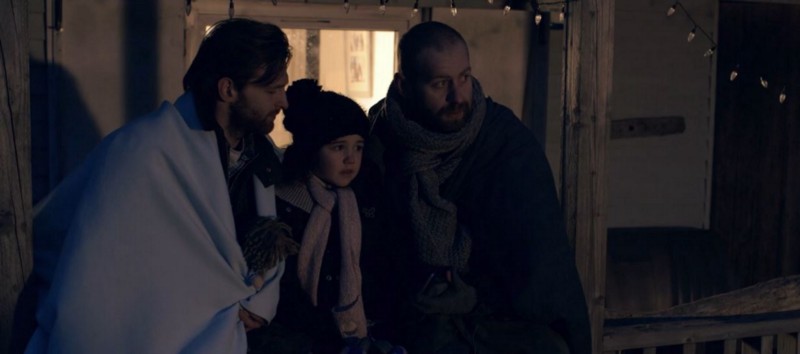
As a genre, science fiction often stretches the imagination as to what life could be like, but incidentally, life for LGBT people is rarely addressed. One filmmaker is seeking to change that, and his newly released short film Credence is already challenging past precedents.
The need for representation
Director Mike Buonaiuto’s vision for a sci-fi film about a same-sex family making a tough decision as the world is about to end started with crowdfunding on Indiegogo. It raised nearly $35,000 — almost four times the original goal. Though he was surprised by the result, he wasn’t surprised that there’s a demand for LGBT characters in science fiction.
“The issue of LGBT inclusion within science fiction or film in general — it’s the same argument as the inclusion of diversity of everyone,” he told ThinkProgress. He noted the racist backlash over the fact that one of the main characters in the upcoming Star Wars movie is black as an example of how hard it is to introduce diversity to science fiction.
He thinks the reason the characters in science fiction are so trite is because writers worry about explaining the complicated science fiction concepts. “They worry that people won’t understand the storyline, so they revert back the same stereotypes that we see again and again and again so that characters are recognizable.”
This has been particularly true for LGBT characters. Even Star Trek, which has always tackled difficult conversations about race and acculturation, has never featured an LGBT character in its 50-year canon — a few twists and gimmicks aside.
Since its reboot in 2005, Doctor Who has regularly featured cameo and recurring LGBTO characters (the “O” for Captain Jack Harkness’s “omnisexuality”), but not without controversy. A same-sex kiss in an episode just last year sparked outrage and was censored when the episode aired in Asia.
Netflix’s Sense8, which debuted this summer, prominently featured both people of color and LGBT people among its protagonists, but was criticized by some for being “too diverse” for the standard sci-fi fan base. That fortunately didn’t keep the series from being renewed for a second season, due out next June.
The representation conundrum
Buonaiuto set out a with a simple task. He wanted to create a film that demonstrated a sci-fi story could be told with LGBT characters without really feeling any different. “We’re not placing the characters in Credence as LGBT because they need to be, they just are. The story doesn’t revolve around that,” he told ThinkProgress.
So many stories, he noted, focus in on the experience of being queer — like characters coming out or struggling with their sexuality. Those have their own value, but queer people are missing “everywhere,” and Buonaiuto hopes young people have the chance to see characters that reflect who they are in all media. “We wanted to do something quite different, telling a story that could have been about a different-sex couple evacuating their children, “but it happened to be a gay couple.”
Ironically, Credence has been criticized for that, the idea that a same-sex couple was just plugged in where a different-sex couple easily could have conveyed the same story. Buonaiuto conceded that “there’s very little in Credence that makes those characters LGBT-specific,” but pointed out that “that was the whole point.” Still, in doing so, he acknowledges that the film sacrificed what’s unique about what LGBT characters have experienced in their lives. He praised the recent TV series Cucumber for essentially doing the opposite: establishing LGBT characters with distinct backgrounds and focusing in on their lives without resorting to tropes.
Buonaiuto’s friends and family have told him that when watching Credence, they forget that they’re watching a film about a same-sex couple. He’s been torn about marketing it as an “LGBT sci-fi” film because “it’s just a film about family at the end of the world, and there’s nothing particularly LGBT about it except that the two main characters are gay.”
This seeming self-contradiction, however, may actually be what makes the film so affecting. It is a film about a couple’s love and commitment to their daughter, and if people don’t see the need to think about the couple being same-sex, it may well help break down the assumptions some people hold about same-sex parenting.
Activism through film
As a 30-minute film, Credence builds on much shorter films Buonaiuto has produced to challenge how people think about the lives of LGBT people. One similarly took a look at the experience of same-sex parents, another explored how gay athletes might feel competing in the Olympics in homophobic Russia, and another poignantly challenged assumptions about marriage equality through the lens of the military:
Credence definitely “tugs on the heartstrings” — Buonaiuto’s words for the film’s intention — in much the same way, and has paved the way for more activism. Buonaiuto says that it could possibly be picked up as a series that displays other kinds families struggling with the same doomed fate of the world, or be expanded into its own feature.
Moreover, he has launched a new agency, the Campaign Agency for Social Change, which aims to “shape history” through emotion, education, and action. The agency has already worked with organizations to help raise awareness about blood cancer research, youth homelessness, and HIV awareness through creative media.
According to Buonaiuto, sales for Credence have been “overwhelming,” such that it is now ranked number two on Vimeo’s On Demand service. He thinks that speaks to how successful the “people-powered” nature of the film has been and he hopes that its popularity inspires other filmmakers to diversify the kinds of stories they tell.
Indeed, stories as poignant, beautiful, and inclusive as Credence deserve all the company they can get.