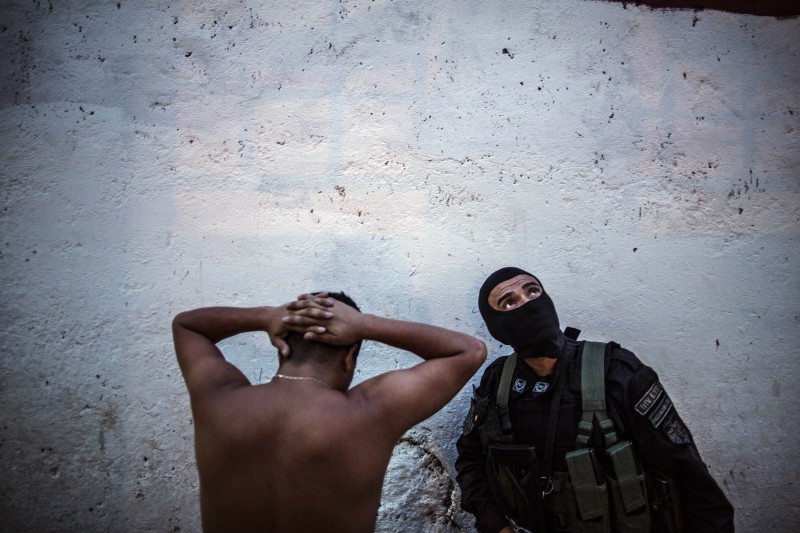
Street gangs in the capital of El Salvador brought buses to a halt this week. The armed groups killed nine people who defied their transportation stoppage.
The country, which has one of the highest rates of homicide in the world, has seen an uptick in violence in recent months. An average of 22 people were murdered each day in the small Central American country in June, totaling 677. That made June the deadliest month its seen in the country in a decade, surpassing a previous record in March. Since a two-year gang truce fell apart in 2014, homicides have only increased — with more and more Salvadorans trying to flee to America to escape the violence. Ironically, however, that’s where much of it came from.
Not only did the gangs come into existence in Los Angeles, but U.S. immigration policy perpetuated their growth in El Salvador. As a bloody civil war raged across their country during the 1980s, many Salvadorans fled to the United States
“These immigrants settled in different parts of the country and, of course, in Los Angeles,” Robert Lopez, a Los Angeles Times reporter who has covered the issue extensively, told NPR.
Finding themselves in a city dominated by feuding gangs, many Salvadoran immigrants felt their only choices were to join gangs or become their victims.
Some joined the 18th Street gang, which was originally formed by Mexican Americans, but came to include Central American immigrants and African Americans as well.
Its rival gang, Mara Salvatruncha, or MS-13, was formed by Salvadoran immigrants in L.A.
“MS-13 formed initially as a self-defense gang, to protect itself against the larger, more established Mexican-American gangs,” Lopez said. “And they quickly gained a reputation for their willingness to use violence because, you have to remember, many of these people who started the gang had seen a brutal, brutal civil war. So it was a very violent mix — a very violent era. But now the violence has turned to Central America.”
Many Salvadorans in the United States wound up in prison for gang-related activities. And, in 1996, Congress passed a law that allowed prisoners to be deported if they had a sentence of just one year. Before, only those with violent felonies who had been sentenced to five or more years in prison would be deported. But this effort in the United States meant that thousands of Salvadorans with gang affiliations wound up back in El Salvador — a country that was largely helpless to combat them.
“As you can imagine, coming out of long civil wars, there was no strong institutionality in this country,” Carlos Dada, an investigative reporter in El Salvador, said. “There were a lot of weapons, a lot of people military trained, and very few means to make a living. And there was a lot — a lot of broken families. So when these gang members, mainly from Los Angeles but also from the D.C. area, started to come back … they were very attractive models for these kids on the street and gang members started to develop their own clique in El Salvador.”
Authorities in El Salvador were largely left in the dark about the specific criminal records and allegiances of those the United States deported. Gangs became a sort of necessary force in the country, and even came to take hold of political networks in the country.
There are now 60,000 gang members on the streets of El Salvador, with about another 10,000 in prison, according to some estimates.
Faced with dim prospects and increasing homicide, many Salvadorans — including many children — have attempted to escape to the United States.
Last year, an estimated 68,000 unaccompanied children allegedly crossed into the United States illegally. The majority of them were from El Salvador and other Central American countries wracked by violence.
“The reason I came is because we were in danger over there,” a 15-year old Salvadoran girl who attempted to illegally cross into the U.S. said. “My mom and dad said we were better off coming here, that’s all I can say.”