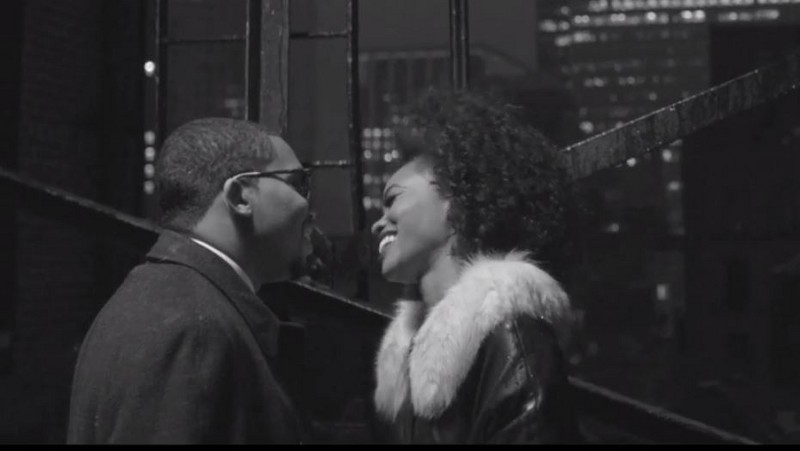
Rapper Charles Hamilton made headlines on Monday when he released a powerful video about police brutality, featuring Rita Ora, for his latest single, “New York Raining.” The video is a direct response to widely-publicized instances of police brutality, which have inspired artists to tackle systemic injustice. But several elements of the song set it apart from other recent explorations of the tense relationship between police and African Americans, and as a result, it presents a more nuanced portrayal of brutality than some of its predecessors. First, there are very few police officers in the video, and second, “New York Raining” is, above all, a love song.
According to Associate Professor Nikki Jones of UC-Berkeley’s Department of African American Studies, brutality can come in the form of extreme, lethal violence, but can also be thought of as a disrupter of everyday life. “One way to think about it is to think of it as brutal forms that the policing of black communities and black bodies can take. I do think it’s important to think more broadly about encounters with the police, about routine encounters that occur each day and deeply affect a young person’s sense of who they are in mainstream society,” Jones, who focuses largely on race, gender, and criminal justice, told ThinkProgress.
Set during the Civil Rights Movement, the video for “New York Raining” opens with Hamilton in a jail cell typing a letter about being confined (in prison and as a black person in society) to his romantic partner, Patricia. It then flashes back to the two participating in a group protest, chanting about justice with raised fists. Between shots of Hamilton playing a piano on a rooftop and Ora looking elegant, we see more flashbacks of the two planning additional protests while falling in love.
In fact, we don’t actually see the police until the 1:30 mark, when they’re standing across from peaceful protesters with linked arms. One officer plays with a baton, while staring down the protesters, but that’s all we see of the cops until the 3-minute mark, when Hamilton and his lady love are taking a casual stroll. Two cops pull up in a vehicle, and one of them cuffs Hamilton, puts him face down on the car, and puts him in the back seat.
Hamilton serves time behind bars, after which he joins back up with the activists, who’ve evolved into a militant group. Now they wear all-black, chant black power, and march in formation. All of the women don afros. But even after the transformation, we don’t witness a direct altercation with law enforcement. With the perpetrators off-screen, we’re to assume that individuals hosing down a group of black men on the street are cops.
Although Hamilton has said that the video is about police brutality, police are on-screen for less than a minute. And aside from a few seconds of hosing, the excessive use of force that’s come to define brutality in recent months is glaringly absent. There are no guns, Tasers, or beatings. The video is a far cry from another police brutality-themed music video released last month.
The majority of Run the Jewels’ video for “Close Your Eyes (And Count To Fuck)” features a physical fight between a black teenager and a white cop. The two roll around the street, grabbing and choking one another, from day to night. The fight is eventually taken to the teen’s house, and ends with the two sitting on the edges of a bed with their backs to one another, gasping for air.
The video is about the ongoing battle between black people and law enforcement, which has left both groups tired. Director A.G. Rojas explained, “The film begins and it feels like they have been fighting for days, they’re exhausted, not a single punch is thrown, their violence is communicated through clumsy, raw emotion. They’ve already fought their way past their judgments and learned hatred toward one another. Our goal was to highlight the futility of the violence, not celebrate it.”
But the glaring absence of physical violence isn’t the only aspect of the video that makes “New York Raining” different. Unlike Run the Jewels’ song, Hamilton’s isn’t just about law enforcement and structural power. It’s about a man and a woman in a tumultuous relationship, who love each other dearly, and long for each other when they’re apart. In the hook, Rita Ora sings, “In the city lights/I swear I hear you call my name/There is nothing right/I am stuck here while you’re miles away/In New York raining, In New York raining/It’s too much my babe I need you/It’s too much my babe I need you,” while staring longingly out of a window. Throughout the rest of the song, Hamilton raps about dedicating himself to an anonymous woman (presumably a wife or girlfriend), wining and dining her, and how the love they share is the only certainty. “Love and affection is all we miss/From the world but with each other that’s all we get,” he says.
There’s nothing cruel, or brutal, about the lyrics. Compare them to Run the Jewels’ song about rebellion, and you’d have no reason to connect “New York Raining” to police aggression. In the rap duo’s anthem, they wonder, “Where my thuggers and my crippers and my blooders and my brothers?/When you niggas gon’ unite and kill the police, mothafuckas?/Or take over a jail, give them COs hell/The burnin’ of the sulfur, goddamn I love the smell/Now get to pillow torchin’, where the fuck the warden?/…We killin’ them for freedom cause they tortured us for boredom/And even if some good ones die, fuck it, the Lord’ll sort ‘em.” The entire theme is premised on exhaustion with the status quo and rising up against a brutal system, which aligns with the music video’s plot. Indeed, much of Run the Jewels’ music revolves around revolution and highlighting systemic injustices.
Speaking about the theme he was trying to communicate in “New York Raining,” Hamilton told ThinkProgress, “because of time, space, and different conditions between us, I can’t converse with her the way I want to and need to. It was much like the Civil Rights Era, because certain ideas couldn’t get across because of a lack of equality. I got arrested in the video and police were standing outside of the bus. Maybe you didn’t get to see much of the police activity, but love and peace are synonymous, and when you’re in a tumultuous love affair, it makes it very disruptive to the peace you try to achieve just by being every day.”
Hamilton’s video is powerful because it relies on human connections to tell a story, instead of depending on police aggression to do so.
Artists like Hamilton, who create visual media, are in the position to enter various perspectives into the national conversation. Jones concluded, “the video takes a step back from the present moment and, in doing so, highlights the role that the police have played in policing black people, black bodies, and the struggle for racial justice historically. I also see his effort to reaffirm the message that black lives matter by illustrating how love persists.”