The United States government will soon spend more on servicing the national debt than it does on its children unless Congress changes course, the Urban Institute reports.
Total federal spending on children was close to half a trillion dollars in fiscal year 2014, but made up just 10 percent of total spending. The combined cost of direct program spending on children and tax code provisions linked to kids has been roughly flat since 2012 in, and is slightly down from 2010 and 2011 when Recovery Act initiatives boosted the figure.
Kids will see an even smaller share of total spending in the coming years, the new analysis of existing budget projections finds. The costs tracked in “Kids Share” will fall from 10 percent of the budget to below 8 percent in 2025. And by 2018, the country will be spending more on annual interest payments than on direct outlays for programs targeted to children.
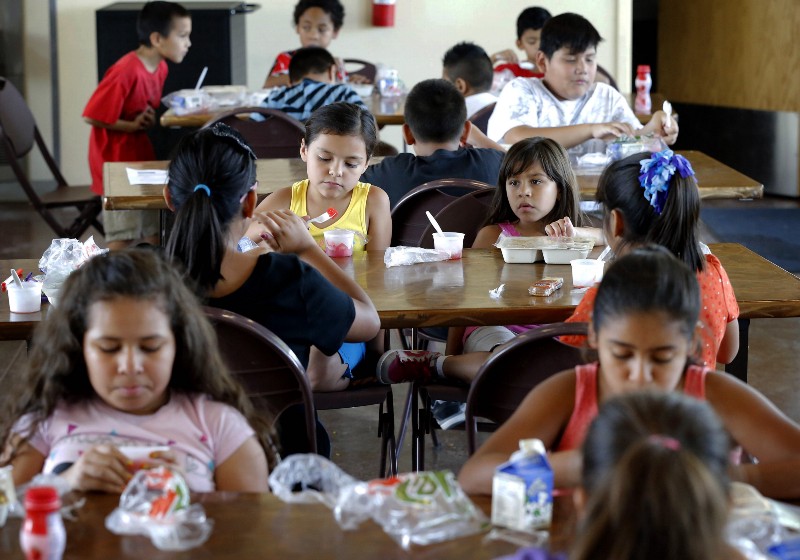
This paltry allocation comes amid ample evidence that American kids need more help, not less. About one in every five children comes from a food-insecure household where caretakers can’t always put enough nutrition on the table come mealtime. More than half of all public school children now qualify for free or reduced-price meal programs. Even kids who turn these early hardships into motivation — rather than the mental health, educational, and economic harms that growing up poor and hungry causes — will grow up in a society that does not provide enough economic mobility for low-income children to reliably climb farther up the economic ladder than their parents managed to reach.
Stagnant and declining federal investment in young people is hard to understand in the context of the data about American children’s economic outlook. The trend stems in part from a structural bias in our public policymaking toward spending on adults at the expense of programs that invest in the future, report author Julia Isaacs said in an interview.
“We decided early on that taking care of the elderly was a federal responsibility, so there are automatic spending increases built into Social Security, Medicare, and Medicaid” but “it’s only been more recently that we’ve realized, from brain science in particular, the importance of investing in children,” Isaacs said.
But even with strong data indicating that investments in early childhood education and nutrition more than pay for themselves by producing more well-adjusted and economically independent adults, our political system ends up targeting those investments when trying to tighten the national belt.
“It’s really hard to get Congress to invest in kids,” Isaacs said. “Many children’s programs like Head Start depend on annual appropriations, so they get squeezed every time there’s a budget cap.”
Programs for the elderly, by contrast, have baked-in structural protections from political turbulence. While those systems automatically adjust to changing needs, Isaacs said, it takes a specific act of political will to back up rhetoric about investing in kids with actual dollars.
“When you look back in time at when we had big investments in kids, it was usually through new initiatives,” Isaacs, a former Congressional Budget Office researcher, said. “But it’s really hard to find funding for new initiatives when the overall budget is out of balance.”
The projected budget imbalance that Isaacs’ work is premised upon is smaller than was forecast a few years ago. As high-profile games of political chicken like the current government shutdown standoff over Planned Parenthood funding have become an annual event, even things that might seem sacrosanct like federal programs for children have been caught up in the anti-spending fervor.
“If our kids were doing fine, we’d say ‘Great, the federal government isn’t spending too much. We don’t need to because our kids are fine.’ But the fact is that one in five children are living in poverty,” Isaacs said. As her report notes, America’s children have it pretty rough by developed-world standards: Out of 29 developed nations analyzed by UNICEF in 2013, the U.S. ranked 28th on child poverty, 23rd on birth weight measures of infant health, and 26th in preschool enrollment rates. The nation’s ranking on a UNICEF composite metric of overall child well-being put us “in the company of Greece, Lithuania, Latvia, and Romania,” according to the report.
“We want to live in a country where children all have equal opportunity,” Isaacs said. “How can you have equal opportunity if you’re growing up with much less income and you’re going to worse schools?”
Most American investment in our children comes through the tax code. Combining direct spending on refundable tax credits and foregone revenue from deductions tied to children — often called “tax expenditures” — nets $185 billion in federal spending in 2014 on Americans 18 and under. Healthcare — most of it through Medicare coverage of low-income children — comes in second at $93 billion. K-12 education spending totaled just $42 billion, down from the previous year. Spending on other core economic necessities like housing and nutrition are even smaller.
Given those figures and the perennial campaign-trail invocations of the children who are our future, maybe there’s both capacity and motivation to reverse the negative trajectory of the kids’ share of federal budgets. But so far, members of Congress appear content to steer the opposite direction. Fields’ report projects that total federal investments in children will shrink as a share of the total budget from the 10 percent recorded in 2014 to less than 8 percent in 2025 under current law.
How would Isaacs fix it? “I would put scarce dollars in the most cost-effective places, like more early-childhood programming,” she said. “And I’m not running for office, so I guess I can say I’d find a way to increase tax revenues so we’re at least covering the cost of the major programs we want and not running a deficit each year.”
But if tax revenue increases aren’t all the way dead in political terms, they’re certainly on life support in a landscape that’s been defined by conservative ideology around deficits for the past five years. In the absence of such an ambitious shift in the overall budget balance that would afford appropriators the elbow room needed to re-invest in children, further cuts to their interests seem more likely.
One change to current policy being considered by budget negotiators at present would further contract Washington’s allocation for the next generation. Both the House and Senate versions of a budget compromise would slash funding for AmeriCorps volunteer programs, erasing at least one dollar out of every five that got spent last year on the system. The proposed cut would undermine the nation’s premier public system for bringing volunteer educational assistants into struggling schools. Stripping away those supports would exacerbate hardship for millions of children who “have not only a money poverty but a relationship poverty” limiting their prospects, former AmeriCorps director John Gomperts said last week.
A previous version of this post misspelled John Gomperts’ name.