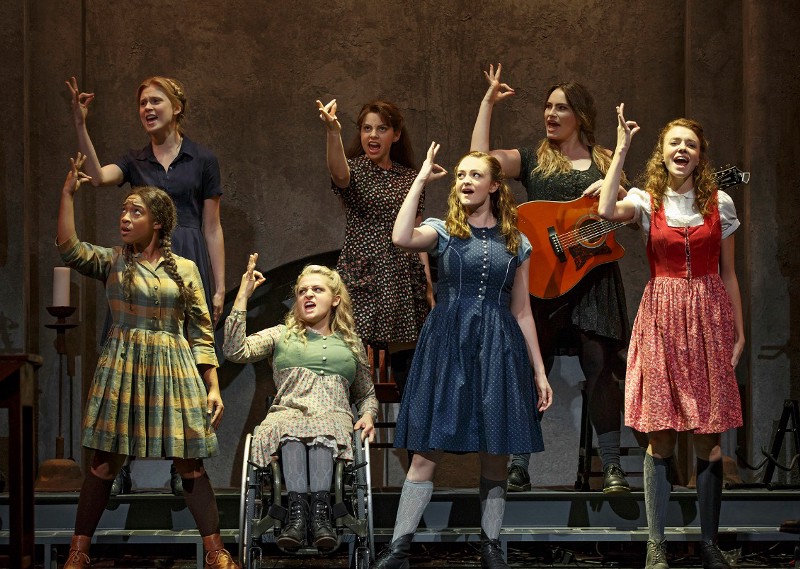
It is hard to put into words what is so extraordinary about the Deaf West Theatre Company’s Spring Awakening. Which is fitting, considering this production zeroes in on the perils of miscommunication, on what happens to individuals who are deprived of the ability to express themselves with whatever means they have to do so.
After playing a sold-out engagement at L.A.’s Rosenthal Theatre last fall, Spring Awakening moved to Broadway this September. Deaf West’s Spring Awakening is a revival of the 2006 musical, the Duncan Sheik and Steven Sater production that was, in turn, based on Frank Wedekind’s 1891 German play of the same name. The story follows a group of German teenagers in late 19th-century Germany, coming of age in a time and culture where all their most primal, youthful urges — to give voice to their inner lives, to have sex, to engage in independent thought — are repressed and punished, harshly and without exception, by the adults in their community.
Sheik and Sater’s Spring Awakening premiered on Broadway in 2006 and won eight Tony Awards, catapulting its then-teenage stars, Lea Michele (Glee, Scream Queens) and Jonathan Groff (Looking, Hamilton) to ever-bigger stages. Were this a straight revival, it would be, while lovely, unnecessary; Spring Awakening closed in 2009, not even a decade ago.
But Deaf West imbued this production with powerful context. In 1880, educators of the deaf from around the world met at the Milan Conference, where it was determined that oralism — the use of speech, not sign language — was the preferred method of education for deaf students.
“Considering the incontestable superiority of articulation over signs,” the Conference resolved, all deaf students were to be taught using the oral method, by speaking and lip reading. Sign language in instruction was banned.
With that dark period of deaf history as the backdrop — essentially, by rooting the play even more firmly in its original setting — Deaf West’s Spring Awakening thematically connects every character and thread in the show. The entire story hinges on whether or not people can understand each other, whether they’re willing to try, how beautiful a person’s life can be when someone, anyone, effectively communicates with someone else, and how tragic life can be when people fail to hear and to be heard.
What scans in the 2006 production as your classic, universal teen angst (adults just don’t get it, no one listens to what we have to say, school is bullshit, etc.) is given new heft and scope. Melchior, with a deaf mother and a hearing father, navigates both worlds, further justifying his place in this world as someone who isn’t content with keeping people in silos, cut off from one another, from new information, and from risky but thrilling experiences. Moritz is deaf, forbidden from signing in class and shunned at home by a father who literally screams in his ear, as if he can force his son to be someone that he’s not by sheer force of volume.
It’s this loneliness, amplified by messaging on all sides that says his failure is predetermined by his biology, that sends Moritz spiraling.
Wendla, too, is deaf, and this alteration makes the inciting incident of our story — Wendla’s mother’s refusal to describe, in any useful terms, how exactly women get pregnant — far more complicated and believable. Wendla’s mother might not even know the signs for what she needs to say, and it’s plausible she wouldn’t have the stomach to write it down. And Wendla, educated in the no-sign-language-allowed, same-sex-only classrooms, could easily have been too isolated from her peers to pick up on the birds and bees buzz other girls would whisper about.
The play at its core serves as a warning for what can go wrong when you withhold information or when you deny people a voice.
When deaf victims of sexual abuse sing, “There’s a part I can’t tell, about the dark I know well,” you sense the real magnitude of their inability to verbalize that they’ve been assaulted. When Wendla tells Melchior she’s never felt anything, you feel how cut off she is from the society in which she lives.
Deaf West’s Spring Awakening draws out what was dormant in the original. It has the same adolescent exuberance as the first Broadway production but with a new layer of urgency and meaning. This time around, there’s more there there. You leave with the sense that, if a person were only able to attend one version of this musical, this is the one they have to see.
On stage, deaf characters are played by deaf actors, joined by actors who provide their voice and, in some cases, musical accompaniment. These “voice of” actors are often in shadow or total darkness, sometimes coming forward to interact with their partner, providing everything from an encouraging nod to a Chekhovian gun. Other times they are on hand to reveal to the audience the inner life the character is unable to show anyone else. Take Moritz, who is awkward, fidgety, and afraid; his voice has a young-Bob-Dylan cloud of hair, a rock star’s pose. He’s the id loosed free from its ego.
When actors are either only singing or signing, text is projected onto screens so no audience member, hearing or deaf, is left behind. There is so much movement, so much full-body-force, so much silence where sound would usually be; it’s a show that is ostensibly about people who get by on only four senses yet manages to give the audience a total sensory overload. The cast, split about evenly between deaf and hearing actors, relies on visual and physical cues where musical cues traditionally suffice; a series of hidden lights, shoulder taps and signals are employed so deaf actors know when to start signing songs and dialogue. The production is an astonishing technical and dramatic feat.
To learn more about the story behind the show, I spoke with director Michael Arden by phone. Our conversation, edited and condensed for clarity, is below.
Your relationship with Deaf West goes back more than ten years, right? But this is the first show you’ve directed for the company?
My first Broadway show I ever did was the Deaf West production with the Roundabout Theatre Company of Big River. So I walked into an audition room in 2003 never having met a deaf person, not knowing any sign language, and now I’ve been lucky enough to act in two productions, both that production and Pippin, as well as now direct this. I had started a theater company, The Forest of Arden Theatre Collective, in L.A., and I was approached by DJ Kurs, artistic director of Deaf West, to see if there was anything I was interested in directing with them. The idea actually came from my partner, Andy Mientus, who is now in the show, to do Spring Awakening. Because at its core, it’s about people trying to be understood.
How did you determine which characters would be deaf? Or that Melchior would be the only character who is hearing but also signs, and by extension, the only actor who really sings and signs his entire part?
That was something we went back and forth with a lot. We did a lot of talking about it. But it seemed like we wanted Wendla and Moritz to be deaf, because we wanted to show one, for Wendla, part of the reason her mom doesn’t tell her how babies are born is because she doesn’t quite know the signs for that. I wanted to show, as honestly as I could, relationships between parents and children. That means from deaf parent to hearing child, a hearing parent to a deaf child, and every combination. We wanted to be as realistic as possible. And we thought Melchior would be, probably, a child of both worlds, and so that’s why he signs as well as he does, because he has a deaf mother. And because his mom is deaf, that might help strengthen the connection between his mom and Moritz, Moritz being the deaf son she never had. And then we went character by character. We also wanted to have the cast be sort of evenly deaf and hearing, because that’s one of Deaf West’s goals.

At what point in your thinking about this project did you learn about the Milan Conference, an international conference at which deaf educators decided oralism, forcing deaf children to learn to read lips and speak, was the only acceptable course of study, and sign language must be banned in schools? Did you already know about it when you picked Spring Awakening?
I learned about the Milan conference and the fallout of that right as we were starting rehearsals of the downtown performance. Before that, I didn’t know about it at all.
Really? That’s not what I was expecting, considering how integral that historical context is to this interpretation of the show.
I stumbled across it in a Google spiral late one night. So that changed some casting; we were going to have a deaf teacher teach the first scene, and that changed. And just using that context, that was a major change. Luckily, I said, “We have to tell this story, it was what was happening at the time.” I was interested in being as honest and truthful as possible. We played with, in as many ways as possible, making that clear without changing any of the text. We haven’t changed any of the dialogue at all. So it’s about: How can we clearly tell this story of what was happening post-Milan conference, in education, through just the choices we make physically on stage?
What were you most surprised by, in all the research you did about this time period and movement in deaf history?
Just that sign language was banned and the fact that so many kids were bereft of language. And you think about how our greatest strength is language, our ability to communicate. To deny any group of people that is a form of genocide. That’s just been an incredible lesson to have learned, and an incredible warning to us. The play at its core serves as a warning for what can go wrong when you withhold information or when you deny people a voice.
Were the hearing actors in the cast familiar with sign language before the production began?
When I first approached it, I thought it was about rebellion and angst and anger. Now, I see it as a play about loss and about folly, hope, and yearning.
I would venture to say that almost no one knew any sign language, except for Austin McKenzie, our Melchior. He’s learned a lot since he started, but he had some groundwork laid. What was incredible to experience throughout this process is that every person on stage had to learn a new skill, whether that be the hearing actors learning to sign, or the voice actors learning new instruments. And for deaf actors, trying to pick up choreography and to understand music for the first time, and to sign in tempo. This amazing thing occurs when someone has to learn something new: Ego goes out the window. You have an Oscar winner and an actor doing their first play, and they’re both sort of on equal footing, I’m really so blessed that we had those conditions to work in, because it feels like everyone is able to grow together and everyone is as important as the other.
Can you talk a bit about all these hidden cues your cast relies on within the show so the deaf actors know what’s going on musically: When they need to start signing, when they move from place to place?
They’re all cueing each other. There’s an intricate series of cues you don’t see. Sometimes it’s just picking up a piece of paper or a letter off a table. There’s several different ways. We have a system of cue lights — behind each entrance, they go off and on to cue entrances. There are also two lights on the front rail of the house, when you’re looking out toward the balcony. Also, lots of internal cues, mostly, so taps on the back in rhythm, or on legs, or if someone is facing upstage, like in “The Bitch of Living,” Austin taps with a finger on his chest that the audience can’t see, one finger, then two, then three, in rhythm, so Daniel [Durant] knows what the rhythm is and what line he should be on. Someone can pick a letter up off a table and that’s a cue for another actor to move a staircase. It feels like it happens naturally with the music, but it’s a mousetrap. If you were watching just those cues, it would be just as interesting as the story.
What was the most complicated scene to direct?
“And Then There Were None,” in which Marlee Matlin, who plays Fanny Gabor, is writing a letter to Moritz. We have her writing a letter, which is interrupted by Moritz singing, so we have lighting cues that happen in that. We have actors who will take the letter from Marlee, cueing her to stop at times, and as soon as they hand it or rip it out of the hands of Daniel Durant, he gets two taps on the leg to jump off the — yeah, it’s a very difficult sequence.
As an audience member, I kept thinking about how much this cast really needs to trust each other. Because there’s so much movement — lots of jumping on and off tables, running up staircases, walking across chairs that are taken out from under their feet — and if someone gets distracted or messes up a cue, you can literally fall on your face. From very high up!
Right: It’s not just the leads are the leads and the ensemble is backing them up. Every single person has to be paying such close attention. Everyone is completely vital and integral to every moment. I think that concentration is so exciting to watch on stage. And it feels like a modern dance company all working together. That’s something I see in people I look up to in my work, like Pina Bausch; you’re seeing a company breathe as one. I did a lot of work to form them into a company. Because when everyone is breathing together and telling the same story, something bigger than the story comes to us as an audience. We can’t help but join in when the group connects.

I’m really interested in the roles that the “voice of” actors play and how they interact with, and are related to, the deaf characters they’re speaking and singing for. How did you envision that relationship? Are the voice actors supposed to be their subconscious, or their soul? Is it like an invisible best friend, sibling-type bond? Sometimes they look like they’re working together and other characters can see both people; at other points, it’s like the only person who can see their voice is that individual.
I wanted to try to show how people are multifaceted, and the human psyche is many faced. And I also wanted to find a unique way of highlighting that for each character. So for instance, we started with this idea of the mirror. (Editor’s note: In the opening scene, Wendla looks at her voice actor self through a frame, looking in the mirror at someone who both is and isn’t her.) Working with the actress we had, and Katie [Boeck, voice of Wendla] is a little bit older than Sandra [Mae Frank, Wendla], so it seemed like it was her mirror image looking back on the life she could have had or did have.
With, Moritz, I wanted to look at, why is he making these decisions? Who is this voice? Maybe it’s the rock star he wishes he could be, or maybe it’s his shadow, a demon. So he, a lot of times, pushes his voice away. So Moritz given the gun by [the voice of] him at the end. I wanted to show with the sisters, the character of Thea, she’s the one character who I have voicing who is on stage, so I added this character who is her sister, because I wanted to show an example of an interpreter. So I wanted to make each one different, and highlight not only methods of communication but how we struggle with ourselves.
How did you go about translating the script from English into American Sign Language? The songs are so lyrical and are often not literal at all, but sign language, as I understand it, doesn’t traffic in metaphor in that same way. So if you translated the exact words from the songs into ASL, they would make absolutely no sense.
You think about how our greatest strength is language, our ability to communicate. To deny any group of people that is a form of genocide.
It’s a difficult process. And luckily, we had an incredible ASL team — ASL consultant Linda Bove and ASL masters Elizabeth Greene, Anthony Natale and Shoshannah Stern — but it is a difficult thing because the lyrics are poetry, and so much, if you translate into ASL, wouldn’t make any sense. There’s a balance they had to strike of not only evoking the mood of the music but the intention of the character and the meaning of the poetry. It’s not an easy process. We made a lot of changes up until opening night to balance all those things together. But I think the ASL helps the poetry, in a way, because the words do evoke images and emotions, but I feel like the physicality — even if you’re a hearing person watching, even if you don’t understand the particular sign — you understand the lyric a little more as it relates to the person singing or signing.
How did the idea to utilize the chalkboard and other projection screens — to have text displayed when an actor is either only speaking or only signing — come about?
That was from day one. I knew I wanted to create an experience that was completely, equally accessible to deaf and hearing audience. If something wasn’t spoken and signed simultaneously, it would be projected. I didn’t want to favor the deaf audience or the hearing audience. That was a tightrope to walk but that was in my mind from the very genesis, because that’s what Deaf West does.
What do you hope people are thinking about when they leave the theater?
I hope people leave thinking about the importance of clear communication. I hope people take away a sense of questions about how they might parent. And if anything, I hope that people might come to this show and leave it being able to begin a conversation they might have been afraid or felt they might not have the tools to have before they walked in, whether that’s to sign something at the stage door to a deaf cast member, or to talk to their own children or parents about sex or sexuality or about their inner thoughts and fears. I feel so blessed that we are here now, to be introducing people to this material in this way. Hopefully now when they think of Spring Awakening, they won’t be able to separate ASL and these characters who are deaf from their memory of the show.
How has your understanding of Spring Awakening changed through working on this production? Does the story mean something different to you now than it did before?Do you ever have conversations with people who haven’t seen the show yet, people who have just read or heard about it, where they say, “Why would you ever make a deaf musical? How does that make any sense?”
Usually that’s the conversation walking in. But walking out, I hear again and again and again, “I was startled but now I can’t imagine it any other way.” And “I’m so excited I was able to understand an experience across lines and barriers of communication.” I think that what that goes to show is, they entered with a bit of fear of being left out or a minority, and they end up watching a story about people who have often been left out.
Spring Awakening is playing a limited engagement through Sunday, January 24, 2015 at Broadway’s Brooks Atkinson Theatre.