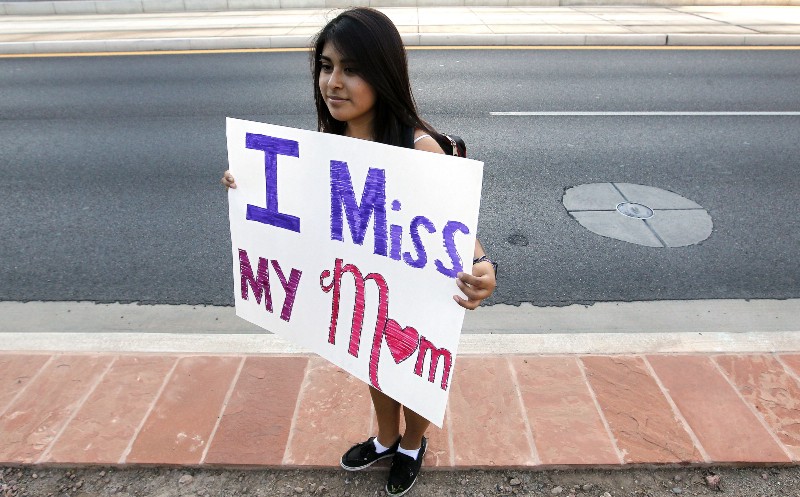
Between 740,000 and 925,000 immigrant parents of U.S.-born children were deported in the decade spanning 2003 and 2013, leaving behind children at risk for significant negative emotional and behavioral outcomes, the Migration Policy Institute found in an extensive study published Monday.
According to the study, children who were unable to communicate with their parents before deportation felt that their parents “disappeared.” Spouses and partners of detained or deported parents reported suffering depression and social isolation, which are in turn “associated with poorer cognitive and socioemotional development in their children.” After a father was deported, study participants typically reported that they continued to stay in the country, but suffered housing instability, emotional harm, and financial stress, which all led to declines in school performance among children.
“Caregivers across the board reported that their children experience anger, depression, and behavioral problems,” Heather Koball, lead researcher and senior fellow in the Center on Labor, Human Services, and Population at the Urban Institute said during a press conference on Monday. She noted that the experience of children seeing their parents’ deportations was “particularly traumatic” and led them to be afraid of the police because they confused them with the uniforms that ICE officers wore.
The MPI study found that families had difficulty obtaining long-term emergency financial, food, and housing assistance after a parental detention or deportation. Families were also less able to find affordable legal services to challenge deportations and that they were often too reluctant to report fraud or other crimes because they were afraid of interacting with the police. Unlicensed parents were reluctant to drive their children to services, especially in South Carolina, South Texas, and rural and suburban areas without reliable public transportation options. Child welfare agencies also reported difficulties in locating parents in custody like “poor coordination with ICE undermined child welfare agencies’ ability to provide services.”
The study also found that beginning in August 2013, the Immigration and Customs Enforcement (ICE) agency established an electronic locator system, established detention center hotlines to consulates and legal-services providers, and “conducted operations when children were not at home or were not awake.”
Though the ICE agency has implemented steps to reduce stress for children, they are not always enforced well. Children are still caught in the crosshairs of immigration raids, like the 11-year-old U.S. citizen who told ThinkProgress that her family was visited by ICE agents on an early morning or the three children left sobbing after their father was taken out of his house by immigration agents. Even Orange is the New Black actress Diane Guerrero described her parents’ deportation in an emotional op-ed stating that when she was 14, she “came home from school to an empty house. Lights were on and dinner had been started, but my family wasn’t there. Neighbors broke the news that my parents had been taken away by immigration officers, and just like that, my stable family life was over.”
“[Immigrants] might be picked up for a DUI — this was happening through the Secure Communities program … this was the large majority,” Koball said. The controversial Secure Communities allowed local immigration enforcement to share all arrested immigrants’ fingerprints with the Department of Homeland Security, regardless of the nature of the offense or whether that immigrant was ultimately convicted.
Though the vast majority of immigrant deportees were undocumented, legal permanent residents (LPRs) could also be deported, as the study found. Still, the findings in part challenge the rhetoric espoused by politicians who say that undocumented immigrants won’t be deported because of so-called “anchor babies,” or U.S.-born children of undocumented immigrants. About 9 million individuals in the United States live in mixed-immigration status families, where at least one parent is undocumented and one child was born in the United States. And a majority of the country’s undocumented population are long-term residents and have have been in the country for about 13 years.