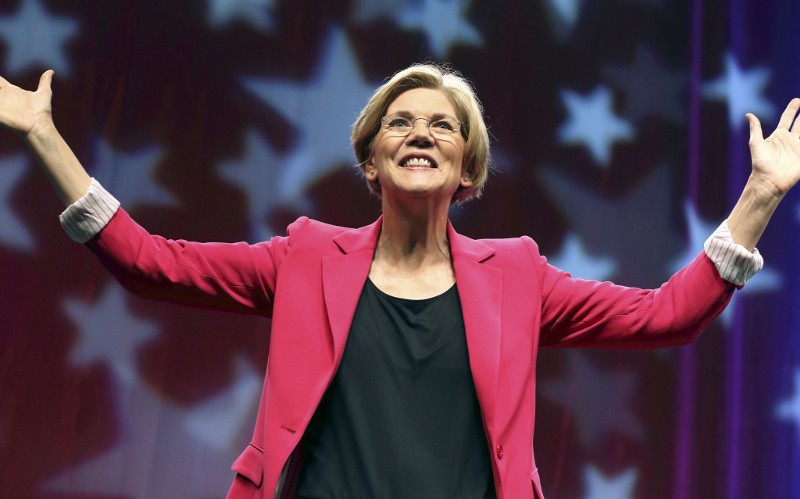
Back in March of this year, Senator Elizabeth Warren dashed scores of progressives’ hopes and dreams with one simple sentence: “I’m not running and I’m not going to run.”
But the influential Massachusetts Democrat is still very much a part of the 2016 presidential election. Her recent private meeting with Vice President Joe Biden — who is said to be seriously considering jumping into the race — has sparked enthusiastic speculation of a possible endorsement, or even a Biden/Warren ticket. Last week, she cast doubt over the widely-held assumption that Hillary Clinton would be the decided nominee. “I don’t think anyone’s been anointed,” she said.
That Warren holds more influence as a non-candidate than as a candidate is not a new idea. But now that presidential campaigns are well underway, the degree of that influence is becoming more visible. Coincidentally or not, the major Democratic contenders have been pressured to take positions on many of Warren’s own key issues.
Their positions, though, haven’t always aligned with hers. So the question remains — which candidate is the most Warren-esque?
Breaking Up Big Banks
Warren is most known for rallying against big banks, and one of the most aggressive ways she’s done this is by proposing a new version of the 1930s-era Glass-Steagall Act, which would divide commercial and investment banking. Allowing commercial banks to offer investment banking and insurance services is too risky, too representative of the “too big to fail” mentality, Warren argues.
Following her proposal, Democratic presidential candidates have been forced to respond to whether they would do the same. Sen. Bernie Sanders (I-VT) said in July that he would support the bill, as did former Maryland Gov. Martin O’Malley. O’Malley also explicitly challenged other candidates to embrace the bill. “Any Democrat running for president who expects to succeed in the general election I believe will need to make basic commitments … to pass a modern version of Glass-Steagall,” he said.
Hillary Clinton, however, has resisted the pressure. Though her campaign has not explicitly answered whether she would support a new version of Glass-Steagall, one of her economy advisers said she would not. “You’re not going to see Glass-Steagall,” he said.
Ending Certain Wall Street Bonuses
At a speech at the progressive Netroots Nations conference this summer, Warren implored progressives to only support candidates who would crack down on financial conflicts of interest within the government. Specifically, Warren challenged candidates to support the Financial Services Conflict of Interest Act, which would “prohibit government employees from accepting bonuses from their former private sector employers for entering government service.”
This was an easy one for Sanders, who co-sponsored the bill in the Senate. And within a few days of Warren’s challenge, O’Malley endorsed the legislation as well.
But Clinton is not yet taking the bait. She has not yet taken a position on the bill. The Intercept published a lengthy piece speculating why this might be, and noted that Clinton’s former colleagues at the State Department worked for big banks, and received bonuses similar to what the bill would prohibit. Clinton reportedly didn’t respond to The Intercept’s request for comment.
Expanding Social Security
Warren’s been making waves for years with her proposal to expand, rather than cut, Social Security benefits. The Washington Post called her “a kind of spokeswoman” for this type of “economic populism.” Mother Jones said she “made expanding Social Security cool.”
Since then, both O’Malley and Sanders have released detailed plans to dramatically expand the program. O’Malley’s plan, released last week, calls for “immediate” boosts to monthly benefits for current retirees, and increased benefits for minimum-wage and lower- and middle-income workers. Sanders’ plan is similar, but says monthly benefit boost would start taking effect in 2021. Both men have proposed raising taxes on the wealthy to pay for the expansions, among other ways.
Clinton has also expressed support for maintaining Social Security, along with some ideas in both Sanders’ and O’Malley’s plans, including lifting the cap on the payroll tax for workers earning more than $250,000. But she has not yet committed to aggressively expanding the program. That does not mean she won’t, though — a spokesperson in April told Talking Points Memo that she would have “a lot to say” on the issue in the coming months. Recent reporting from National Journal also speculates that Clinton is leaning towards endorsing an expansion.
Debt-Free College
One thing every candidate seems to agree with Warren on is providing a debt-free college option. Rather than simply making college tuition free, a debt-free college option makes it so students don’t just avoid tuition debt, but also debt from living expenses as well.
Candidates like Sanders and O’Malley had been talking about debt-free college before Warren released her debt-free college plan back in June, and both have introduced their own plans to do it (Sanders actually released his plan before Warren).
Clinton has also called for making higher education “as debt-free as possible,” and this month released a 10-year, $350 billion education plan that aims to make public colleges debt-free.