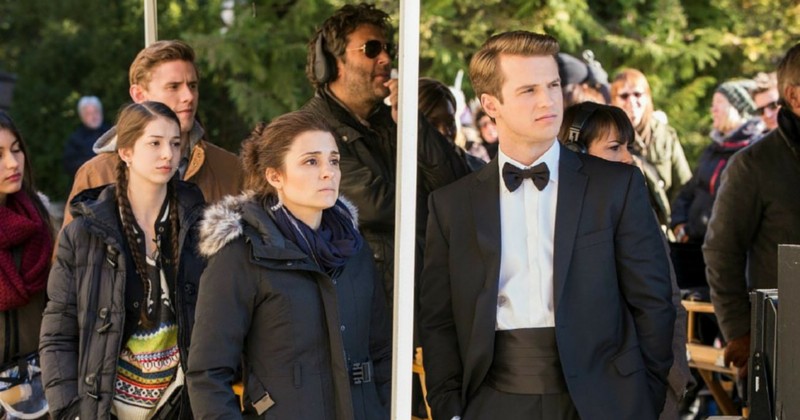
UnREAL is the breakout show of the summer. (Not to say we told you so, but, ahem.)
The new drama takes us into the deeply messed-up minds of the producers behind a Bachelor-style reality show, Everlasting, on which a suitor — Adam (Freddie Stroma), the British ne’er-do-well-heir to a family fortune — has his pick of a telegenic phalanx of hopeful brides, a handful of whom are ditched each week in this Hunger Games of the heart until only one wife-worthy candidate remains. Rachel (Shiri Appleby) starts the season recovering from a professional and relationship flameout. When she returns, only partly by choice, she kills it at work while losing it in her personal life: The better she as at her job (bending the wills of the contestants to fit her ideal narrative arc on-screen) the worse she is at literally everything else. Her boss, Quinn (Constance Zimmer), manipulates Rachel in turn, and by the end of the season, no one emerges with idealism or integrity in tact.
UnREAL could have been held back from smash hit status by any number of things — that annoying title typography; that it airs on Lifetime, home of the treacly-TV-movie; the fact that no one wants to admit they watch The Bachelor, let alone that they would watch a serious show dismantling The Bachelor — but critical adoration, along with the power of word-of-mouth, lifted the show from lackluster premiere numbers to an early second season renewal. In early July, after UnREAL had only been on the air for one month, Lifetime ordered 10 more episodes for next year.
At the beginning of the season, I talked to co-creator Sarah Shapiro, who was inspired to write the show after a contractual obligation forced her to spend nine seasons working on The Bachelor — not exactly the ideal place of employment for a self-proclaimed feminist — about her hopes for the show’s debut. After watching the finale, I spoke with Shapiro and her fellow co-creator Marti Noxon. (The interviews were conducted separately and are combined here for your reading ease.) Read on for their thoughts on the power of the princess fantasy, why “I love you” can be a weapon, and what you can already look forward to seeing in season two.
Congratulations on such an excellent — and well-received — first season! Was there a moment when you felt like the show really took off? When you knew the audience was getting what you were trying to do?SS: There have been moments where I can’t really believe how deeply and accurately people are understanding what we’re trying to do. I feel like a lot of that came from the “Mom” episode. People got it in a really deep way. I was feeling the love coming off of the Faith episode, because that was one of the more humane episodes we have. And the end of episode nine, where Adam asks Rachel to run away with him, seeing the social media response to that is incredible. People are feeling exactly what we wanted them to feel.
What was the reaction you wanted?SS: It’s the princess fantasy full-blown. Marti and I talk about this a lot: What girl doesn’t want to hear that? We wrote that scene to absolutely slay her. When you’re a hard-working, ambitious, creative woman, and someone says, “Quit your job, run away with me, you’re special, you need to be protected.” You’ve worked so hard to be independent, but how tempting that is, and also, what a trap. That was a really important moment for us.
Marti, Sarah had this very personal experience that she brought to her short, Sequin Raze and now to UnREAL. She knew that world really intimately. What was your Bachelor-background? How did you feel about these romance reality shows?MN: I have a show on Bravo [the network’s first scripted series, Girlfriends Guide to Divorce]. I’ve watched my fair share of Housewives. And I just felt a little dirty afterwards. Not proud. But I watched The Bachelor only once and I really felt, after that experience, that I could never do it again. I felt it was so morally compromising, as a woman. And even though I was hating myself the whole time, I still kind of caught up in it. “I wonder if he would pick me if I was the Bachelorette!” I got caught up in the whole romantic fantasy of the thing. And what I really disliked about it was how it sort of pitted women against each other and reinforced all these cultural stereotypes. So even though I found myself wanting to win, I hated myself for wanting that.
It is amazing to step outside the show and think: These women are completely isolated from reality and the internet and everyone they know. All they have to think about is this one guy.
The idea of being watched and documented and paid so much attention to is horrifying while it’s happening, but losing it is terrifying, too. Do they go back to anonymity? They just don’t want to leave. They don’t want to be off-camera.
MN: I really think that design is genius. It’s so smart. Because there’s a primal thing, I believe, with women, when there’s a great number of women and they’re all basically going after the same guy. You know there’s a world outside, but you start to forget. But it’s just behavioral conditioning. If you’re in this situation, and there’s one object of desire, every woman will start to fixate on it. There’s no other form of entertainment, there’s nothing else for them to do, except work out, drink, and fight.
Are you surprised that people will still sign up to be on a show like The Bachelor in real life?MN: No, not at all. One of the misconceptions that I had, and that a lot of people probably have, is that, I used to think, “Oh, they know what they’re signing up for. They deserve what they get.” But the truth is, now that I’ve been exposed to this world of reality TV and how it works, I know that they don’t know what they’re signing up for. How could they? And I think most people outside the entertainment business really don’t understand what you can get away with in editing. It sounds like an adventure for a lot of people. Like something, at the very least, that will take them out of their everyday world and give them this life experience that can be really exciting. So it doesn’t surprise me that people do it, but it amazes me that there’s no such thing as just reality television. They’re going to be expected to deliver like actors, but they’re not equipped like actors.
On UnREAL, when someone says, “I love you,” they’re usually using it as a weapon. How do you read the way Rachel says it to Quinn, and how Quinn says it back? Does Rachel really mean it, or is she using it to gain some measure of control and power in the situation, or both?SS: I think that line was probably the most complicated line in the whole show. When we wrote it, I definitely knew exactly what it meant. And it took a while for everyone to understand what it was. It’s got three layers to it. It’s the first time Rachel has ever said “I love you,” since we met her. And you’re absolutely right, in this universe, it’s always transactional. But for Rachel, she really does mean it, and she’s utterly betrayed, and she needs it, and it is, as you said, a weapon. That really is the architecture of the scene: How does she take power back? And she does it by being as vulnerable as she’s ever been.
MN: It’s one of those things that lives in a gray area. I think Rachel really means it, on one level, and it is a threat, in a way. It is something that, if I heard it coming out of Rachel’s mouth, I’d beware. I think the complexity of their relationship, so much of it is, they have a kind of mother-daughter dynamic. And just like with your parent, sometimes they do what they think is best for you, and you want to kill them, even though they might be right. It’s humiliating, being told you’re not responsible enough to make your own choices in life. We talk a lot about he fact that they’re the central relationship of the show. And that “I love you” is loaded with all the meanings.

Quinn seems to really respond to Rachel better when Rachel is vulnerable. She prefers Rachel to be that way, for their dynamic to work.SS: You can see it sort of completely destabilize Quinn. Quinn is just knocked off of her center for a minute. We think of that scene as a boxing match and Rachel landed the final punch.
That’s such an apt description, because this is a really emotionally violent show. This leaves everyone in a rough place heading into next season.SS: It’s the major push off into season two: All the betrayals. All the chickens are coming home to roost. Everyone gets what they deserve, and no one gets what they want. I feel like, in this episode, Rachel gets everything she deserves and nothing she wanted. And that’s true for Adam, Chet. Quinn gets what she deserves: A career win but a personal loss. For our series-long arc with Rachel, the question about her having a real relationship, you can’t have that if you’re not honest. And the fact that she wasn’t being honest with herself or with anyone else about relationships is the reason why she’s left the way she is. That’s where we leave her: In a place of understanding that all of these lies only bring to fruition more pain, more lies.
It seems like, by the finale, Rachel has kind of lost her magic touch. She’s supposed to be the best at manipulating the contestants, but at this point, she is really struggling to control them effectively. Is she off her game, or is it that these women who have made it to the final round are outsmarting her?SS: I think it’s actually a combination of both: Rachel is a little off her game, because she’s cuckoo-pants. She’s out in the wilderness, mental-health-wise, and telling a contestant you slept with a suitor is not actually smart. But as you said, the women who are left have been there for ten weeks, and they are farther along in knowing how to play the game. One of our endeavors has been to make those women more intelligent.
The contestants do seem savvy but also like they’ve lost all their romantic drive. Everyone just wants to be on the next season, or get their own spin-off.MN: What Sarah and I committed to, from the very beginning, was to make the contestants to be fully fleshed out characters. It would be too easy to make fun of them. I think on some levels, they’re smart and they’re trying to stay above and control it. But on the other hand, they find themselves falling back in to thinking, “I want the prize.” I think, individually, everybody but Faith — fortunately, she figures out who she is — but I do think that certain points, they all feel like they’re falling in love with him, even if they don’t want to. As savvy as they are, everybody wants the fantasy. Everybody wants the prince. And Adam can be pretty damn charming.
You can be a sophisticated person and still have really old ideas about what love is supposed to look like.
SS: The addiction to the limelight is completely irresistible. The idea of being watched and documented and paid so much attention to is horrifying while it’s happening, but losing it is terrifying, too. Do they go back to anonymity? It’s all of them clinging to the light. They just don’t want to leave. They don’t want to be off-camera. I think it’s also, the thing is, it’s ten weeks later, and everyone has drunk the kool-aid. Everyone is off the reservation. They’re committed to the Stockholm Syndrome of it. It’s become completely transactional and it’s become a game. It’s the evolution of where the show is at ten weeks later: Everyone has moved down the path to pure transaction.
Even rookie Madison, with the pigtails! She’s crossed over! Did you always plan on having her lose that innocence?SS: Madison is a really fun character. It was kind of inevitable. Even in the first episode, you could think to yourself, “She’s going down.” She’s a babe in the woods, and especially in this industry, when you first show up, everyone has these growing pains, because it’s an intense, competitive industry. And she was kind of marked from the beginning. We figured that out as we would go along, but we knew, by the end of the season, she would become a player.
MN:: There are moments when I feel like Madison shows a fair amount of, dare I say, moxie. I wouldn’t be surprised, totally, if she ended up being a pretty serious player like Rachel or Quinn.
That reminds me of the scene Madison has with the on-set psychologist who tells her, “No one here does anything just to be nice.” So if Madison didn’t become a player, she’d get crushed.SS: We talked about that scene a lot. That’s a really important line. We have these stages of maturation in these women: Madison stage, Rachel stage and Quinn stage. Madison could be Rachel in five years, and Rachel could be Quinn. It’s watching how they grow into this world. That’s a really important first step.
Are they destined to follow that path? Is Rachel fated to turn into Quinn?SS: Rachel is going to be fighting that, hard. I think we’re going to see that going forward.
I think feeling like if you’re skinny and pretty enough someone will come rescue you, that’s not really true. That takes a toll on women’s mental health. So we’re asking this question: Does this princess fantasy drive us insane?
MN: There’s a real battle going on in Rachel’s heart and mind about who she wants to be, and this crazy mom she has who told her she was sick her whole life. When you’ve internalized that, it’s a real struggle to break out of it. And if she’s broken, why not be broken there at Everlasting, with all the other misfit toys? I hope we will continue to have hope for her. For Quinn, sometimes, I think she’s so deep, it would take a crowbar to take her out of there. With Rachel, it’s funny, it’s like Breaking Bad, where as much as you want for her to stop doing despicable things, you want her to keep doing those things.
I’m honestly more afraid of Rachel’s mom than I am of Quinn. She really unnerves me.SS: Oh, you should be! Rachel’s mom is such a threat because she’s the only person who can really destroy Rachel. Rachel was at her house for maybe an hour and a half and she was flat-out destroyed. She is a nuclear bomb, when it comes to Rachel’s mental health.
Did you expect mental health to be such a prevalent theme in the series? So many characters struggle with it: Contestants have eating disorders, Mary had bipolar disorder, Rachel is always kind of on the verge of crumbling, mentally and emotionally.SS: When I was working on Rachel’s backstory, we always have had the idea that she’s struggling with some stuff. And once we figured out her mom as a character, that became really clear. Marti and I are very passionate about mental health issues with women — eating disorders are one we talk about a lot — and those are all tied into the idea of the princess fantasy in general. We’re asking the question: Is this just frivolous fun, or does this have an effect on us as a whole? I think having unrealistic expectations about love and being destroyed over and over again has such an effect on your mental health. And feeling like if you’re skinny and pretty enough someone will come rescue you, that’s not really true, and that not being a full way to live, that takes a toll on women’s mental health as well. So we’re asking this question: Does this princess fantasy drive us insane?

I was more surprised to see Quinn fall for that romance fantasy than I was to see Rachel fall for Adam. Because Adam is the star of the show, and no one is immune to that power, and Rachel is younger and emotionally unstable. But Quinn seems much tougher. And then we still see Quinn with the wedding magazine stuffed with tabs. How did you get her to that place?MN: I think that we felt like, one of the clues to Quinn’s softer side is that she’s basically devoted a huge amount of her life to a man who is always promising but never delivering. She’s really in love with him! So even though she probably knows better, part of her wants to believe this time is the real time. And of course, she feels like a fool. You can be a sophisticated person and still have really old ideas about what love is supposed to look like. Even Quinn. I always joke that I’m a feminist with a boob job. I want it all. I want to be objectified, but on my terms.
SS: I feel like one of the most important lines in the scene when Chet proposes is him saying, “It’s your turn.” We talk about the idea of show ponies and work horses in the writers room. Some women get to be pretty pretty princesses who are saved and protected and get married, and some women are out in the field working and making things but they don’t get to be pretty pretty princesses. And the allure of that, when he says, “It’s your turn,” even if the guy is actually a toad instead of a prince, the idea that a guy is saying that to you is so alluring. And letting Quinn get carried away with it — there’s a part of her that struggles with that. Marti and I feel like, more than making declarations, we’re asking questions. We’re still figuring that out in our own lives. This fourth, fifth, sixth wave of feminism is so much about that.
Do you feel like you’ve figured any of that out by working on this show?SS: For me personally, I’m very focused on work-life balance and love. Making a show about Hollywood ruining people’s lives, unless you’re deaf and blind, that inevitably tries to make you pay a little bit more attention to your own. You give everything you have to the show — everyone did, and I’m so proud of what we made — but in this little break between seasons, I’m going to be focusing on myself.
Why do you think the princess fantasy is still so compelling?MN: I think that, in some ways, women and our place in the world is changing so fast, in terms of just our work life and our home life, that I don’t feel like the culture is keeping up with it. We’re being bombarded with these messages: There’s this one person out there for us, and we must be pretty pretty ponies to be ready when he shows up. I don’t actually think that’s gotten better. I think it’s something we need to take a harder look at. And it’s one of our central theses: Even Quinn and Rachel, who make the lie, will fall for it.
Marti, are you disappointed or surprised at all that this princess fantasy is still so powerful, given that, more than 15 years ago, you were working on Buffy the Vampire Slayer, which is such a feminist show that really traffics in the opposite messaging about love and femininity and strength?MN: I think that “disappointed” would be the wrong word. I think that I’m frustrated sometimes with the fact that there’s not more conversation about how media portrays women and men and relationships, and how often that perception skews our expectations of life, and I think it makes people unhappy. That happily-ever-after thing sets people up for expectations that just can’t be met. Certainly as a mom to a young girl, I wish there were 100 percent less of the message that, “If she only had a thigh gap, she’d feel better about herself.” That makes me crazy.
One thing that was particularly striking to see in the end of this season of UnREAL is that the male characters also get burned by this fantasy. No one gets out unscathed. Do you think this stuff is as damaging for men as it is for women?MN: I think men are just as confused about their roles right now as anybody. Just like women, they’re now expected to be good at everything: Taking care of kids, earning a living. In some ways, we all long for a simpler time, when men were men and women were women. I feel like Jeremy is sort of an old-fashioned guy. I think he probably cast himself in that role of protector and provider. But I think Adam is much more a reflection of our times, in the sense that he is greatly conflicted about intimacy and sex and the world is full of too many choices.

When you talk to women about the show, do they fess up to having the princess fantasy? Because it sounds like the sort of thing that either happens on a subconscious level or women do realize it affects them, but would never want to admit it. It means accepting that something totally fake has this very real influence over your mind and your feelings.SS: I don’t know that I’ve ever directly addressed it! I don’t think anyone has really honed in on it, exactly. It’s really complicated. For some people, the princess fantasy is real. I know some women who think Prince Charming showed up and married them. They live their lives in a really different way than I have. What’s really fascinating is seeing on Twitter how people reacted to the end of episode nine, which was really exciting as a writer and really scary as a person.
What did people say that scared you?SS: “Run away with Adam! Team Adam!” We wanted that scene to be absolutely irresistible. Because what woman wouldn’t want to hear that? “I can give you the world if you let me, just let me!” Would I rather work here in oblivion and live off Dunkin Donuts and Doritos? The idea that someone can helicopter in and lift you out of your life is so irresistible. We really wanted people to feel that way.
How does the cast feel about this stuff? Do the actors believe in the princess fantasy, too?SS: Shiri and Constance actually had a huge problem with that scene where Rachel says she’d rather write a novel and live with Adam than sign a five-year contract. They were like, “Why would she do that?!” And I was like, obviously she would do that! It was so revealing of their true selves — the actresses, not the characters. And that informed Constance’s performance in that scene because she really thinks Rachel is being an idiot.
Going forward, are you sticking with the model of one season of Everlasting for every season of UnREAL?SS: Way back, that’s two, three years ago, when we pitched and sold the show, one of the things I loved and Nina [Lederman, senior vice president of Lifetime’s scripted series department] loved too was that it was the perfect scaffolding. A season of the reality show was a season of UnREAL. There’s something so tidy and satisfying about that.
How do you map out Rachel’s emotional arc? Does that take precedence over the plot, or do you let the action of the story lead the inner lives of the characters?
I watched The Bachelor only once and I really felt that I could never do it again. I felt it was so morally compromising, as a woman. And even though I was hating myself the whole time, I still kind of caught up in it.
SS: We break stories from inside the characters first. So when we broke the season arc, it was all about Rachel’s emotional arc. From the very beginning, the idea was always to have her get her Walter White moment at the end, which was having her watch Adam propose to someone else after he asked her to run away. That would harden the last bit of softness in her heart. Each episode, we really start off by asking the question: What is going on for Rachel? Where is she on her Walter White journey? And we talked about it a lot: The battle for Rachel’s soul. And we always wanted, by the end of the first season, she’s kind of lost the fight. She’s in a really dark place.
What else can we expect from season two?MN: We know Rachel and Quinn will be in it, and Everlasting will continue in some format. Maybe it’s Everlasting in Hawaii, or maybe the suitor will be a woman and the rest are men.
SS: We always break stories from inside character in terms of Rachel and Quinn, so thematically, we want the outside world to reflect what’s going on with them. So we’ll stick with Everlasting, probably with a significant twist. And race is something we brushed by in the first season and it’s something we’re really passionate about exploring more next season. You’re definitely going to see Rachel’s mom at some point. That’s all going to come crashing down. And we’re open to Adam coming back.
MN: The place where we did touch on race was Jay and his contestants, and the way Quinn was so blatantly racist in her comments. In that world, it’s just sort of a given that these guys aren’t going to go the distance. We’d love to explore that more, and we’ve talked about having the suitor be a person of color.
I hear Chris Harrison, host of The Bachelor, hates UnREAL. Are you annoyed that he’s dismissive of what your show is trying to do? Do you just think it’s cool that he’s watching your show?SS: To be totally honest, when we saw it and heard it, we were kind of thrilled. I’m really glad he saw it.
Do you get the sense that UnREAL has opened doors at Lifetime for grittier, darker shows? I know the last time we talked, Sarah, you mentioned that was something Lifetime was hoping would come in the wake of your show’s success.SS: I think the response from Lifetime has been unbelievable. Picking the show up the way they did at the time they did was really incredible. It’s really been a dream come true in terms of their level of support. I think it does open the door for different kinds of content on the network. There’s a feeling like: This is the kind of place you’d want to bring your show now. This is a place for premium content. Which was not the case when I started working on it.
These interviews have been edited and condensed for clarity.