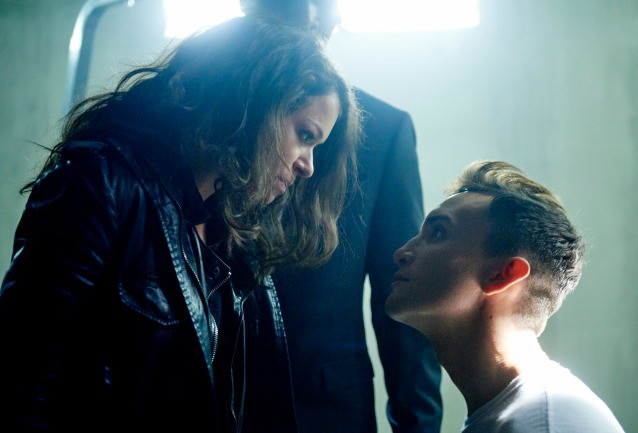
Orphan Black, the genre-bending cult phenomenon on which actress Tatiana Maslany plays as many as five different clones in a single episode, returns for its third season on April 18. The series is centered on Sarah Manning, a smudgy-eyelinered-grifter who finds herself at the center of a secret, vast cloning experiment. Sarah meets, and eventually allies with, her “sisters,” whose lives are as different as their genetics are identical. In the season two finale, we discover that Sarah and her fellow Project Leda creations aren’t the only clones running around: we meet Project Castor, a pack of male clones.
If you subscribe to the notion that shows take on the ethos of their protagonists (e.g. Mad Men is gorgeous, elliptical, often infuriating; Broad City is off-the-wall, effervescent, at least a little buzzed), then it makes sense Orphan Black is so many things at once: science-fiction, action, family drama, thriller. It is also one of the most unapologetically feminist shows on the air, digging into the questions about female agency, reproductive rights — the clones are infertile by design; Sarah, who has a child, is a fluke — and personal autonomy. Who owns a woman’s body? Who gets to decide how women live their lives? Who has the right to stand in judgment of those choices, and what do you do when you are judged and found wanting?
To find out how the upcoming season of Orphan Black will grapple with these big questions, I spoke with showrunners Graeme Manson and John Fawcett. Read on for their thoughts on what to expect from the male clones, how gender roles get flipped in the Orphan Black universe, and why it’s important to maim and/or murder characters in as many different ways as possible.
Tell me about the introduction of male clones into the Orphan Black world. How long has that been in the works? And what does the addition of male clones do to the feminist center of the show?GM: It was always part of the plan. We had the concept of it in season one: to introduce male clones as we slowly expanded our world. But we didn’t want to open the door until the end of season two. It was a nice way to open up the mystery and throw it forward. That being said, it’s still Sarah’s story. Sarah is the one pursuing the mystery on behalf of the sisters, so the drive and the mystery is focused on our girls. And in terms of the feminist aspects of the show, the themes of the show that have grown exponentially as the show has evolved, there’s no reason that introducing males should do anything except highlight those themes.
JF: I think that is one of the things we were trying to do, is strengthen our themes of sisterhood and family and use the male clones as a kind of way to put the focus back on Sarah and her sisters, if that makes any sense at all. Honestly, the boys plan to be adversaries, for the most part, and they’re part of the mystery, too. Sarah is our lead character, and we like to see our show through her eyes as often as possible.
GM: And I think, definitely, if you want to explore feminist themes, you have to challenge those themes. And if there’s one way to highlight our feminist themes, it would be to throw a misogynist into the mix.
It seems already like the creators of these clones treat the female and male projects very differently. The men have access to more information, it appears; they’re all self-aware and have always known that they’re clones.JF: The interesting difference between the girls and the boys is the boys have all grown up together, and they’ve grown up in a military environment, and they’ve grown up like brothers. That’s a very, very different thing than the way the girls have grown up. The girls have grown up not knowing about each other, in very different environments, in different levels of society. It created a very different result in the boys than in the girls.
If there’s one way to highlight our feminist themes, it would be to throw a misogynist into the mix.
GM: And I think because the girls were raised this way, the way they treat each other is as individuals. They want to give each other the freedom to be individuals. If you met your own clone, the first thing you’d do is try to identify your differences. The boys are different that way; they’ve grown up in a little wolf pack. There’s more peer pressure. Putting them all in the same room together, they lose the edges of their personality.
How much should viewers read into the names of these operations: Project Leda for the women and Project Castor for the men? If you fall down an internet rabbit hole, is there useful information to be gleaned from what you’d find?JF: If you fall down a rabbit hole, that’s great!
GM: We do our research around it. We do look at the mythological implications. Thematically, you really want to rub up against those things and make people think.
It feels like the themes of the show have become more explicit as the series has gone on: characters talk directly about ownership, reproductive rights, female autonomy. At one point last season, Sarah is getting grilled by these scientists who ask her all these invasive questions like “when did you lose your virginity?” and “have you ever had an abortion?” Is that a conscious decision on your part, to bring those ideas to the foreground of the show?GM: The overall themes of ownership and individuality, corporate control of genetics, be they human or natural: they’re really important questions, and we don’t want to hit everyone over the head with them, but it’s nice when they’re intrinsic to the show. We try to make it about the real heart of the characters and what they’re struggling with. They don’t have to talk about it all the time and analyze it too much. We want to spawn conversation after the show. We call it the coffee conversation: what you’d be talking about over coffee the next day.
The way Sarah and her sisters are trying to hunt down their original genome — this central question of parentage, basically — reminds me of what Paige is going through on The Americans, as she has spent so much time wanting to know who her parents really are. It’s so universal, even though in Orphan Black there’s this otherworldly, sci-fi element. But I’m curious if you think the clones have the right to know all these answers: does that information belong to them? Or is it the opposite view that’s unrealistic or unfair?JF: Yeah, that’s interesting. In this day and age, it’s harder to keep those secrets. And biologically, our information is harder to keep control of. It’s harder to keep secrets from your parents, because your parents stalk you on Facebook. And there’s the future possibility of publicly-accessible information about everybody’s own genome. Would you give your genome to Ancestry.com?
In the beginning of season three, we see Cal and Sarah take on these gender-flipped roles: Cal stays home with Kira and tells Sarah to be safe, while Sarah leaves, putting herself in danger and fighting evil. What are your thoughts on that character? Was it a conscious decision, to structure that dynamic this way?GM: It’s actually the unintended consequence of putting females front and center and square in all of your lead roles. And then what happens to your supporting characters? They become the usual female supporting casts, and they perform those roles. That’s largely it. We like the fact that it’s bent on its ear, but really it’s a function of storytelling.
JF: It is nice, though, to see Cal, in a much more active role.
GM: Sarah deserves an ally, I think. She deserves an ally.
Sarah has a lot of allies though, doesn’t she? It feels like it didn’t take too long for all the Project Leda clones to join forces and call each other “sister.”
We want to keep the audience feeling on edge, feeling afraid that one of our girls could be hurt, injured, or killed at any moment.
JF: It took at least one season. It took Sarah shooting Helena. And Cosima and Sarah weren’t exactly seeing eye to eye in season one. In season one, they were all kind of not super trusting of each other. It took part of season two to get together. It’s interesting watching the evolution of those relationships, though, and how Sarah went from a girl, really, a street urchin who is running from her responsibilities, to come back to kind of own the fact that she was a mother, and to really start to take some responsibility for the fact that she’s a mother, and to become okay with the fact that she has a weirdo, psycho sister. That’s almost all of season two. In season three, one of the things i’m most excited about for Sarah and her journey is that Sarah has stepped into her own and is in this place where she wants to protect. She is spearheading the search for answers for the sisters. She wants to protect the sisters. It’s very much about Sarah wanting to protect the family, in a way. She’s really grown up a lot. So I like the evolution of that.
I know almost everything is secret, but what can you reveal about season three?JF: There are some great journeys taken by our supporting cast. Delphine has a very interesting line, and Paul, I think, really shines in season two.
GM: Felix gets to spend time with Cosima quite a bit, so that relationship expands. We put characters together that you wouldn’t expect to see together. I don’t want to say too much about that, but that’s just something that we love to do.
One of the elements of Orphan Black that makes it so intense for a viewer is that it feels like any main character could actually die at any moment. Like you know, when you’re watching Homeland, “Well, Carrie can’t die because they’re not going to fire Claire Danes, or if she were leaving the show, I’d have read about it somewhere.” Because all your key characters are played by the same person, dangerous scenarios really feel dangerous. Do you share that sense when you’re writing: that anyone could go at any time?GM: The thing is, I don’t know. It’s a constant battle. But we like our sisterhood. We like our core sisterhood.
When it comes down to killing, injuring, maiming, or otherwise defiling, we always push ourselves really hard.
JF: The other thing you’ve got to remember too, is, okay, we want to keep the audience feeling on edge, feeling afraid that one of our girls could be hurt, injured, or killed at any moment. That’s a really important part of our show. And we work hard at keeping that in the forefront of people’s minds and placing a level of reality on the material so that you feel that way. That being said, you’ve got to remember that even though you know they’re not going to fire Claire Danes, and of course we’re not going to fire Tatiana, but in people’s minds, these characters — Sarah, Helena, Alison, Cosima — they’re all very separate characters in the world of the show and amongst our fans. So that’s obviously something that we take extremely seriously, because no one looks at this like it’s the same actor playing the same part. So they’re hard-to-kill characters.
Speaking of killing, you’ve offed and injured some characters in particularly bizarre ways: letting a scarf get caught in the garbage disposal, a gun accidentally going off while a character is trying to negotiate, a weaponized pencil. Do you keep some running list of weird murder methods?GM: I don’t know if it’s a running list. but when it comes down to killing, injuring, maiming, or otherwise defiling, we always push ourselves really hard. John’s not gratified with just getting shot.
JF: It’s more fun when you can hurt people in other ways.
GM: And it could be more hilarious.
This interview has been edited and condensed for clarity.