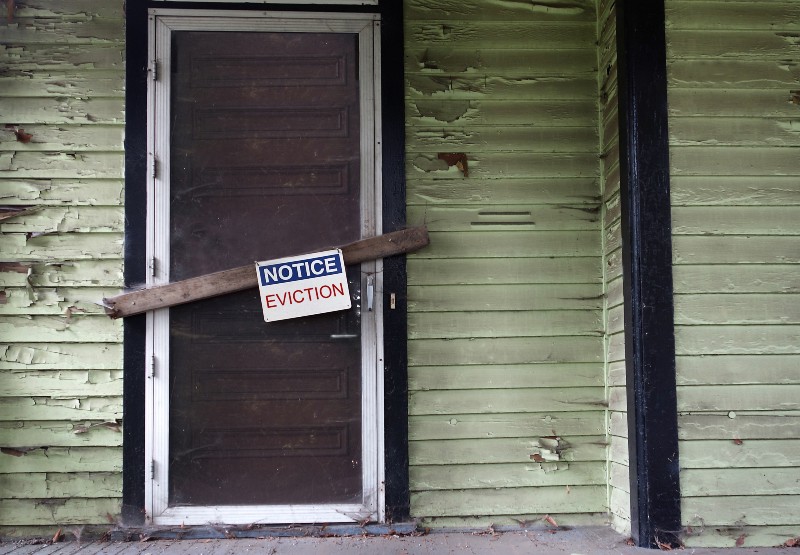
Immigrant families in Virginia are suing a mobile home company for unfairly evicting them after discovering that some of their family members were undocumented, according to a Legal Aid Justice Center complaint released this week.
The families, who live in Waples Mobile Home Park in Fairfax County, VA, allege that the landlord — the Waples Mobile Home Park and its management company A.J. Dwoskin & Associates — increased the rent for or refused to renew the leases of residents who have undocumented family members living with them.
The complaint was filed on behalf of four Latino families who claim the landlord began strictly enforcing a years-old, dormant policy requiring the Social Security number of every occupant over the age of 18. When residents were unable to provide the information, the landlord forced them into month-to-month leases that were as much as $300 more than what they paid for in their annual leases. Landlords also handed out eviction notices.
I was overcome with frustration and disbelief.
“I have been sick from the stress of what happened at Waples,” Rosy Giron de Reyes, a former tenant, said in a press statement. “When they told me I had to move, even though my husband and son could keep living there, I was overcome with frustration and disbelief. This is why I’m standing up for my rights, together with my neighbors. I hope this lawsuit will force them to do the right thing.”
Rosy, an immigrant from El Salvador, doesn’t have a Social Security card. But her husband Jose, who has temporary protected status (TPS) and is authorized to work in the United States, does.
The couple says that when they first signed an one-year lease with Waples in May 2013, the landlord only requested Jose’s Social Security number for a credit and criminal background check. But the next year, when they tried to renew their lease, the landlord demanded Rosy provide proof of lawful immigration status — and sent an agent to search through the Reyes’ home to look for her documents. The agent told the family that Waples “did not want undocumented immigrants to reside at the Park because undocumented immigrants ‘might be criminals,’” the complaint claimed.
The Reyes were ultimately able to sign a second one-year lease. But when they tried to renew their lease again, they were told their only option was to enter into a month-to-month lease and pay a surcharge. The landlord again told Rosy to provide a government-issued identification card and a Social Security card, or risk eviction.
The Reyes has since moved out to an apartment that costs more than twice what they paid to reside at the Park in their mobile home.
Attorneys for the families said that Waples Mobile Home’s policy disproportionately targets Latino immigrants. As many as 210,000 undocumented people live in Virginia, and many of them are unable to obtain Social Security cards.
A policy of this nature is bound to have a discriminatory impact on Latinos.
“In this area especially, but also in much of the country, the rates of Latinos who lack a Social Security number is far, far, far greater than say, white people, African-American people, Asian folks,” Simon Sandoval-Moshenberg, the legal director of the immigrant advocacy program at the Legal Aid Justice Center, told ThinkProgress in a phone interview. “A policy of this nature is bound to have a discriminatory impact on Latinos. They shouldn’t be able to profess surprise that this is disproportionately kicking Latinos out of the park as opposed to white people who live in the park.”
The Fair Housing Act has long ensured that landlords can’t discriminate against tenants — not even undocumented immigrants — because of their race, color, familial status, and national origin.
Other cities and counties have tried similar tactics to restrict housing for undocumented immigrants. Hazleton, Pennsylvania and Farmers Branch, Texas separately and unsuccessfully tried to pass ordinances to enact this type of policy citywide, but both cases were shot down by federal courts.
Limiting the way that undocumented immigrants are able to live has already had an unforeseen effect at Waples. Sandoval-Moshenberg said he’s started to see more foreclosure signs.
“It doesn’t make a lot of economic sense,” Sandoval-Moshenberg said. “[These Latino immigrants] pay their rent on time for many many years. They don’t cause problems. Why a landlord wants to kick out a tenant like that, I have no idea. These are folks, but for this Social Security issue, would not be at any risk of eviction.”