This week Kansas has been struggling to dig itself out of a budget hole so deep that it has gone into legislative overtime to fix the problem. This week, the House rejected yet another a proposal that would have used a hikes in sales and cigarette taxes to raise revenue.
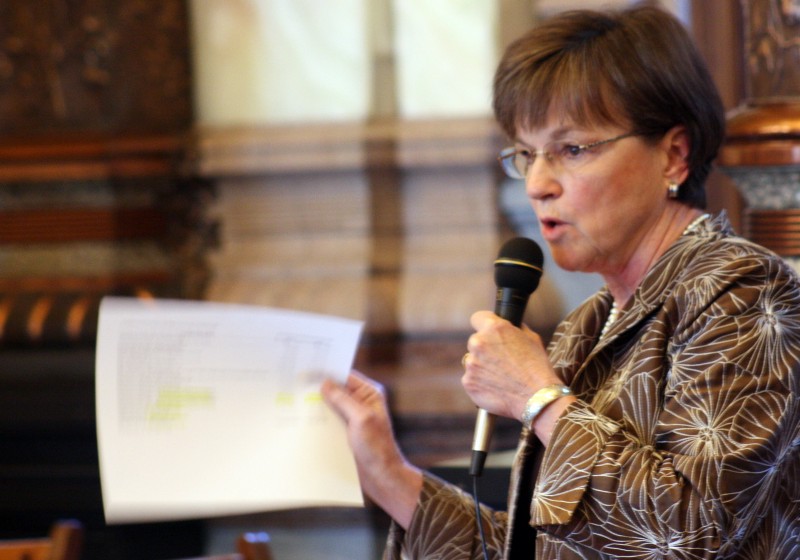
“The longest session we’ve ever had was 107 [days] and we’re already on our 112th, with no end in sight,” said state Sen. Laura Kelly, a Democrat from a district in the northeast part of the state who has been working on the Kansas conference committee to reach a deal between the two bodies of the legislature on the budget. Kansas is constitutionally obligated to create a balanced budget each year.
Kansas has been paying the price for tax cuts passed in 2012 and 2013 after the election of Gov. Sam Brownback and other Republicans who sliced income taxes and taxes on small businesses in the hopes of spurring greater economic growth. But that dream hasn’t been realized. Instead, the legislature is left scrambling to try to pass a balanced budget without making alterations to the tax code.
“I don’t see a way of reconciling this without putting at least some of the business tax back on,” Kelly said, referring to one proposal that would at least tax small business profits at the same as the lowest level of income tax, 2.7 percent. “Just doing sales tax, it doesn’t work in the long run.”
“We knew back in 2012 when the debate was going on about the tax bill exactly what the ramifications were going to be. Our finance folks ran the numbers and made it very clear that we’d be $1.2 billion under water by now. And that’s exactly what’s happened,” Kelly said. She explained that even though the current budget is about $400 million short, they managed to collect about half of the overall $800 million deficit by pulling funds from highways and other budgetary tricks.
“A lot of my colleagues and the governor just wear these ideological blinders and refuse to see and deal with reality,” she said. Kelly serves as the ranking minority member on several committees, including the state Senate’s Ways and Means committee.
One contentious piece of the legislation has been tweaks to how the state distributes Temporary Assistance for Needy Families (TANF), or welfare, benefits. The state passed a bill that would limit any withdrawals of benefits to $25 a day, which “gets negotiated down to $17 a day once you realize that ATMs only dispense twenties and the state imposes an 85-cent or a dollar on each transaction and the bank has fees.” Kelly explained that her colleagues are concerned that the federal government will revoke more than $100 million in funding over this law, which they may see as too restrictive for the beneficiaries. They tried to raise the cap to $60 a day, but it was negotiated out in committee. Instead, they decided to leave it up to the secretary at the Department of Children and Families to lift or remove the cap should the Feds crack down.
“What we were doing with that bill was taking things that have always been in policy, rules and regulations, and we were going to put them into statute only so that the next administration could not easily make changes if they wanted to restore some of the benefits, some of the flexibility or reduce some of the stringent criteria that had been imposed over the last four or five years. I had constituents pretty outraged about that,” Kelly said.
She also says it’s been challenging to even bring her colleagues to the negotiating table. During her 11 years in the legislature, she’s seen Kansas go from a “moderate majority” in the Senate to a divided mess, even within the Republican caucus. “It used to be that the House was the more conservative body, and would often come up with some pretty outrageous legislation, but then it would come over to the Senate, but Senate moderates, really Democrats and moderate Republicans, formed what we called the moderate majority. We could pretty much block any outrageous legislation,” she recalled.
“We worked very closely together, putting together budgets and education policy and that kind of thing,” she said. Now, as the state struggles to pass a balanced budget, with the latest proposal of a sales tax hike still falling $50 million short, “all of that is gone.”