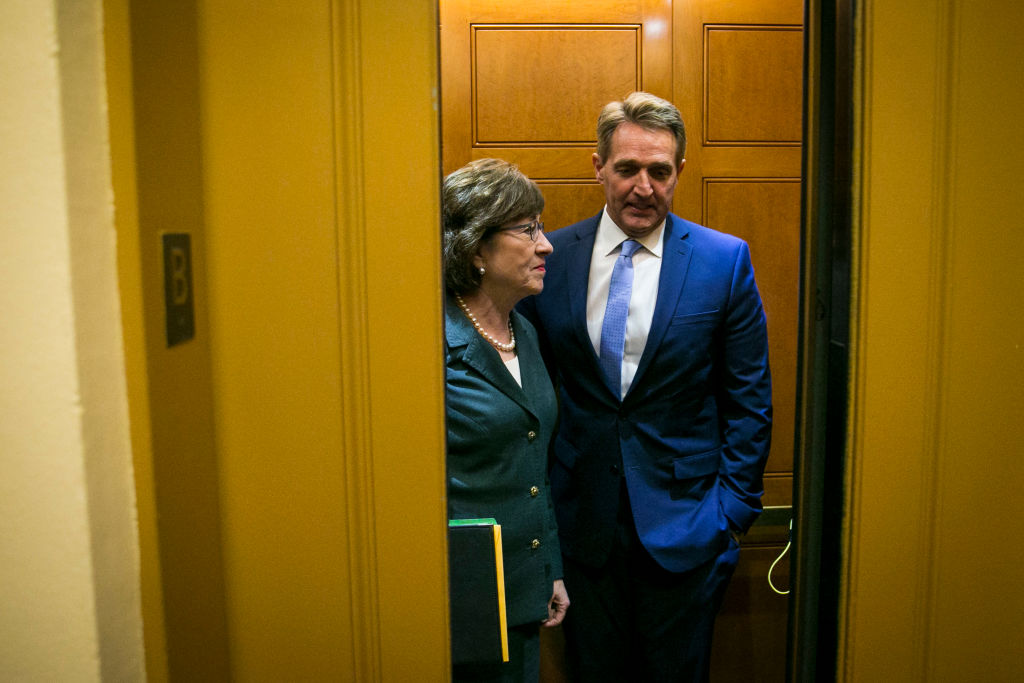
On the heels of the Trump administration’s unhinged, ad hominen attacks against Canadian Prime Minister Justin Trudeau over the weekend, Sen. Jeff Flake (R-AZ) responded by tweeting, “Fellow Republicans, this is not who we are. This cannot be our party.”
Fellow Republicans, this is not who we are. This cannot be our party. https://t.co/xkGMYfoR9w
— Jeff Flake (@JeffFlake) June 10, 2018
It was far from the first time Flake has tweeted basically that same thing.
how many more times can he say it before he figures it out pic.twitter.com/VYu35UoqRh
— Simon Maloy (@SimonMaloy) June 10, 2018
Flake is among a group of Republican senators who took to Twitter to signal moral opposition to Trump’s latest attack on an American ally — one that included John McCain (R-AZ) and Susan Collins (R-ME).
To our allies: bipartisan majorities of Americans remain pro-free trade, pro-globalization & supportive of alliances based on 70 years of shared values. Americans stand with you, even if our president doesn’t.
— John McCain (@SenJohnMcCain) June 10, 2018
We’ve had differences w/ Canada over the years, particularly regarding subsidies from the provincial & nat’l governments; nevertheless, Canada remains our close ally, good friend, & one of America’s biggest trading partners. In Maine, we have a special relationship w/ Canada. 1/2
— Sen. Susan Collins (@SenatorCollins) June 10, 2018
But while Republican senators are willing to talk about how they oppose Trump, they seem to be unwilling to actually do anything to stop him.
It’s not as though it’s an impossible task. With the U.S. Senate currently including 51 Republicans, all it would take is one Republican to break from the majority and form a coalition with the chamber’s 47 Democrats and two independents that could effectively hold up Trump’s agenda.
They could block the protectionist trade policies that fueled Trump’s ire toward Trudeau in the first place. One Republican senator, Bob Corker (R-TN), already made an effort to do that by introducing legislation that would give Congress broad authority to block the president from implementing tariffs without congressional approval. While Flake is a co-sponsor of the bill, Collins and McCain are not, and its prospects are uncertain at best.
Beyond Trump’s veto power, recent polling alludes to a major reason why Republicans are reluctant to do more than tweeting to oppose Trump. According to a Gallup survey released earlier this month, 87 percent of Republicans approve of Trump’s performance — the highest same-party favorability of any Republican president at this point in his first term in the last 60 years, with the exception of George W. Bush, who at the time was riding a post-9/11 wave of popularity.