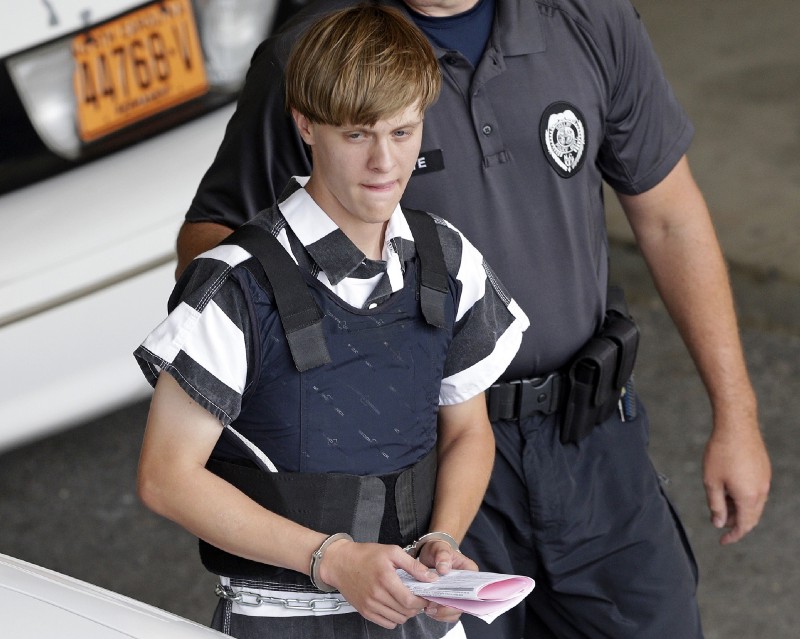
As Donald Trump’s pick for Attorney General, Sen. Jeff Sessions (R-AL), faced questioning from the Senate Judiciary Committee on Tuesday, the man who killed nine black churchgoers in South Carolina was sentenced to death by a unanimous jury.
Dylann Roof, who represented himself in federal court and maintained that he felt no regret for what he had done, will join 62 other prisoners on federal death row.
Before Trump’s election, it was more likely that the 22-year-old would live out the rest of his natural life on death row, rather than be killed by the state. The federal government has executed just three death row inmates since 1988, and Obama’s Department of Justice has put federal executions on hold while they figure out their lethal injection protocol.
But with Trump and Sessions poised to take charge of federal death row, the fate of these inmates is an open question.

Sessions has demonstrated a pronounced enthusiasm for the death penalty. As Alabama’s attorney general, he pursued the execution of mentally disabled and delusional people who clearly had no idea what was happening to them, as well as people whose trials were marred with racial discrimination, prosecutorial misconduct, or inadequate counsel. He pushed legislation to speed up executions and to make people convicted of multiple drug crimes eligible for the state death penalty. He also blasted a Supreme Court ruling that barred states from executing mentally disabled people.
Support for the death penalty has waned over the years, and fewer states are choosing to seek capital punishment. But the Attorney General holds significant power to change the tide of executions in the United States.
Just look at the last Republican Attorney General’s record. The only three executions since 1963 occurred almost immediately after former president George W. Bush took office and appointed John Ashcroft to head the DOJ. Ashcroft quickly approved the first execution in forty years: Oklahoma bomber Timothy McVeigh in June 2001, followed by the executions of Juan Garza and Louis Jones, Jr. At the same time, Ashcroft aggressively stepped up federal death penalty prosecutions, often in states that had lost their taste for executions. He overruled a third of local prosecutors who had recommended against the death penalty or decided not to seek capital punishment.

Attorneys General in recent administrations have mostly rejected requests to execute inmates. But even though federal death penalty cases are less common than state prosecutions, they share some of the same problems and racial motivations.
The federal death penalty was reinstated in 1988 and expanded twice under President Bill Clinton. Research shows that people of color are the target of most death penalty prosecutions, and Department of Justice heads have authorized the death penalty more often when the victim is white.
Far from being reserved for the most serious crimes, prosecutors have sought the federal death penalty as a tactical measure, often as a way to get African American defendants in front of white juries and out of local jurisdictions with substantial non-white populations, such as New Orleans, LA, St. Louis, MO, Prince Georges County, MD, and Richmond, VA. Legal experts found that far more death sentences have been brought in those federal districts than the higher-crime districts of New York, California, or Florida.

The longest residents of death row are three African American gang members, Corey Johnson, James Roane Jr. and Richard Tipton, who were sentenced in 1993 for murders related to their crack cocaine drug ring in Richmond.
President Obama, who has said he finds the death penalty “deeply troubling,” could commute the sentences of the 62 men and 1 woman on federal death row to life in prison without parole. Over a year ago, he said he had instructed the DOJ and White House Counsel to examine the facts of these cases and evaluate the fairness of the federal death penalty. Obama has made commutations a priority in the final months of his presidency, reducing the sentences of more than a thousand people.
An eleventh hour commutation for death row inmates would not be unprecedented: former President Bill Clinton commuted the sentence of the first federal death row inmate, marijuana dealer David Ronald Chandler, two hours before George W. Bush took office.
But the biggest stumbling block to Trump’s execution regime may come from elsewhere in the Trump administration: the Food and Drug Administration. The federal government and the states have struggled to obtain the drugs to carry out lethal injection, thanks in part to the FDA’s ban on importing one crucial drug. The FDA has seized the lethal injection drug sodium thiopental from states that have tried to import it, as it is not FDA-approved. Some states have turned to black markets and passed laws to shield the source of their drugs as a result. The question of whether or not the FDA should make an exception for law enforcement is winding its way through the courts now. Texas sued the FDA on Tuesday, accusing the agency of “gross incompetence or willful obstruction” for delaying a decision on whether or not it would allow importation of the drug.
Trump has not yet named a nominee to head the FDA.
Aviva Shen, a former ThinkProgress editor, is now a freelance writer in New Orleans focused on criminal justice.