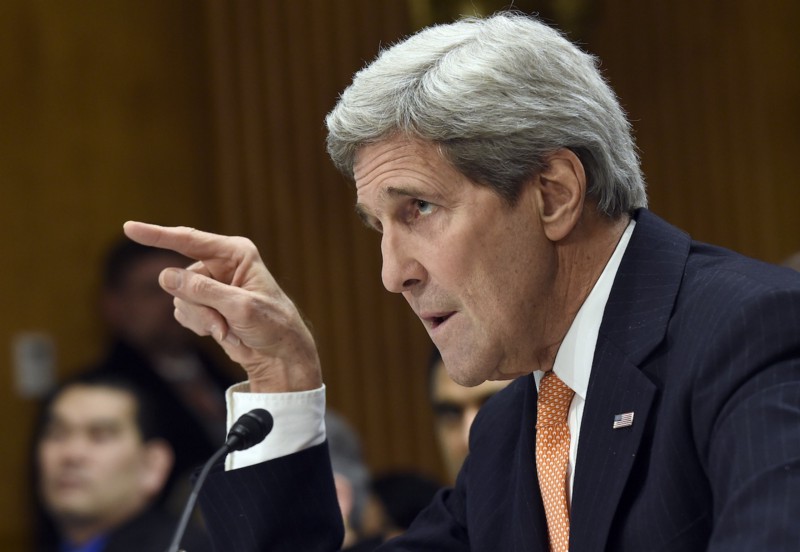
Secretary of State John Kerry sharply rebuked press reports on Tuesday that the United States is finalizing a deal surrounding Iran’s nuclear program that would prevent Tehran from building a nuclear bomb for only a decade.
Testifying before the Senate Foreign Relations Committee, Kerry insisted that the United States is “looking for a deal that will prove over the long term” — one that will presumably last longer than 10 years.
Numerous press accounts reported on Tuesday that the United States and Iran are closing the gap around an agreement that would establish a 10-year regime of strict controls on Iran’s uranium enrichment and should Iran comply, lift economic sanctions against the country during the final five years.
Republicans and some Democrats quickly condemned the deal as inadequate and Israeli Prime Minister Benjamin Netanyahu lambasted it as dangerous.
“Don’t believe what you read…it’s not true,” Kerry said in response to pointed questions from Sen. Bob Manendez (D-NJ), a skeptic of the administration’s negotiations. He told the committee that the administration would only agree to a deal that ensures that “each pathway to a bomb is closed off.”
“We have some tough issues in front of us, there are no guarantees here, some very tough issues. And we are adamant about not doing a deal that can’t withstand scrutiny,” Kerry said. “It is not certain yet that they [Iran] are prepared to meet whatever we think this important standard is that has to be met.”
The former Massachusetts senator also pushed back against conservative critics who are urging the administration to adopt a no-enrichment standard, one that would prohibit Iran from enriching any uranium at all. Kerry reminded the committee that the Bush administration adopted such a policy and saw Iran’s centrifuges grow from 164 in 2003 to approximately 19,000 centrifuges today.
“Guess what, they learned how to enrich. They’re now enriching. And the question is whether or not we can create a system where they have a peaceful nuclear program like other people who enrich that is manageable, controllable, verifiable, accountable,” Kerry said.
The United States, along with Britain, France, Russia, China and Germany, is seeking to limit Iran’s ability to enrich weapons-grade uranium, reduce its number of operating centrifuges and advanced centrifuges, and lower its low-enriched uranium stockpiles. The emerging agreement would allow Iran to retain its nuclear infrastructure but delay the “breakout” period for developing a weapon by more than a year.
Iran and its negotiating partners must agree to broad principles on limiting Iran’s nuclear capabilities no later than March 24 and reach an agreement on the technical aspects of the deal by June 30.