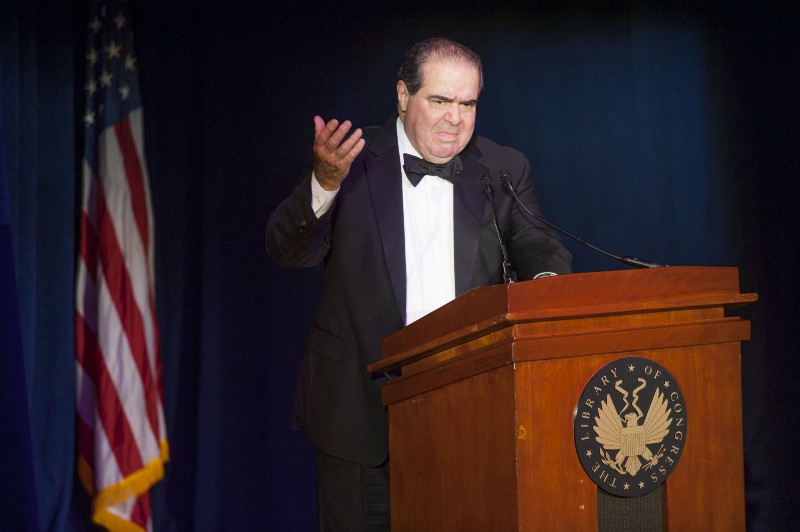
Justice Antonin Scalia, along with two of his conservative brethren, used a largely unnoticed immigration case to offer an implicit rant against marriage equality. Though his opinion never mentions same-sex marriage or the rights of LGBT Americans directly, it is hard to imagine that Scalia did not have the battle over marriage equality on his mind when he wrote the plurality opinion in Kerry v. Din.
Din was not an especially closely watched case this Supreme Court term. It involves a “former civil servant in the Taliban regime” who is married to a United States citizen, yet was denied a visa to immigrate to this country. For six of the justices, it also turned on a fairly minor and technical question. Justice Stephen Breyer, joined by his fellow Democratic appointees, wrote that the federal government owed this man, Kanishka Berashk, a more complete explanation of why he was denied a visa. Justice Anthony Kennedy, joined only by Justice Samuel Alito, wrote what lower courts will probably view as the controlling opinion in this case. Kennedy concluded that the federal government’s citation to a law “prohibiting the issuance of visas to persons who engage in terrorist activities” was all the explanation Mr. Berashk and his wife were entitled to.
That left Justice Scalia who, joined by Chief Justice John Roberts and Justice Clarence Thomas, transformed this seemingly minor case into a sweeping refutation of the idea that marriage rights can be expanded beyond their historic bounds.
The case arose after Berashk’s U.S. citizen wife, Fauzia Din, made a somewhat unusual constitutional claim. As Scalia describes her case, Din “claims that the Government denied her due process of law when, without adequate explanation of the reason for the visa denial, it deprived her of her constitutional right to live in the United States with her spouse.” He then devotes the bulk of his opinion towards explaining why “[t]here is no such constitutional right.”
On the surface, Scalia’s opinion hews to the issue presented by Din without mentioning marriage equality at all. Yet his dismissive take on Din’s legal arguments would be harmful to the cause of marriage equality if they were ever adopted by a majority of the Court. “Nothing in the cases Din cites,” Scalia says, “establishes a free-floating and categorical liberty interest in marriage (or any other formulation Din offers) sufficient to trigger constitutional protection whenever a regulation in any way touches upon an aspect of the marital relationship.” Instead, Scalia writes that this case is controlled by the Court’s decision in Washington v. Glucksberg, which tied the scope of many constitutional rights to “this Nation’s history and practice.”
“Even if we might ‘imply’ a liberty interest in marriage generally speaking,” Scalia writes, “that must give way when there is a tradition denying the specific application of that general interest.”
In Din’s case, Scalia cites a bevy of early twentieth century laws, many of which unconstitutionally discriminated against U.S. citizen women, to justify the proposition that a wife’s right to live in the United States with her non-citizen husband is not rooted in America’s legal tradition. Yet his attempt to tie the scope of the marriage right to history and tradition has obvious echoes in the marriage equality debate. During oral arguments over marriage equality this past April, Scalia focused a claim that “for millennia, not a single society” supported marriage equality. His frequent ally, Justice Alito, claimed that even “ancient Greece,” a society that Alito perceived as welcoming to same-sex relationships, did not permit same-sex marriage. Even Justice Kennedy, a frequent proponent of gay rights, worried that “we’re talking about millennia” that human civilization did not recognize same-sex marriages.
To be sure, gay rights attorneys have other arguments at their fingertips beyond the claim that their clients are protected by a constitutional right to marry — including a very strong claim that dening marriage equality to same-sex couples violates the Constitution’s ban on many forms of discrimination. Nevertheless, if marriage rights are fixed in place according to past generations’ frequently abusive treatment of LGBT Americans, then marriage equality is a lost cause.
The good news for same-sex couples is that Scalia’s opinion was only joined by himself and two other justices. All five of the votes that supporters of marriage equality need to prevail — Kennedy and the four liberals — either wrote separate concurring opinions or joined the dissent. If anything, in other words, Din may give marriage equality’s proponents some additional cause for hope, as no one joined Scalia’s opinion who wasn’t already expected to vote against equality.