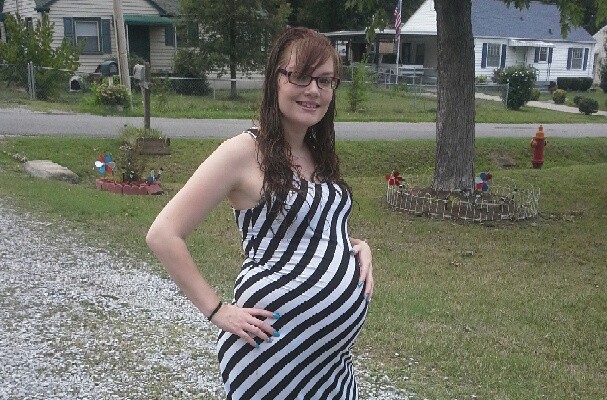
Jessica Craddock risked her health and lost her housing all because her employer wouldn’t give her a break while she was pregnant, she says.
Craddock has worked for a Kroger grocery store in Nashville since 2012, and she loves her job. But it got a lot harder on her when she got pregnant two years ago. After she found out she was seven weeks along, she started to experience health problems. She says she experienced severe abdominal pain, back pain, urinary pain, irregular bleeding, and was at a heightened risk of miscarriage.
And it didn’t help that her job requires her to lift heavy boxes. “I was lifting boxes of chicken, I was doing supplies…stocking the shelves, slicing meat,” she said. Some of the boxes weighed as much as 40 pounds each.
In February of 2014, she says, she told her manager that she was pregnant and needed to avoid lifting heavy objects, “because it’s putting a strain on my stomach,” she said. She says was told she couldn’t have her request met without a doctor’s note, but she didn’t have health insurance, so she couldn’t go to the doctor. When a coworker would try to help her with the heavy lifting, she says, her coworker would get reprimanded by a supervisor.
Things only got worse. One day in March her symptoms intensified. “I was sick, I was weak, I felt so dehydrated I couldn’t stand up. I kept throwing up,” she said. She asked her manager if she could leave to get medical treatment. She says that when her manager asked how far along her pregnancy was and she informed her she was at 13 weeks, the manager replied, “You need to solve your problem,” refusing to let her go. “She didn’t let me leave early that day, she insisted on me to work my scheduled work,” Craddock said.
“That day I worked my whole shift sick,” she added. She stayed for the next five hours, she says. But her condition got so severe that after her shift was over she was rushed to the hospital and treated for severe dehydration.
Craddock still went back to work, but in April, at four months pregnant, things worsened once again. “Eventually I was in so much pain I was rushed to the hospital,” she said. It was there that she found out that even though she was just four months pregnant, her baby had dropped into her cervix and she was at risk of miscarrying.
She was able to keep her baby, but the doctors gave her a note saying she couldn’t lift more than ten pounds. When she gave it to her manager, she says she was finally given light duty work in the deli and bakery section of the store and freed from lifting heavy objects.
Yet a few weeks later, when she returned to work after receiving more emergency medical treatment for her pregnancy, she says she was told that Kroger has a “no restrictions” policy for employees unless they’re injured on the job. Because her job restrictions were related to something else, she was told to go home and stop working altogether, she says. “It came as a shock,” she said. “They just sent me home, didn’t tell me if I could come back or what I needed to come back or anything.”

Craddock hasn’t taken the incident lying down. She’s filed a lawsuit against her employer with the help of A Better Balance, an organization that advocates for protections for pregnant workers, charging that her treatment violated the Pregnancy Discrimination Act. The complaint argues that Kroger’s policy of only offering light duty to those who are injured at work, but not to those who are pregnant and also need the accommodation, is a violation of the section of the PDA requiring women who are affected by pregnancy and childbirth to be treated the same as similar workers who aren’t pregnant.
Kroger declined to comment, saying it doesn’t comment on pending legal matters.
“Kroger’s policy and practice impose a significant burden on pregnant workers who rely upon income from work to provide for themselves and their families,” the complaint states. “Due to Kroger’s discriminatory policy and practice, many pregnant workers are placed on unpaid leave, put on short term disability with lesser pay, or deprived of their jobs altogether. Others must risk their health, or the health of their pregnancy, for fear of losing income during a critical period.”
That’s exactly what Craddock says happened to her. After she was told to go home, she was placed on unpaid leave for seven weeks, she alleges, while she went through a difficult pregnancy.
That had big consequences for her finances. “I lost my apartment then and I wasn’t able to afford rent,” she said. She had to instead move in with her grandmother. “It was very emotional and stressful.”
Things are better for her now. After Kroger was notified of her initial complaint in June of 2014, it told her it had made an “inadvertent mistake” by saying it had a blanket ban on light duty for anyone who wasn’t hurt at work and let her come back, the complaint says.
She went back and was allowed to finish out her pregnancy without having to lift heavy boxes. She had her baby on September 17, 2014. “We’re both good,” she said. She has also managed to get her own apartment again.
But the complaint argues that the period of forced unpaid leave has hurt her subsequent pay and chances for promotion. And it also says that while Kroger told Craddock it had made a mistake, it hasn’t amended its official policy of requiring employees to work without restrictions. “Kroger has not published, created, or disseminated any policies regarding pregnancy-related accommodations or accommodations to persons who experience pregnancy-related disabilities,” it says.
That’s why Craddock is pushing forward on her lawsuit. “I knew that what they were doing was not right,” she said of her decision to take action. “I was wondering how many people had went through what I went through and were scared to come up and speak on it.”
Her lawsuit is tailored as a class action, purporting to represent anyone who has been employed at the company in Tennessee since July 2013 who needed an accommodation for their pregnancy but were told they couldn’t get one because of the no restrictions policy. So far she is the only named plaintiff.
But she is far from the only woman to go through such an experience in this country. There were nearly 31,000 charges of pregnancy discrimination filed with the EEOC and state agencies between 2010 and 2015 across all industries and states. The problem is even wider, as many women don’t take any action when they face such problems. But an estimated quarter million women have their requests for an accommodation for their pregnancy at work denied every year, while more don’t ask because they’re afraid of retaliation.