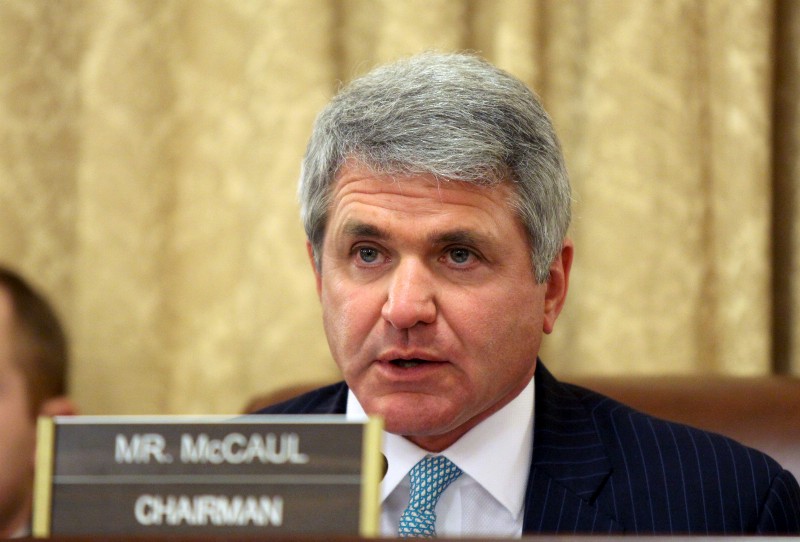
The recent murder of five American service members in Chattanooga, Tennessee has been dubbed an “ISIS-inspired attack” by the chairman of the House Homeland Security Committee. Investigators are hard at work examining the shooter’s personal property and looking into recent travels to the Middle East to see if they can find a connection to the radical Islamist group.
“My judgment in my experience is that this was an ISIS-inspired attack,” Chairman Michael McCaul (R-Tx) said at a press conference. “This is a new generation of terrorists. This is not [Osama] bin Laden in caves and couriers anymore. This is what the new threat of terrorism looks like.”
Fitting the ISIS mold perhaps, Muhammad Youssef Abdulazeez was a lone, Muslim gunman who attacked service members. While evidence yet to be uncovered by the investigators may later indicate that this attack was inspired by ISIS (also called the Islamic State or ISIL) there is still no conclusive evidence that Abdulazeez had any connection to the group.
“At this time we have no indication that he was inspired by or directed by anyone other than himself,” Ed Reinhold, Chattanooga’s top FBI official, told reporters. He added that investigators have so far covered 70 leads.
In fact, CNN reported on Monday that Abdulazeez told a close friend ISIS was a “stupid group” that was “doing wrong” and “completely against Islam.”
A closer look at Abdulazeez actually paints a picture of a troubled 24 year old man with a history of depression and drug abuse. He also was deeply affected by news reports of children being killed in Syria, according to ABC News.
Abdulazeez’s first trip to a psychiatrist was at age 12 or 13, a family spokesman said according to AP. Authorities are examining if recent trips to visit family in Jordan contributed to his radicalization. But according to the spokesman, Abdulazeez traveled there to try and deal with drug and alcohol problems.
He was arrested in April for drunk driving and later admitted to using marijuana and cocaine. He was also thousands of dollars in debt, on pain medication for a bad back, sleeping pills to deal with working a 12-hour night shift, and came from a troubled home. Abdulazeez “was battling depression, had suicidal thoughts and was on a three-day downward spiral before the attack, a family representative told NBC News.”
“For many years, our son suffered from depression. It grieves us beyond belief to know that his pain found its expression in this heinous act of violence,” the Abdulazeez family said in a statement.
“Several years ago, relatives tried to have Abdulazeez admitted to an in-patient program for drug and alcohol abuse but a health insurer refused to approve the expense,” a family representative, speaking off the record, told AP.
But rather than look at Abdulazeez’s issues with depression, his mental health, and the fact that he was allowed access to assault rifles, certain politicians and members of the media have chosen to focus on an assumed affiliation.
“ISIS is a catchall term,” Daveed Gartenstein-Ross, a senior fellow at the Foundation for Defense of Democracies. “What’s happening now is the same as what happened with al-Qaeda after 9/11 where ISIS is being used as a catchall for jihadism.”
Gartenstein-Ross said that it is important to note the major distinctions between various jihadi groups as well as those who commit such acts but are unaffiliated. “You have people who are from a Muslim background who might be engaged in terrorism and might not be with either of those groups,” he said.
Part of the problem is the way authorities, and Americans in general, view the prospect of radicalization.
“Radicalization is complex. Yet a thinly-sourced, reductionist view of how people become terrorists has gained unwarranted legitimacy in some counterterrorism circles,” Faiza Patel, the co-director at the Brennan Center for Justice’s Liberty & National Security Program, wrote in 2011. “Domestic law enforcement agencies, including the FBI and state and local police departments, have stepped into the breach. They have developed simplistic theories of how American Muslims become radicalized.”
“It is delicate trying to determine what is at the core of what motivates somebody,” Gartenstein-Ross said. “The first question is — in whose name or in what cause’s name was he carrying out this attack?”
In the case of Abdulazeez, this question is still not entirely clear. Gartenstein-Ross said there are usually various trajectories that lead an individual to perpetrating violent acts. These trajectories may be ideological, political, based on adrenaline or adventurism, or related to mental illness. The various motivations may not be mutually exclusive either.
While mental health issues appear to be at the forefront of Abdulazeez’s issues, investigators are still struggling to figure out what pushed him to attack American service members. It seems Abdulazeez, who described himself at times as an “Arabian redneck” or a “Muslim redneck,” struggled with his faith.
Abdulazeez did not regularly attend mosque and his alcohol and drug abuse do not align with the behaviors of a religious fundamentalist.
Abdulazeez’s blog featured two posts in the days leading up to the attack. These blog posts were religious in nature, the first entitled A Prison Called Dunya (meaning the material world before the afterlife) and the second Understanding Islam: The Story of the Three Blind Men. Abdulazeez also sent a text with a Hadith translated into English to a friend the day before that read, “Whosoever shows enmity to a friend of Mine, I will indeed declare war against him.”
“He obviously was not a religious person,” Rizwan Jaka, the Chair at the Board of Trustees at the All Dulles Area Muslim Society (ADAMS), told ThinkProgress. ADAMS released a statement Monday on the attack that condemned the act and offered condolences to the service member’s families.
“There’s no religious justification. I, as a Muslim, condemn this attack and very clearly, there is no Islamic justification for this,” Jaka said. “Obviously, the criminal justice system, law enforcement, and health and human services need to come to the table with all faith leaders from all faith backgrounds to respond to these challenges.”